
ICCF 2025 Calls for Fairer Standards and Market Access for Farmers
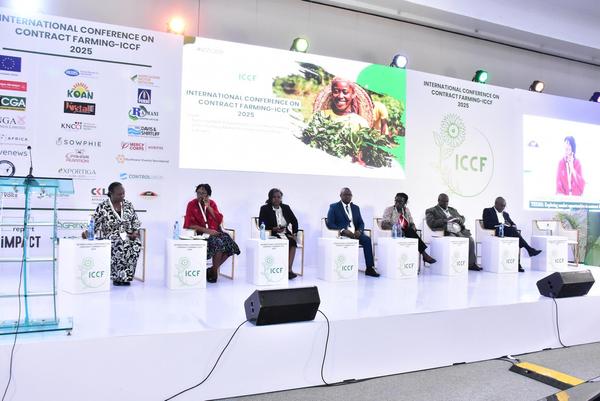
From left: Elizabeth Mueni, food security, climate justice and trade policy specialist, Lynette Kithinji from East African Green council, Faith Ndunge, deputy director standards, International relations and trade at KEPHIS, James Mureithi, managing Director at control union Kenya, Jane Musindi from Agricultural sector Network (ASNET), Antony Mwangi, CEO of Visible industries and Antony Mwangi, standards officer at KEBS during a panel discussion on how standards and certification shape market access, in Nairobi on Tuesday November 18, 2025.
The International Conference on Contract Farming (ICCF 2025) opened in Nairobi on Tuesday November 18, bringing together government officials, agribusiness leaders and farmer organisations to push for stronger contract farming practices that deliver predictable markets, fair standards, and better incomes for smallholder farmers.
Speaking on behalf of the Principal Secretary for Agriculture, Dr. Paul Kipronoh, Peter Odhiambo highlighted the challenges farmers face with costly and complex certification systems that limit competitiveness. He noted that some sectors demand “10 or even 17 certifications,” each requiring payment, before produce reaches premium markets.
“For a smallholder farmer, this makes it uncompetitive,” Odhiambo said. “We must ask whether we are facilitating trade or obstructing it.”
He said contract farming remains one of the most reliable ways to guarantee stable markets, provided contracts are fair and backed by clear responsibilities.
“The market is there; what many farmers lack is volume. A contract assures livelihood and improves chances of accessing credit,” he added.
Odhiambo urged stakeholders to embrace digital tools, climate-smart technologies and innovation, while ensuring women and youth who form the backbone of primary production are fully included in new opportunities.
During the afternoon panel, experts agreed that standards and certification shape market access but warned that the system is too difficult for most farmers to navigate. Moses Mwangi from Kenya bureau of standards (KEBS) said standards define what is acceptable in different markets, from pest control to maturity levels.
However, panelists noted that many farmers lack information about these requirements. Lynette Kithinji from the Eastern Africa Grain Council said a farmer unaware of the 13.5 percent moisture limit will likely be rejected “not because they cannot produce quality grain, but because they do not know how to achieve it.”
Antony Mwangi who is the Chief executive officer of Visible industries added that most standards were designed for regulators and processors, not farmers. “A small-scale farmer cannot detect aflatoxin or salmonella. The system was not created with them in mind,” he said.
Jane Musindi of ASNET called for simpler, more practical approaches. She said certification should only be required where the market demands it, with government-verified self-assessments helping reduce costs. “Once farmers understand the ‘why,’ compliance becomes easier,” she said.
Participants raised concerns about weak extension services, poor information flow from national institutions, and exploitation of farmers, especially in northeastern Kenya. Retired agriculturalist Jean Jiro said farmers pay taxes expecting extension officers to interpret standards, “but today that link is broken.”
A farmer from Molo requested a clear, step-by-step production-to-market guide, highlighting the fragmented systems that farmers must navigate alone.
Organisers say ICCF 2025 aims to close these gaps by forging partnerships among farmers, agripreneurs, processors and financiers. The conference includes a networking forum with the Cereals Growers Association and a Deal Room for contract negotiations and investment discussions.
Odhiambo urged delegates to turn conversations into concrete commitments. “As we explore market opportunities, the goal is not just to grow markets, but to grow people,” he said. “To empower farmers, transform rural livelihoods and build a competitive agricultural sector.”