
Women’s Groups Push for Safe Reproductive Healthcare, End to Unsafe Abortions
Women’s rights activists have called for improved access to safe reproductive healthcare and stronger protections for women facing crisis pregnancies, warning that unsafe abortions continue to endanger lives across the country.
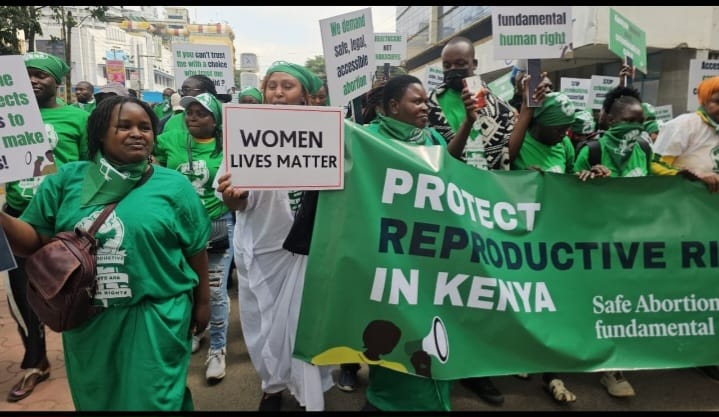
The calls emerged during a peaceful march organised by the Women’s Collective Kenya, Federation of Women Lawyers Kenya (FIDA-Kenya) and other reproductive justice movements in Nairobi, where petitioners delivered memoranda to the Ministry of Gender, Ministry of Health, Senate and the Supreme court. This followed a recent court rulling which nullified safe abortion as a fundumental constitutional right.
Speaking during the demonstration, community organiser Ruth Mumbi said many women and girls continue to suffer due to stigma, inequality and limited access to safe abortion and post-abortion care services.
“We have seen women die because of unsafe abortion, because they could not access post-abortion care,” she said.
Mumbi noted that women from poor and informal settlement communities are often the most affected by restrictive policies and weak healthcare systems, arguing that reproductive healthcare should be treated as a constitutional and public health issue.
She said grassroots organisations continue to document cases involving rape, defilement and unsafe abortions, particularly among vulnerable girls and women living in informal settlements.
“When laws and policies are unjust, poor women and girls become the biggest victims,” she added.
The demonstrators said the protest was aimed at urging policy makers and state institutions to protect women’s health rights and ensure access to evidence-based reproductive healthcare services.
Participants also raised concerns over gaps in reproductive health policies, saying inconsistencies and delays in implementing progressive guidelines continue to create uncertainty among healthcare providers and patients.
Gender and climate justice advocate Okoko Felicitus said access to reproductive healthcare allows women to make informed decisions about their lives and futures.
“Abortion rights and reproductive rights are human rights. For me, this means being able to choose at what point I want to have a child,” she said.
Felicitus, who shared her personal experience as a survivor of sexual assault, teenage motherhood and unsafe abortion, said lack of comprehensive sexual education and limited access to contraceptives continue to trap many young women in cycles of poverty and dependency.
“My lived experience drives my passion. Young girls become trapped in poverty, toxic relationships and repeated pregnancies because they lack information, contraceptives and access to safe services,” she said.
She argued that preventing unsafe abortions should focus on education, awareness and access to healthcare rather than criminalisation.
Activists further challenged the government to strengthen dissemination of reproductive health policies, especially in rural and faith-based health facilities where access to services remains limited.
Medical students and reproductive health advocates who joined the march also called for expanded sexual education programmes and increased investment in maternal healthcare services.
The protest comes amid renewed national debate over reproductive rights following recent court decisions on abortion laws and access to post-abortion care in Kenya.
Rights groups maintain that access to safe abortion care should be approached primarily as a healthcare and human dignity issue, particularly for vulnerable women and girls facing economic hardship, violence and health complications.