
Kenya Rallies Global Partners to Accelerate Forest Restoration and Tree-Growing Drive
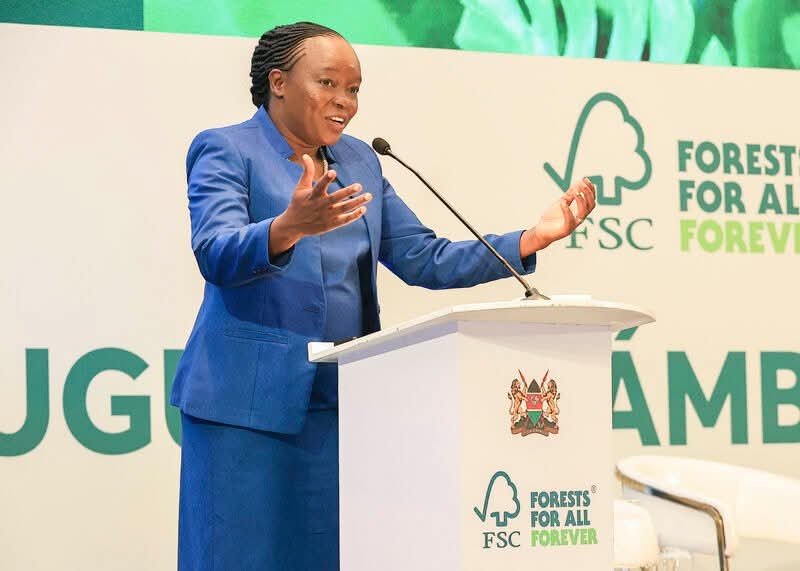
Environment, Climate Change and Forestry Cabinet Secretary Dr. Barasa Mulongo speaking during the Zamba Heritage Congress, held in Nairobi on 11th,February,2026.
Kenya has reiterated its commitment to large-scale forest restoration and sustainable management, with Environment, Climate Change and Forestry Cabinet Secretary Dr. Barasa Mulongo calling for stronger partnerships to support the country’s ambitious tree-growing programme.
Speaking on Tuesday at the Zamba Heritage Congress held in Nairobi ,the CS said the government’s flagship 15 Billion tree-growing campaign aims to plant 15 Billion trees over the next 10 years as part of Kenya’s broader climate action and environmental sustainability strategy.
She noted that collaboration with global and African partners in forest management, certification and conservation will be key to achieving the target.
“The tree-growing campaign remains one of the President’s flagship initiatives, and we are keen to work with partners to explore interventions that will help us realise this ambitious goal,” Barasa said, while acknowledging the Forest Stewardship Council (FSC) for convening the congress and championing responsible forestry across the continent.
Kenya has aligned the campaign with national, regional and global environmental commitments and continues to implement policies aimed at increasing forest and tree cover in line with international forest landscape restoration initiatives.
In 2021, the country launched its FSC Interim Standard to guide certification of forest management and forest-product supply chains. The Kenya Forest Service has since piloted certification in forest blocks within the Upper Tana landscape, covering about 65,000 hectares, marking a significant step toward sustainable forest management in both public and commercial sectors.
Barasa said Kenya is also leading in chain-of-custody certification in Eastern Africa, with 12 certified businesses reflecting growing demand for sustainable and traceable forest products.
She acknowledged partnerships such as the Kenya-European Partnership Programme, which supports commercial forestry development while advancing climate action and green economic growth.
The CS further highlighted the government’s focus on inclusivity, noting that youth, smallholder farmers and private sector players are being actively engaged. More than 2,000 young people have already benefited from forestry awareness programmes, while learning institutions and investors are adopting sustainable forestry practices.
She said certification strengthens Kenya’s environmental and economic goals by improving market competitiveness, supporting rural livelihoods and contributing to climate-resilient development.
The CS reaffirmed Kenya’s support for continental forest initiatives and called for deeper regional collaboration to unlock the ecological, cultural and economic value of Africa’s forests.
Making her Remarks, Madame Minister Dr. Rosalie Matondo, Ministry of Forest Economy, Republic of Congo, stated that it is a responsibility to our people , biodiversity and our planet to manage the forest sustainable since it is not an option but the responsibility to everyone.
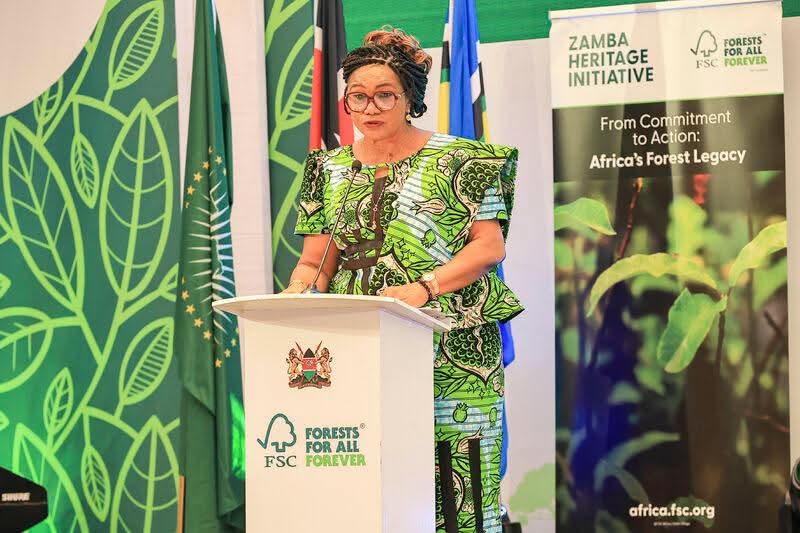
She showcased Congo’s leadership ,highlighting that 23.5 million hectares of forests under sustainable management,5.1 million hectares FSC -Certified and deforestation kept below 1%.Additionally, she noted the country’s vision towards forest is to restore degraded landscapes, planting millions of trees, transform industries and empower communities- all in alignment with the Zamba Heritage Initiative to deliver measurable, continent-wide impact.
Africa’s Forests Are Our Heritage, Says Expert, Calling for Urgent Sustainable Management and Restoration
Africa must urgently embrace sustainable forest management (SFM) and large-scale restoration if it is to safeguard its ecological heritage, cultural identity, and future prosperity, Forestry and Climate Policy Expert , African CSO Biodiversity Alliance (ACBA) and the FSC Africa Advisory Committee Dr. Yemi Katerere has said.
Making his presentation at the Zamba Heritage Congress, Dr. Katerere who described Africa’s forests not merely as natural resources, but as a living heritage deeply intertwined with people, culture, and justice.
“My presentation is about indigenous forests, but it is also about people,” he noted, adding that “It is about equity, dignity, and whether Africa’s children will inherit thriving landscapes or degraded ones. At its core, this is about transformative change.”
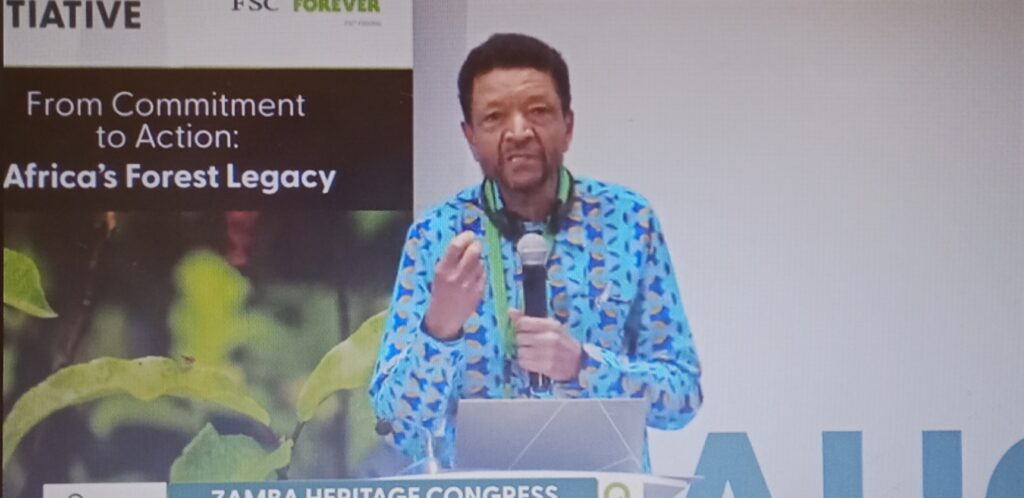
Forests as Cultural, Ecological, and Economic Heritage
Dr. Katerere emphasized that forests have historically shaped African identity, serving as sacred spaces, sources of medicine, food, and livelihoods, and as anchors of indigenous knowledge systems. Recalling reflections from Mozambique’s former President, he said forests once defined spiritual life, healing traditions, and even liberation struggles.
“Forests are not just trees they are living history, guardians of culture, and the foundation of community life,” he said.
Across the continent, forests remain central to survival and development:
- Africa holds 674 million hectares of forests, covering 22% of the continent’s landmass and about 16% of global forest area.
- Nearly 25% of global terrestrial biodiversity is found within these ecosystems.
- An estimated 250–300 million Africans depend directly or indirectly on forests for their livelihoods.
Central and Southern Africa together account for roughly 65% of the continent’s forest cover, while North Africa has the lowest share.
Rising Threats: Deforestation, Climate Change, and Inequality
Despite their value, Africa has experienced the world’s highest rates of deforestation over the past three decades. Between 2000 and 2005, six African countries were among the ten nations responsible for 71% of global deforestation.
“This reality demands reflection,” Dr. Katerere said. “Why do we continue to lead in forest loss while knowing their importance to our survival?”
He linked forest degradation to population growth, rapid urbanization, weak governance systems, extractive industries, and global market pressures. Africa’s population is projected to reach 2.5 billion by 2050, intensifying demand for land, food, and energy.
Climate change is compounding the crisis. With 2024 recorded as the warmest year globally, forests once reliable carbon sinks are increasingly under stress and, in some cases, releasing more carbon than they absorb.
“We cannot address climate change separately from biodiversity and forest loss,” he warned. “These crises are interconnected.”
Financing and Governance Remain Major Obstacles
Dr. Katerere highlighted chronic underfunding as one of the biggest barriers to sustainable forest management. Financing for conservation remains far below what science and economic analysis recommend, while global financial systems often prioritize short-term extraction over long-term ecological stability.
He also warned that colonial-era economic structures and inequitable trade systems continue to shape how Africa’s natural resources are exploited.
“Africa must define its own vision,” he said. “If we do not, we will always be responding to narratives created elsewhere.”
Call for Transformative Change
The expert called for a fundamental shift in how forests are valued and managed, drawing on global research advocating “transformative change”—a systemic reorganization of economic, governance, and social systems to address root causes of environmental loss.
He outlined five priority strategies:
- Community-led conservation that empowers indigenous peoples and improves livelihoods.
- Reforms in sectors such as mining, agriculture, and infrastructure to reduce biodiversity loss.
- Economic transformation that prioritizes ecological sustainability over unchecked growth.
- Inclusive and accountable governance with strong public participation.
- A shift in societal values to recognize the deep connection between people and nature.
He stressed that restoration must not separate people from forests but instead integrate local knowledge, gender-sensitive approaches, and equitable benefit-sharing.
A Shared Responsibility for the Future
Dr. Katerere concluded by urging governments, civil society, and the private sector to treat sustainable forest management as a collective movement rather than isolated projects.
“Africa’s forests are our inheritance and our gift to the world,” he said. “To lose them is to lose ourselves. To restore them is to secure resilience, livelihoods, and prosperity for generations.”
He called on participants at the Congress to leave with renewed commitment to mobilize resources, strengthen governance, and tell a new story of Africa’s forests“not as a tragedy, but as a renaissance.”
“Nothing is impossible,” he said, echoing Nelson Mandela. “Let us remember, restore, and act.”