

Fourteen African Countries Back Harmonisation of Digital Inclusivity Standard
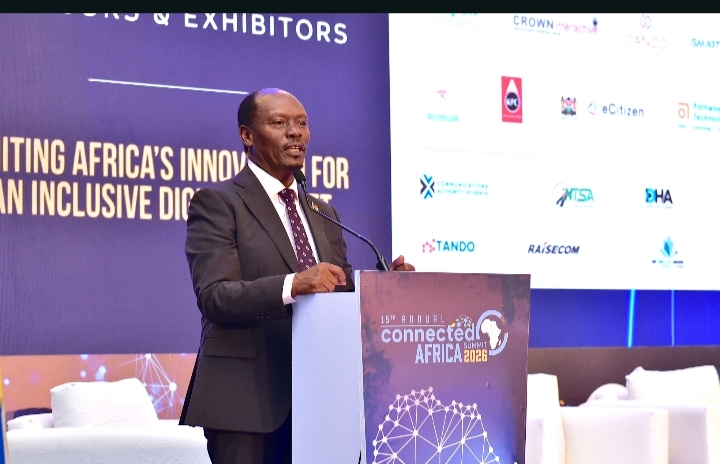
Cabinet Secretary for ICT and the Digital Economy William Kabogo (centre) with delegates during the Ministerial Roundtable on digital inclusion at the Connected Africa Summit 2026 in Nairobi, where 14 African countries announced support for the harmonisation of the Africa Digital Inclusivity Standard.
Fourteen African countries have announced their support for the harmonisation of the Africa Digital Inclusivity Standard, marking a significant step towards building an inclusive and accessible digital future across the continent.
The announcement was made during a Ministerial Roundtable on digital inclusion at the closing ceremony of the Connected Africa Summit 2026 held in Nairobi. The meeting brought together representatives from several African countries, including Kenya, Angola, Chad, Malawi and South Sudan, among others.
The move aims to ensure that digital technologies and services are accessible to all people, particularly persons with disabilities who continue to face barriers in accessing digital platforms.
Digital accessibility refers to the design and development of digital products and services in a way that allows people with different types of disabilities to perceive, understand, navigate and interact with them effectively and independently. This includes websites, mobile applications, software, online platforms, ATMs and payment systems being usable by individuals with visual, hearing, physical, speech, cognitive or neurological impairments.
The harmonisation process is being undertaken through a partnership between inABLE and the African Organisation for Standardisation. The two organisations are working to develop Africa’s first unified digital accessibility standard for ICT products and services.
The proposed standard is being designed to reflect Africa’s realities, including infrastructure gaps, linguistic diversity, varying levels of connectivity and the lived experiences of communities across the continent.
Speaking during the closing session, William Kabogo, Cabinet Secretary for the Ministry of ICT and the Digital Economy, said Africa’s digital transformation must be inclusive to ensure that no one is left behind.
He noted that while the digital economy is expanding rapidly, persons with disabilities still face significant challenges in accessing digital services, underscoring the need to eliminate these barriers.
Reuben Kisore, Technical Director at ARSO, reaffirmed the organisation’s commitment to harmonising digital accessibility standards across Africa. He said standardisation will ensure that technologies developed or deployed on the continent meet uniform accessibility requirements.
According to Kisore, this will enhance interoperability, improve market access and strengthen consumer protection. He added that 14 countries have already confirmed participation in the harmonisation process, with more expected to join.
Hon. Ângelo Miguel Buta João, Angola’s Secretary of State for Telecommunications and Information Technologies, called for stronger cooperation among African countries. He said aligning Africa’s digital accessibility standards with global benchmarks will enhance competitiveness and enable African innovations to access international markets.
He added that such alignment will also ensure the continent remains competitive in the global digital economy.
Hon. Ateny Wek Ateny, Minister of Information, Communication Technology and Postal Services of South Sudan, confirmed his country’s commitment to the initiative. He highlighted South Sudan’s affirmative action policy that allocates 10 per cent of opportunities to persons with disabilities.
He emphasised the importance of harmonised regulations in strengthening inclusive digital development and promoting shared learning across African countries.
Stakeholders say the harmonisation of digital accessibility standards is not only a matter of social inclusion but also an economic opportunity. Ensuring that digital platforms are accessible to all people is expected to unlock the potential of millions of Africans living with disabilities.
The initiative is also expected to promote innovation by encouraging developers and technology companies to adopt inclusive design principles.
In addition, a unified standard will make it easier for businesses to scale their products across different markets without facing varying accessibility requirements.
The harmonisation process is seen as a critical step towards bridging the digital divide in Africa, where access to technology remains uneven.
The Africa Digital Inclusivity Standard is expected to contribute to a more inclusive digital environment where technology empowers all citizens, supports economic growth and ensures equal participation in the digital age.