
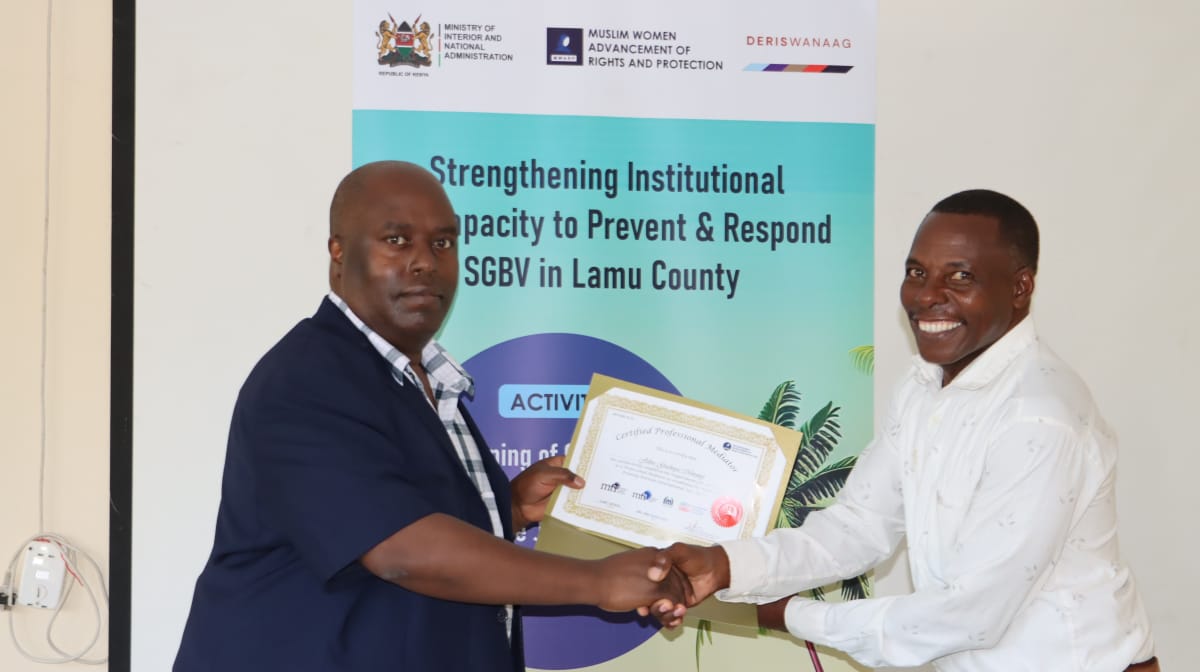
50 Trained Mediators to Enhance Access to Justice in Lamu Border Communities
By Nancy Wachira
About 50 newly certified mediators are set to begin resolving long-standing community disputes in Lamu County following an intensive five-day training program aimed at improving access to justice in the marginalized border region.
The training was conducted by the Mediation Training Institute of East Africa in partnership with the Muslim Women Advancement of Rights and Protection (MWARP). It brought together members of the Court Users Committee (CUC) and local Civil Society Organizations (CSOs), equipping them with practical mediation and conflict resolution skills to address persistent disputes that have long affected peace among border communities.
The initiative responds to the need for alternative justice mechanisms in Lamu, where residents have struggled to access formal courts due to the county’s vast geography and its location along the Kenya-Somalia border. Many people live far from established judicial facilities, making it costly and time-consuming to attend court sessions.
“Lamu being at the border, also marginalized, we have been facing challenges with the location of courts which are far away from many places and it’s very costly to travel. It’s also hard to arrange mobile courts,” said Rahma Abbas, the Executive Director of MWARP.
She said the absence of timely justice has often led to tension and violence. “Cases have remained unsolved leading to killings of people and long-time grudges that make people live in fear and hatred. With the trained mediators, we intend to solve such conflicts and reduce cases of injustices,” she added.
The 50 mediators, who have completed all the required training, are now awaiting formal accreditation from the Judiciary’s Mediation Accreditation Committee. Once approved, they will handle both community and court-referred cases, bringing justice closer to the people.
The group includes civilians, chiefs, teachers, police officers, and county personnel to ensure mediation services are accessible and trusted by all residents.
Speaking during the closing ceremony, Hon. Peter Wasike, the Lamu Court Station Head and Chairperson of the Court Users Committee, praised the diversity and commitment of participants, terming it a significant step in improving justice delivery in Lamu.
“This is a professional mediator’s training and the turnout has been excellent. We have the widest category of stakeholders who have joined us,” said Hon. Wasike. “Even as a magistrate, I took part in the training to improve my own mediation skills. This shows how valuable this initiative is for all of us.”
The training was facilitated by expert mediator James Mangerere, who took participants through sessions on communication, negotiation, and dispute resolution. He emphasized the importance of neutrality, confidentiality, and cultural sensitivity in mediation.
The program is part of the Lamu Court Mediation Program launched on September 26, which promotes Alternative Dispute Resolution (ADR) as provided for in Article 159 of the Kenyan Constitution. ADR encourages mediation, negotiation, and reconciliation as effective ways of resolving disputes outside formal courts.
Hon. Wasike said the mediators will serve in areas that are beyond the reach of mobile courts. “Some are coming from as far as Kiunga, which is on the border with Somalia, areas that even the mobile courts don’t reach. We normally only go up to Faza,” he said.
He added that the mediators’ work will ease the pressure on local courts, reduce case backlogs, and promote lasting peace. “Through mediation, people can resolve their disputes quickly, affordably, and in a way that restores relationships rather than breaking them,” he noted.
The initiative comes at a time when border communities in Lamu have faced numerous conflicts, including land disputes and resource-related disagreements, often worsened by delays in accessing justice. Local leaders believe the introduction of trained mediators will help address these conflicts early and prevent violence.
Rahma Abbas expressed optimism that the mediators will bridge the gap between citizens and justice institutions. She said MWARP will continue supporting them through mentorship and capacity building to ensure the program’s sustainability.
“Our goal is to see communities that are peaceful and where disputes are resolved amicably without bloodshed or fear. We want justice that is timely, affordable, and inclusive,” she said.
Once accredited, the mediators will work closely with the Lamu Law Courts and local administration to handle both court-annexed and community-based mediation cases.
The initiative is expected to enhance social harmony, promote reconciliation, and strengthen public confidence in the justice system. It also supports the national goal of expanding access to justice for citizens in marginalized areas.
As the mediators prepare to begin their work, there is optimism that their efforts will bring peace and unity in Lamu County. Their interventions are expected to resolve long-standing disputes and promote a culture of reconciliation and mutual respect among border communities.