
Ruto Assents to Coffee, Meteorology and Railway Levy Bills in Boost to Key Sectors
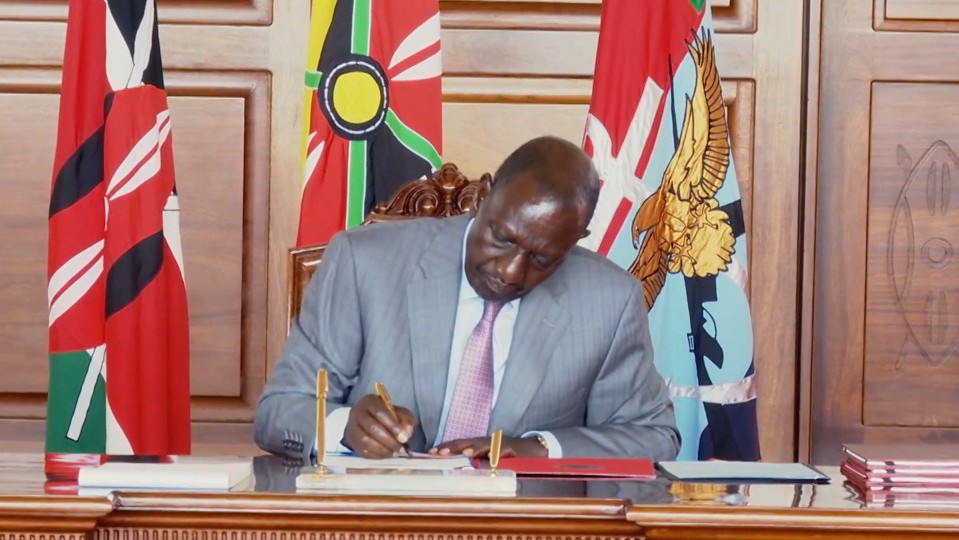
On Friday afternoon at State House in Nairobi, President William Ruto picked up a pen and did something that hundreds of thousands of Kenyans had been waiting years for. He signed the Coffee Bill 2023 into law. Then the Meteorology Bill 2023. Then the Miscellaneous Fees and Levies Amendment Act. In less than an hour, three pieces of legislation that had spent a combined total of nearly a decade navigating Kenya’s bicameral Parliament, surviving committee scrutiny, inter-house disagreements and at least one formal mediation, became the law of the land.
But what does that actually mean for the ordinary Kenyan?
In coffee, Kenya earns roughly KSh 38 billion a year from coffee exports, approximately $296 million according to the Kenya National Bureau of Statistics, and the sector directly supports an estimated 800,000 smallholder farming households spread across 33 counties. In the auction rooms of Amsterdam, Tokyo and New York, Kenyan coffee still commands some of the highest prices of any origin in the world. And yet, by almost every measure, the farmer tending those trees has been getting poorer for the last thirty years.
In 1988, Kenya produced approximately 130,000 metric tonnes of coffee in a single crop year. By the early 2020s, according to industry data compiled by the Agriculture and Food Authority, that figure had collapsed by roughly 70 percent to around 40,000 metric tonnes annually. The average Kenyan coffee tree today yields just two to three kilograms of cherry per year, against a documented agronomic potential of more than 30 kilograms per tree, according to the Kenya Agricultural and Livestock Research Organisation. Kenya, once among Africa’s five largest coffee producers, now ranks 16th on the continent by volume.
The Coffee Bill 2023, introduced in the Senate by Hon. James Kamau Murango and co-sponsored in the National Assembly by Majority Leader Hon. Kimani Ichung’wah, seeks to address this by creating two new institutions. The first is the Coffee Board of Kenya, a dedicated regulator that will replace the Agriculture and Food Authority as the body overseeing the coffee sector. The second is the Coffee Research and Training Institute, which will take over research currently conducted under KALRO and go further, becoming the legal custodian of the Kenyan Coffee Genome and leading the development of climate-resilient coffee varieties.
The Board will license everyone in the value chain, from growers and millers to roasters, brokers and exporters. Operating without a licence will attract a fine of up to KSh 5 million, a prison term of up to three years, or both. A levy of 2.5 percent on the export and import value of coffee will fund the Board, the Institute, a price stabilization fund for farmers and conditional grants to coffee-growing county governments.
A survey by the Kenya Coffee Producers Association found that only 11.5 percent of smallholder farmers fully understood the contracts they were signing with their millers and marketing agents. The government’s argument, laid out in the official brief presented to the President at Friday’s ceremony, is that a dedicated regulator focused only on coffee will fix this where a multi-crop authority could not. Whether that proves to be the case is something only implementation will reveal. The bill took nearly three years to reach the President’s desk, passing through Senate, the National Assembly, a rejection, a constitutional mediation under Article 113 of the Constitution, and two further rounds of approval before Friday’s signing.
The second law, the Meteorology Bill 2023, sponsored by Senate Majority Leader Senator Aaron Cheruiyot, addresses a legal gap that most Kenyans would be surprised to learn existed at all. The Kenya Meteorological Department, the institution responsible for weather forecasts in this country, has operated for over 130 years without a dedicated piece of primary legislation giving it statutory authority. It has never been a body corporate. It cannot sue or be sued in its own name. It cannot own intellectual property. It has moved between ministries over the decades, currently sitting under the Ministry of Environment, Climate Change and Natural Resources, but has never had the legal standing of a formal institution.
The consequences of that gap surfaced during the long rains of March to May 2024, when catastrophic flooding killed hundreds of Kenyans and displaced tens of thousands from their homes not mentioning the March 2026 floods that are still wreaking havoc. The Department had issued warnings ahead of the rains. A survey conducted by Geopoll in the aftermath found that large numbers of Kenyans could not identify the Meteorological Department as the body responsible for weather warnings, with many attributing that function to the Kenya Red Cross or to the national government in general. The new law establishes the Kenya Meteorological Service Authority as a fully legal body corporate with statutory powers.
It will serve as the principal technical advisor to national and county governments, run a multi-hazard early warning system, register weather observation stations around the country and own the intellectual property rights over all data and research it generates, enabling it to commercialize services in ways the old department legally could not. The bill also fulfils Kenya’s obligations under the Chicago Convention on International Civil Aviation, which requires member states to designate a formal authority for aeronautical meteorological services. Staff of the existing Department will transition to the new Authority, with one year to decide whether to remain or return to the civil service.
The third law, the Miscellaneous Fees and Levies Amendment Act, introduced by Majority Leader Ichung’wah following Cabinet approval, addresses the Railway Development Levy, a charge collected from importers and businesses for years that has gone into a general government fund with no dedicated board to oversee it, no defined rules for its use and no public accountability for what it has financed. The new law creates a Railway Development Levy Fund with a formal governing board, expands the eligible projects to cover all railway infrastructure regardless of classification, and empowers the National Treasury to issue regulations under the Public Finance Management Act to operationalize the fund. The stated aim is to create a transparent structure through which public and private capital can be directed toward railway development across the country.
The Friday ink answered a few questions Kenya has carried for years. Before it dries, the journey ahead will determine whether these become fulfilled promises or simply the latest additions to Kenya’s long list of laws that were passed, celebrated and never fully actualized.