

Kenya Shilling Holds Steady as Public Debt Nears KES 10 Trillion
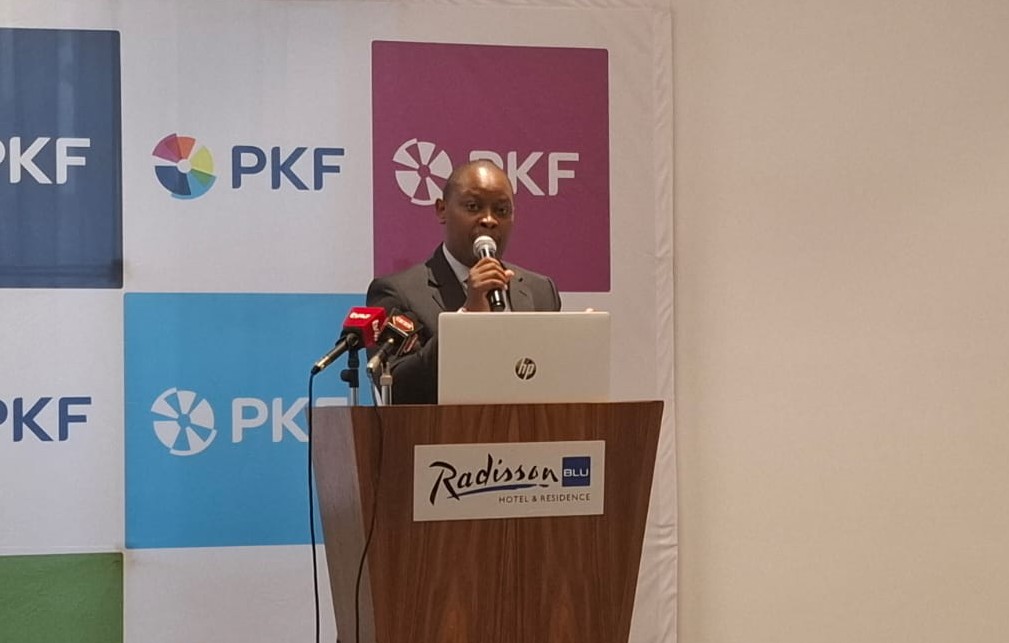
Tax Director,James Mulili speaking during a PKF Pre- Budget Media Briefing offering insights on the economy ,Finance Bill,and expectations for the 2025/2026 Budget.
The Kenya Shilling has demonstrated stability in recent weeks, buoyed by the weakening of the US Dollar amid ongoing trade tensions triggered by tariff policies under the new U.S. administration. The depreciation of the dollar against major international currencies has offered emerging economies like Kenya some breathing space in managing exchange rate pressures.
Analysts attribute the stable outlook of the Shilling to easing global inflation, which has prompted a decline in international interest rates. As a result, capital flight from developing markets like Kenya is expected to subside, further enhancing the country’s currency stability.
At the same time, Kenya’s fiscal position remains under close scrutiny as public debt inches closer to the KES 10 trillion mark. According to the National Treasury, the country’s debt stood at KES 9.96 trillion by the end of June 2024.
The fiscal year 2024/25 projects an increase in total government expenditure to KES 3.98 trillion, up from KES 3.61 trillion in the previous year. With anticipated revenues of KES 3.12 trillion, the resulting budget deficit is estimated at KES 862.7 billion.
Tax revenue is expected to account for KES 2.54 trillion, complemented by KES 529.6 billion in non-tax revenue and KES 50.3 billion in donor grants.
Debt servicing remains a major expenditure item, with interest payments projected to rise to KES 995.8 billion in 2024/25 from KES 840.7 billion in the prior year. External debt makes up over half of the total debt portfolio. While bilateral debt saw a general decline from KES 1.26 trillion to KES 1.09 trillion, the United States emerged as an exception, with its lending rising significantly from KES 1.2 billion to KES 40.2 billion. This increase was attributed to the conversion of previously guaranteed obligations into active debt.
Multilateral borrowing grew by 5 percent, reaching KES 2.79 trillion. Notably, Kenya’s obligations to the International Monetary Fund (IMF) surged by 25.5 percent, reflecting increased reliance on institutional support amid fiscal pressures.
Despite these figures, the IMF’s debt sustainability analysis categorizes Kenya as a medium performer in terms of Debt Carrying Capacity. The report flags potential risks tied to global economic shocks, though the government’s ongoing fiscal consolidation and shift towards concessional financing are expected to moderate long-term debt levels. The debt-to-GDP ratio, currently at 68.7 percent, is projected to decline to the 55 percent threshold by 2028.
PKF Weighs in on Proposed 2025/26 Tax Measures, Urges Balanced Reforms for Sustainable Growth