

Kenya Hosts Launch of WFEO Engineering Capacity Building for Africa Programme
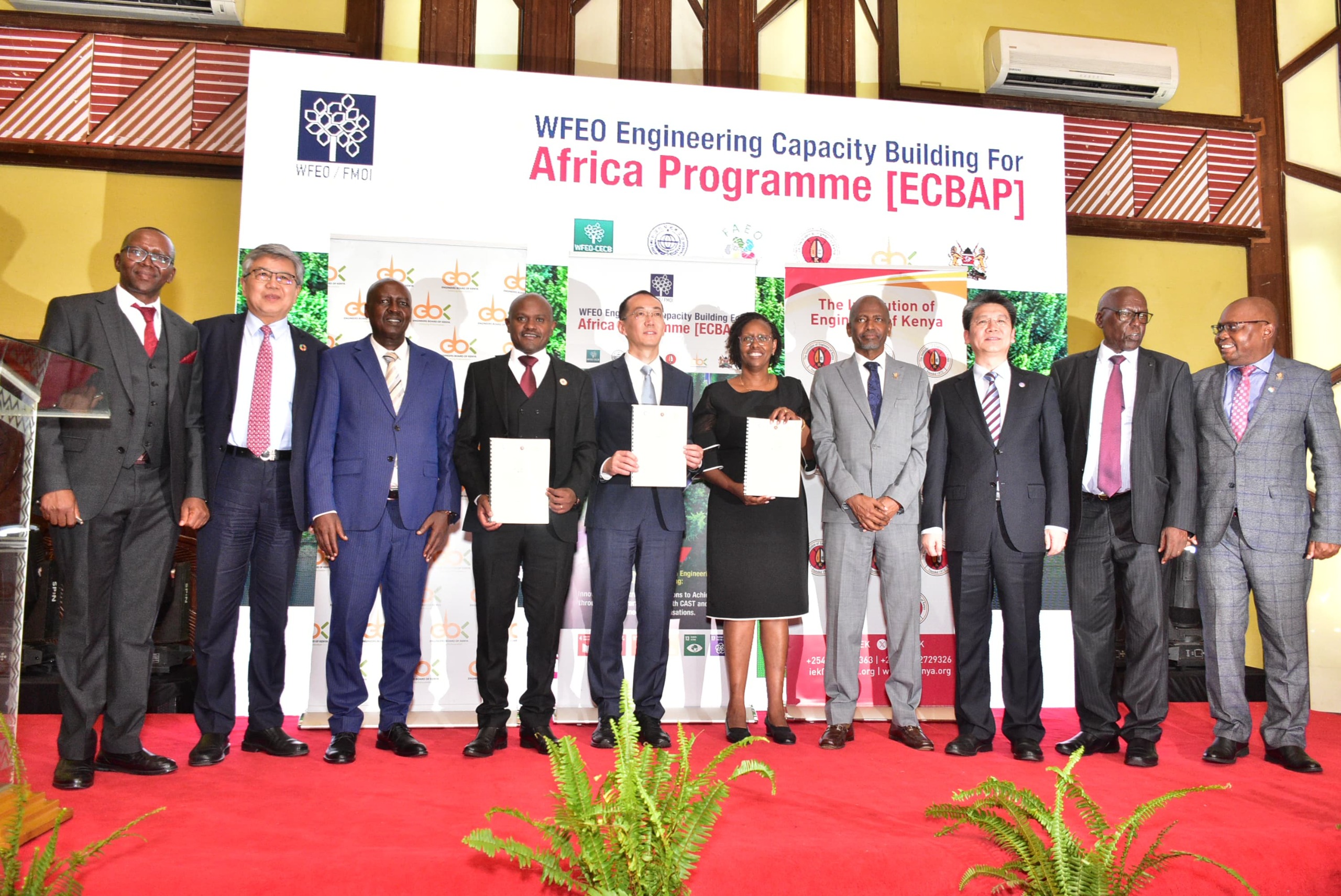
Kenya has taken a significant step toward strengthening Africa’s engineering capacity with the launch of the World Federation of Engineering Organizations’ (WFEO) Engineering Capacity Building for Africa Programme (ECBAP). The initiative, inaugurated by Institution of Engineers of Kenya (IEK) President, Eng. Shammah Kiteme, aims to enhance engineering education, foster innovation, and promote sustainable development across the continent.
Speaking during the launch, Eng. Kiteme emphasized the critical role of engineers in driving Africa’s growth, noting that the programme will address key capacity-building challenges through education, institutional support, and industry collaboration.
“Africa remains a virgin continent, and it requires local solutions to the challenges we face. This program will equip African engineers with the skills to lead in solving local problems using cutting-edge technology,” Eng. Kiteme stated.

IEK President Engineer Shama Kiteme Speaking during the WFEO Launch
The ECBAP initiative aligns with the United Nations’ declaration of 2024-2033 as the International Decade for Science and Technology for Sustainable Development. WFEO, in partnership with the China Association for Science and Technology (CAST) and UNESCO, is spearheading the programme to ensure Africa’s engineers are well-equipped to tackle global challenges.
Kenya’s economy, driven by sectors such as agriculture (21.8% of GDP), manufacturing (7.6%), construction (6.6%), transport (13.6%), and ICT (2.2%), relies heavily on engineering expertise. However, with the rapid advancements in technology—including Artificial Intelligence (AI), the Internet of Things (IoT), and automation—the engineering landscape is evolving.
“Engineers are at the forefront of economic transformation. AI is revolutionizing industries, from predictive maintenance in manufacturing to optimizing traffic systems. We must embrace these changes to drive sustainable development,” Eng. Kiteme noted.
As part of the ECBAP rollout, IEK recently conducted a specialized AI training for engineers, bringing together professionals from the water, energy, agriculture, and infrastructure sectors.
This marks the beginning of a larger training initiative, aiming to train over 100,000 engineers across Africa.
In addition to AI, IEK offers training in Quantum Engineering, Nanotechnology, Renewable Energy, Circular Economy, Autonomous Systems, Bioinformatics, and Climate-Resilient Designs. These programs are designed to keep African engineers at the forefront of global technological advancements.
“IEK is proud to be one of the training centers for ECBAP. We commit to scaling up these efforts, ensuring engineers across Africa acquire the latest skills and technologies,” said Eng. Kiteme.
A major highlight of the event was the signing of an MoU between IEK and the Chinese Society of Engineers, fostering knowledge-sharing and professional collaboration. This aligns with SDG 17 on global partnerships, strengthening Kenya’s and Africa’s engineering capabilities through international cooperation.
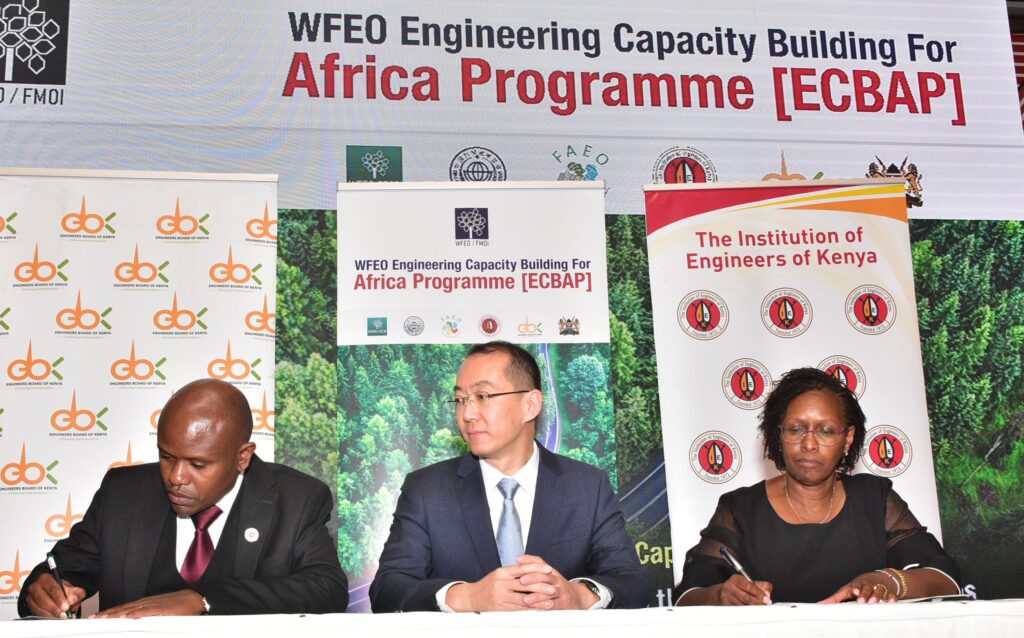
“With China’s advanced engineering expertise, we have much to learn and share. This partnership will accelerate skills development and enhance engineering excellence,” Eng. Kiteme remarked.
The ECBAP programme directly supports several United Nations Sustainable Development Goals (SDGs), including:Goal 1 Ending poverty through engineering-driven economic transformation.Goal 2: Advancing sustainable agriculture with innovative engineering solutions.Goal 6 & 7: Ensuring clean water and sustainable energy for all.Goal 9: Promoting resilient infrastructure and industrialization.Goal 11 & 13: Building sustainable cities and tackling climate change.
The launch of ECBAP signals the beginning of a new era for African engineering. By investing in capacity building and embracing technology, African engineers will be at the forefront of shaping resilient, sustainable, and innovative solutions for the continent’s development.
“Today marks the start of a transformative journey. By working together, African engineers will lead the way in innovation, solving challenges, and building a sustainable future for all,” Eng. Kiteme concluded.
By Sharon Atieno