

Global Gender Equality Gains Under Threat as Rights Groups Call for Urgent Action Through UN Accountability Mechanisms
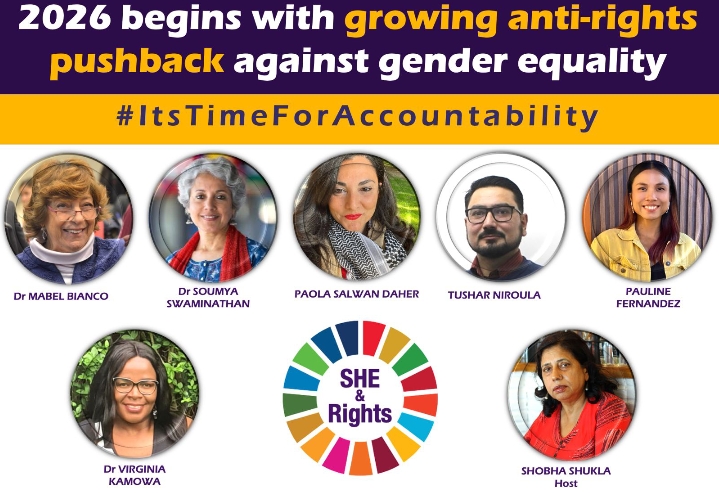
Advocates urge governments to “walk the talk” on promises made for gender equality and the human right to health as anti-rights pushback intensifies worldwide
As 2026 begins, the world remains dangerously off track in delivering on gender equality and the human right to health, with decades of commitments failing to translate into meaningful change. New and persistent data paint a troubling picture: gender-based violence has barely declined since 2000, female genital mutilation has increased by 15% over the past eight years despite global pledges to end the practice by 2030, and access to sexual and reproductive health services remains deeply unequal.
The situation has been further worsened by a growing global backlash against gender equality. The United States’ withdrawal from 66 international organisations—many of them working to advance women’s rights and health, including 31 UN entities such as UN Women and the World Health Organization—has sent shockwaves through the global development and human rights community. Several other countries have followed suit, threatening multilateral efforts that underpin progress on gender justice.
“We need to acknowledge the sinister link between gender injustice and patriarchy, capitalism, militarisation and religious fundamentalism,” said Shobha Shukla, Coordinator of SHE & Rights (Sexual Health with Equity & Rights). “Despite historic pushbacks, feminist movements have made gains. Today, frontline defenders continue to protect those gains and resist renewed attacks on the rights of women, girls and gender-diverse people.”
Table of Contents
ToggleCrisis of Multilateralism, Crisis for Women’s Health
Feminist leader and physician Dr Mabel Bianco, founder of Argentina’s FEIM Foundation, warned that the US withdrawal has triggered an economic crisis for human development programmes worldwide.
“Sudden funding cuts are disrupting health systems, especially in low- and middle-income countries,” she said. “Countries in Africa, Latin America and the Caribbean have been forced to reduce services for malaria, HIV, TB, and sexual and reproductive health. It signals that gender equality and human rights are no longer global priorities for some powerful nations.”
However, Dr Bianco noted that some countries are stepping up financing, offering a glimmer of hope. She urged nations committed to equality to unite against the anti-rights push and strengthen South–South solidarity, particularly ahead of the 70th Commission on the Status of Women (CSW70) in March 2026.
Patriarchy Never Takes a Vacation
Feminist movements, advocates say, remain the strongest line of defence.
“Patriarchy never takes a vacation, so feminists never stop organising,” said Paola Salwan Daher, Senior Director for Collective Action at Women Deliver. She pointed to the rise of far-right politics, online misogyny, and governments openly promoting harmful gender stereotypes.
“This moment is different. We are seeing unapologetic attacks on women’s rights and on all marginalised communities. But we are also building global solidarity,” she said, adding that the Women Deliver Conference 2026 in Melbourne will serve as a key space for collective strategy and mobilisation.
Daher also highlighted the erosion of multilateralism, worsened by double standards in the application of international law. “We do not want a world without multilateralism. We need to reimagine it so that it is people-centred and rooted in accountability.”
Using the Universal Periodic Review to Turn Promises into Accountability
Advocates are now calling for stronger use of the Universal Periodic Review (UPR) the UN’s mechanism that reviews every country’s human rights record every four years to hold governments accountable.
“The UPR is the only global mechanism that regularly reviews all 193 UN member states,” explained Dr Virginia Kamowa of the Global Center for Health Diplomacy and Inclusion (CeHDI). “All commitments are public, time-bound and linked to national policy, budgets and service delivery.”
According to Kamowa, 76% of all UPR recommendations are accepted by governments, with health-related recommendations seeing an even higher acceptance rate of 82%. These include commitments to reduce maternal mortality, expand sexual and reproductive health services, and address harmful practices.
“UPR transforms advocacy from moral appeals into evidence-based accountability,” she said. “It connects local realities to international promises and gives civil society a powerful tool to monitor progress.”
UPR reviews are ongoing in 2026, with countries including Rwanda, St Lucia, Namibia, Mozambique, Somalia, Seychelles and Eswatini under review.
National Consequences of Global Pushback
At country level, the impact of shrinking international support is already being felt. Tushar Niroula, gender justice advocate from Nepal, warned that progress on maternal health and women’s political participation could stall without UN technical and financial backing.
“Marginalised women Dalit, indigenous, disabled and migrant are most at risk when global support is withdrawn,” he said. “Stronger national commitment and resilient multilateralism are now essential.”
Abortion Rights Remain a Flashpoint
In the Philippines, advocates say global anti-rights signals are emboldening governments to ignore international obligations.
“The US withdrawal is a message that it’s okay to deprioritise gender equality,” said Pauline Fernandez, Coordinator of the Philippine Safe Abortion Advocacy Network (PINSAN). She cited the government’s refusal to accept UPR recommendations to decriminalize abortion, citing culture and religion, despite the country having one of the world’s most restrictive abortion laws.
PINSAN continues to push for decriminalization, framing abortion as a matter of bodily autonomy and compassionate healthcare. “No one should be punished for accessing care,” Fernandez said.
As global anti-rights forces grow louder, rights groups insist that accountability not rhetoric must define the next phase of the gender justice movement. With tools like the UPR, they say, governments can no longer hide behind promises. It is time to walk the talk.