
Gachagua Seeks UN Intervention Over IEBC Bias Ahead of 2027 Polls
Former Deputy President Rigathi Gachagua has called on the United Nations (UN) to intervene in Kenya’s political environment, raising concerns over alleged bias within the Independent Electoral and Boundaries Commission (IEBC), human rights violations and political violence ahead of the 2027 General Election.
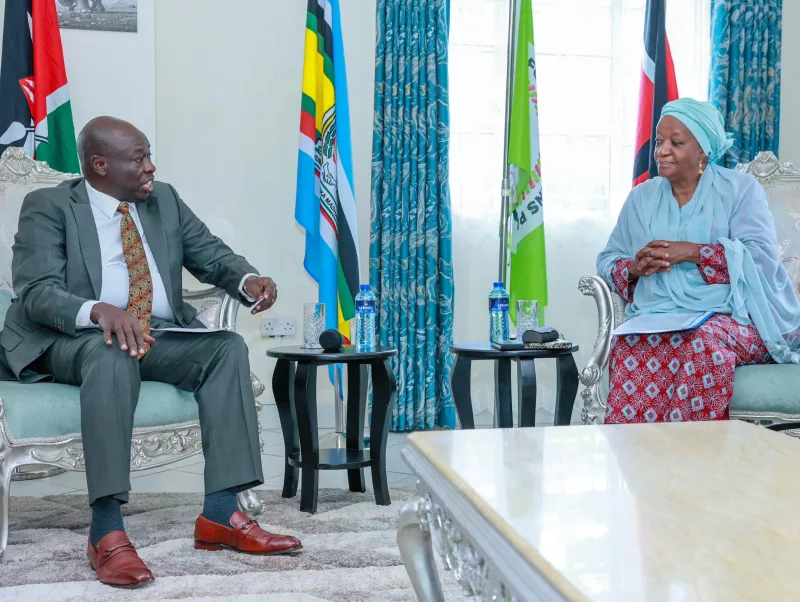
Gachagua, who is the leader of the Democracy for the Citizens Party (DCP), made the appeal on Monday, November 23, 2026, during a meeting with United Nations Nairobi Office Director-General Zainab Bangura in Nairobi.
The meeting, held at the Office of the Second Deputy President, focused on Kenya’s democratic environment, the state of human rights, electoral preparedness and the need to safeguard the credibility of the forthcoming August 10, 2027, General Election.
In a statement issued after the meeting, Gachagua said he had presented concerns about what he described as growing violations of human rights, disregard for the rule of law and political violence under the current administration.
He particularly questioned the independence and impartiality of the IEBC, arguing that the electoral commission had failed to inspire confidence among Kenyans as the country prepares for another election cycle.
According to the former Deputy President, public confidence in the electoral body is essential to ensuring peaceful elections and preventing political tensions that could escalate before, during and after the polls.
“We informed the UN that the IEBC as it were, has lost the confidence of the people of Kenya, which is a precursor to suspected mischief in the forthcoming polls,” Gachagua said.
He challenged the commission to demonstrate independence, transparency and impartiality while engaging political parties and other stakeholders in addressing concerns about its preparedness.
Gachagua further urged the United Nations to use its influence to encourage the Kenyan government to address alleged human rights abuses, including extrajudicial killings, abductions and attacks targeting young people.
He also raised allegations of State-sponsored militias, claiming that such groups were contributing to insecurity and political instability in different parts of the country.
The DCP leader argued that the international organisation should pay closer attention to Kenya’s democratic processes and intervene where necessary to ensure that constitutional principles and fundamental freedoms are respected.
On the IEBC’s role, Gachagua insisted that the commission should remain independent of political influence and provide an open platform for all political players to raise concerns about the electoral process.
“The IEBC must be objective, non-partisan and willing to listen to all stakeholders in this election and not stay in bed with this regime,” he said.
His remarks come at a time when political parties and potential presidential candidates are increasingly positioning themselves ahead of the 2027 General Election.
The credibility of the electoral process is expected to remain a major issue in the coming months, with political leaders likely to scrutinise the IEBC’s preparedness, independence and ability to conduct credible elections.
Gachagua warned that Kenya risked returning to a cycle of pre-election, election and post-election violence if concerns surrounding electoral transparency and accountability were not adequately addressed.
He noted that previous election periods had been characterised by political tensions, arguing that electoral institutions must take responsibility for their actions and omissions to prevent disputes that could threaten national stability.
The former Deputy President, however, welcomed calls for peaceful elections, saying the country needed a transparent, free, fair and verifiable electoral process.
“We strongly welcome the call for peaceful elections that are transparent, free, fair and verifiable,” he said.
Gachagua also acknowledged Kenya’s strategic importance to the United Nations, particularly following the organisation’s growing presence in Nairobi.
He called for increased international attention to Kenya’s democratic development, human rights record and political stability.
The meeting with Bangura provides another indication of the growing political attention being directed towards the 2027 elections, with questions surrounding electoral credibility, human rights and political accountability likely to feature prominently in the country’s political debate.
However, the allegations raised by Gachagua regarding the IEBC and human rights violations remain his claims and would require independent investigation and verification.
As the election approaches, the IEBC is expected to face increasing scrutiny from political parties, civil society organisations and other stakeholders over its ability to conduct credible elections and maintain public confidence in the electoral process.