

Kenya, UNOPS Sign Five-Year Pact to Expand Irrigation and Strengthen Food Security
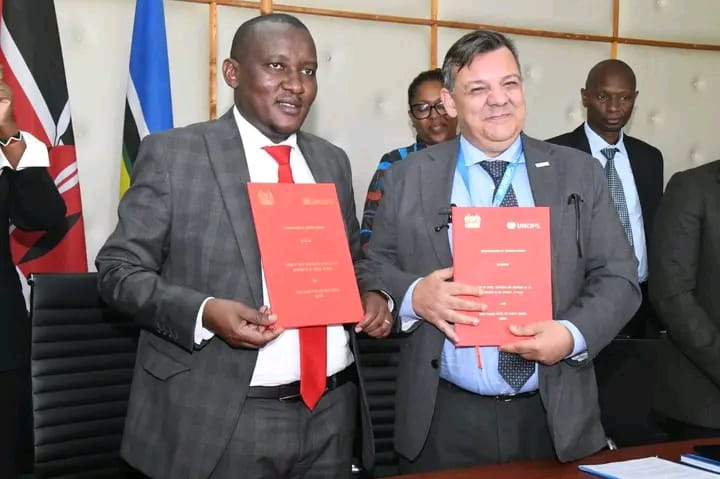
The Memorandum of Understanding (MOU), signed by the State Department for Irrigation and UNOPS, will support the implementation of the National Irrigation Sector Investment Plan (NISIP) 2025–2035, which targets an additional one million acres under irrigation over the next decade.
One million acres targeted for irrigation
Principal Secretary for Irrigation Ephantus Kimotho said the partnership would strengthen the Government’s capacity to undertake project studies, improve infrastructure planning and accelerate the delivery of irrigation investments across the country.
He said the agreement would provide technical support in project preparation, feasibility studies, procurement, implementation and infrastructure management, helping the State Department develop projects capable of attracting sustainable financing.
Kimotho noted that Kenya’s agricultural potential remained largely untapped, despite the country having considerable land and water resources that could be harnessed to improve food production and reduce dependence on imports.
“Kenya remains a net food importer, particularly of rice, where domestic production falls far short of consumption. Our untapped land and water resources, if harnessed through strategic irrigation investment, can cut import dependence while creating jobs and improving livelihoods,” Kimotho said.
He observed that expanding irrigation infrastructure was central to improving agricultural productivity, strengthening rural economies and ensuring the country could meet its growing food demand.
The PS said the Government’s target of bringing an additional one million acres under irrigation over the next decade would require strengthened technical capacity, proper project preparation and sustainable financing mechanisms.
Partnership to attract investment
The partnership with UNOPS will support project design and structuring, feasibility studies, procurement, environmental and social impact assessments, implementation and long-term asset management.
Kimotho said the collaboration would also help the State Department develop bankable and commercially viable projects capable of attracting investment from development partners, climate finance institutions and the private sector.
He noted that the Government was increasingly exploring blended financing models to complement public resources and accelerate infrastructure development, adding that technical support in project preparation would be critical in unlocking such investments.
The five-year agreement will provide a framework for technical cooperation, with specific interventions identified on a project-by-project basis depending on the State Department’s priorities.
Kimotho clarified that the MOU was not a direct financing agreement but a technical cooperation framework intended to strengthen the Government’s capacity to prepare projects and link them to appropriate financing opportunities.
Massimo Diana, Director of the UNOPS East and Southern Africa Sub-Regional Office, reaffirmed the organisation’s commitment to supporting Kenya through technical assistance, capacity development, procurement expertise, feasibility studies and project preparation.
Diana said UNOPS would leverage its global expertise to help the Government develop infrastructure projects that were properly planned, efficiently implemented and capable of delivering sustainable benefits.
Climate resilience in irrigation projects
He underscored the importance of incorporating climate resilience into irrigation infrastructure, noting that poor planning, inadequate design and construction quality often contributed to infrastructure damage during extreme weather events.
“Floods alone do not necessarily destroy infrastructure; poor design, inadequate construction quality and failure to plan for climate resilience are often the real causes,” Diana said.
He said UNOPS would work with the State Department to integrate climate resilience and sustainability across the project lifecycle, from feasibility studies and design to implementation and long-term asset management.
The collaboration is expected to support the development of irrigation infrastructure that can withstand climate-related risks while ensuring public investments deliver lasting benefits to farmers and communities.
The partnership also comes as Kenya seeks to transition from largely public-funded infrastructure development towards blended financing models combining Government resources, development partner support, climate finance and private capital.
Through technical support and improved project preparation, the agreement is expected to enhance the State Department’s ability to mobilise financing, accelerate irrigation expansion and improve the sustainability of infrastructure investments.
The signing ceremony was attended by senior Government officials, including the Secretary for Land Reclamation, Climate Resilience and Irrigation Water Management, Secretary Administration David Kipkemei, MBS, and directors and senior officers from the State Department for Irrigation.
UNOPS was represented by senior officials, including Mewael Addis Kahsay, Head of Programmes, and Emmah Akinyi.
The partnership is expected to play a key role in advancing Kenya’s irrigation expansion agenda, boosting agricultural productivity, creating employment opportunities and strengthening national food security under the NISIP 2025–2035 framework.