



Experts Advocate for Agroecology to Enhance Soil Health and Food Security
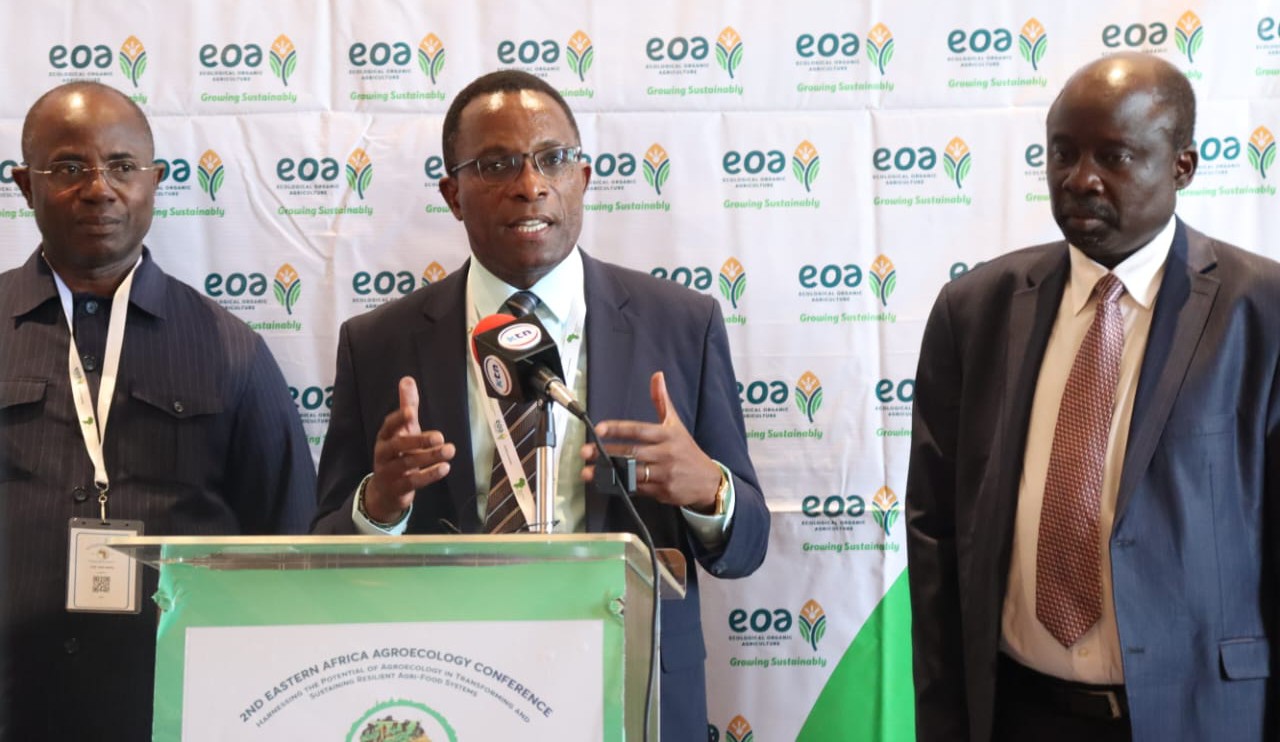
Agricultural experts and policymakers have emphasized the urgent need to adopt agroecological practices to enhance soil health, improve productivity, and ensure food security in Africa.
The summit, attended by government officials, researchers, and farmers, underscored the need for homegrown solutions to address soil degradation.
Speaking during a press briefing at a high-level summit on fertilizers and soil health, David Amudavi, Executive Director of Biodiversity, highlighted the critical role of sustainable farming methods in maintaining soil fertility without excessive reliance on chemical-based inputs.
“Our soils are the foundation of our agriculture. Just as human beings need to be healthy to function optimally, our soils must be healthy for sustainable crop production,” Amudavi stated.
He cited a 2012 study by a national research institute, which found that most Kenyan farm soils suffer from acidity, reducing their ability to support high crop yields.
Experts agreed that investment in research, extension services, and innovative farming techniques is crucial in scaling up agroecology.
“We must take proven research from institutions like KALRO (Kenya Agricultural & Livestock Research Organization) and ensure it reaches farmers. Why look to GMOs when we already have high-yielding, climate-resilient crop varieties?” Amudavi posed.
With Africa facing unpredictable weather patterns and rising concerns over food security, policymakers are being urged to integrate agroecology into national agricultural strategies.
“If we diversify our farms, adopt nature-friendly inputs, and invest in local fertilizer production, we can transform agriculture into a resilient and sustainable sector,” Amudavi stated.
Uganda’s Minister of Agriculture, Hon. Fred Bwino, reiterated that agroecology is not just a practice but also a science and a movement that prioritizes nature-based solutions over inorganic inputs.
“If you are looking at fertility, are you using compost and organic matter, or are you relying solely on inorganic chemicals? Agroecology is about working with nature rather than against it,” Bwino said.
Despite the strong advocacy for organic farming, experts acknowledged the need for a balanced approach.
Joyce Mutua, County Executive Committee Member for Agriculture in Makueni County, emphasized that while organic fertilizers are essential for long-term soil health, Kenya cannot entirely phase out inorganic fertilizers immediately.
“We must ensure food security while transitioning to sustainable farming practices. Counties are now promoting drought-resistant crops such as mangoes and green grams and implementing integrated pest management methods,” Mutua explained.
Other speakers pointed to successful organic farming practices already in use, including the production of Bokashi, a widely adopted organic fertilizer in Kenya, Uganda, and Tanzania.
Experts argued that promoting such innovations could reduce dependency on expensive chemical fertilizers, whose supply has been disrupted by global geopolitical tensions.
The Role of Research and Policy Support
Dr. Sara Olembo, an advocate for farm-managed seed systems, warned against the monopolization of seed production, emphasizing the importance of preserving indigenous and diverse crop varieties.
“We cannot feed Africa with only five crops promoted by industrial agriculture. Women, who are the custodians of traditional seed varieties, must be included in policy decisions,” she noted.
The discussion also touched on the impact of pesticides on human health and the environment. Some speakers called for policies to regulate harmful chemical inputs, citing their long-term effects on soil fertility, biodiversity, and human reproduction.
As discussions continue, stakeholders are calling for greater collaboration between governments, researchers, and farmers to implement policies that support sustainable agriculture.
The summit’s resolutions will likely shape future policies on soil health and fertilizer use, ensuring Africa moves towards a food-secure and environmentally sustainable future.
Kenya Hosts 2nd Eastern Africa Agroecology Conference to Advance Sustainable Farming
By Sharon Atieno

2 thoughts on “Experts Advocate for Agroecology to Enhance Soil Health and Food Security”