
Equity Bank Partners with Agri All Africa to Boost Rice Production in Tana River

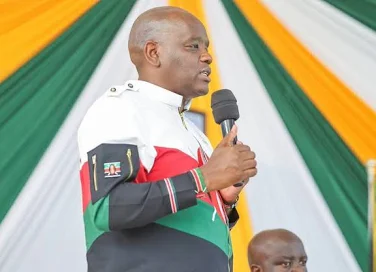
Moses Nyabanda, Managing Director of Equity Bank Kenya, operates a combine harvester during a field visit to Agri All Africa rice Farm.
Equity Bank Kenya has partnered with South Africa’s Agri All Africa in a large-scale rice farming initiative aimed at enhancing food security and reducing the country’s reliance on rice imports.
The project, launched in collaboration with the Tana & Athi Rivers Development Authority (TARDA), seeks to strengthen local agricultural value chains and boost rice production in Tana River County.
The initiative was officially inaugurated by President William Ruto alongside Priscillah Dimakhatso, Co-founder of Boholo Group and Director at Agri All Africa. Dimakhatso, a seasoned entrepreneur and international business executive, highlighted the strategic nature of the project, which blends public-private partnerships to unlock Kenya’s agricultural potential.
“We partnered with the government of Kenya through TARDA in a Public-Private Partnership initiative to revive and bring to the surface the immense agricultural potential of this area, and in so doing, help address the rice deficit in the country, which is currently met through importation,” Dimakhatso explained.
She further acknowledged the role of Equity Bank Kenya in providing critical support for the initiative. “We engaged Equity not just as a financial institution but as a partner with a deep understanding of agribusiness ecosystems and community empowerment through the Equity Group Foundation,” she noted.


Agri All Africa’s silos at the Tana & Athi Rivers Development Authority (TARDA) in Gamba, where harvested rice from the farm is securely stored (L).
The project has already demonstrated resilience despite setbacks, including the devastating 2023 El Niño floods, which destroyed significant acreage. However, over 370 acres survived, providing valuable lessons for future cultivation.
“We studied what made that crop resilient and came back stronger with a second crop, determined to contribute towards reducing Kenya’s reliance on rice imports,” Dimakhatso said.
Currently, 1,300 acres of rice are under cultivation, with plans to expand to over 4,000 acres within the year. At full capacity, Agri All Africa expects to produce more than 20,000 tonnes of rice annually, with yields of approximately three tonnes per acre.
This is a significant step towards bridging Kenya’s rice deficit, as the country imports nearly 1.2 million tonnes annually while producing only 200,000 to 250,000 tonnes locally.
During a visit to the farm at Gamba in Tana River County, Equity Bank Kenya Managing Director Moses Nyabanda commended Agri All Africa’s structured approach, emphasizing the importance of scaling up agricultural productivity through partnerships.
“One of the challenges we’ve seen over the past 40 years is that Africa doesn’t punch at its weight level,” he said.
“Despite having 60percent of the world’s arable land, we only produce 10percent of global food crops. Agri All Africa has demonstrated what’s possible when agricultural projects are structured for scale, and we see this as a model worth supporting.”
Nyabanda reiterated that Equity Bank aligns this collaboration with its commitment to the Africa Recovery and Resilience Plan (ARRP), which prioritizes agriculture as a key driver of economic transformation.
“We’re not just looking at agriculture as a sector to finance; we see it as a pillar of economic growth,” he said.
“Through our ecosystem approach, we are keen to explore ways to support structured agricultural development, whether through technical assistance, market linkages, or financial instruments tailored to the needs of agribusiness players.”
Dimakhatso emphasized the broader impact of the project, which spans the entire rice value chain—from cultivation to milling and market distribution.
“Equity’s ecosystem approach offers a platform that could help scale this initiative. There is potential to support out-growers, improve access to quality inputs, and strengthen market linkages,” she said.
Beyond rice production, we are also focused on community development—80 percent of our workforce are women, and our goal is to create not just jobs, but a thriving local economy with access to education, healthcare, and sustainable livelihoods.”
Looking ahead, Dimakhatso remains optimistic about the future of large-scale agribusiness in Kenya.
“Projects like ours require long-term commitment and structured financing tools. Women, especially those in agriculture, need access to reasonable financing not cheap, but fair. If we can unlock that, the ripple effects will be transformative for the industry and the country,” she concluded.
With continued institutional support, Agri All Africa’s vision of transforming Kenya’s agriculture sector and ensuring food security remains within reach.