

Kenya’s TVET enrolment doubles as Africa hosts WFCP Congress.
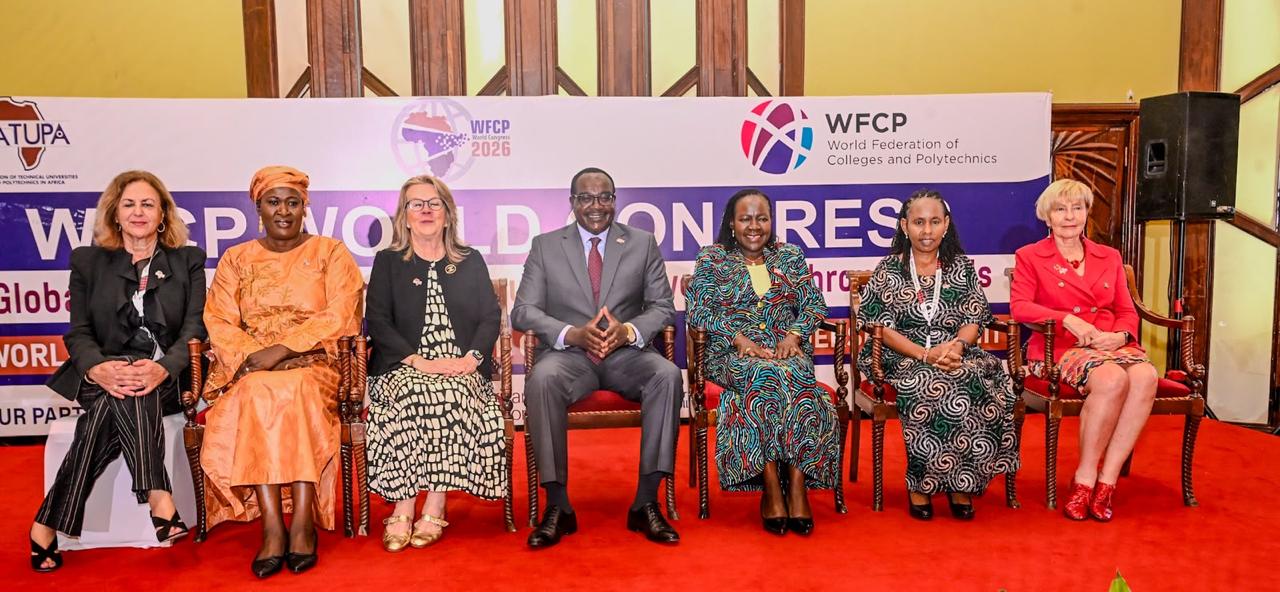
Education Cabinet Secretary Julius Migos Ogamba (centre) alongside TVET Principal Secretary Dr Esther Thaara Muoria with delegates and organisers during the opening of the 2026 World Federation of Colleges and Polytechnics (WFCP) World Congress at the Safari Park Hotel, Nairobi.
Public technical and vocational training enrolment in Kenya has risen from about 345,000 in the 2022/23 financial year to over 800,000 in 2025/26.
Speaking on Monday while opening the 2026 World Federation of Colleges and Polytechnics (WFCP) World Congress in Nairobi, Education Cabinet Secretary Julius Migos Ogamba said the growth was under the Ministry of Education and came alongside reforms in how skills are developed, assessed and recognised.
The Congress, held under the theme “Building Skills for Sustainability, Innovation and Global Employability,” is the first in the Federation’s history to be hosted on the African continent.
Ogamba said the choice of Nairobi recognizes Africa’s growing authority in shaping the global skills agenda and described it as a homecoming. Africa was among the WFCP’s founding members, alongside Canada, the UK, the US and Australia through the Commonwealth Association of Polytechnics in Africa, the predecessor of the Association of Technical Universities and Polytechnics in Africa (ATUPA).
State Department for TVET Principal Secretary Dr Esther Thaara Muoria said Ogamba’s presence underscored the government’s commitment to technical education.
“Behind every trainee is a family with hopes, a community with expectations and an economy in need of skills,” she said.
Citing the African Development Bank, Ogamba said 10 to 12 million young people enter Africa’s workforce every year while only about three million formal jobs are created.
“Our youth represent both Africa’s most pressing development challenge and the greatest engine for our future prosperity,” Ogamba said.
He pointed to a World Bank-supported programme in Rwanda that has trained nearly 24,000 young people, 82 per cent of whom were employed or self-employed within nine months of graduating.
On Kenya’s reforms, Ogamba clarified that the government is using Competency-Based Education and Training, modularized curricula, Recognition of Prior Learning and Dual Training to make graduates job-ready.
Industry leaders are now being brought to the table “not as spectators, but as strategic partners,” while solar systems installed in 92 TVET institutions power the campuses and double as classrooms for renewable energy training tying the reforms to President William Ruto’s Bottom-Up Economic Transformation Agenda and Vision 2030.
Ogamba urged delegates to ensure the Congress is judged by lasting partnerships and measurable results for learners, not by the eloquence of its resolutions.
He commended the attention given to women, persons with disabilities and young people congratulating the nominees and laureates of the WFCP and ATUPA Awards of Excellence.