
Fresh Life, Atoo Kakuma Ink Deal to Expand Climate-Resilient Sanitation in Turkana
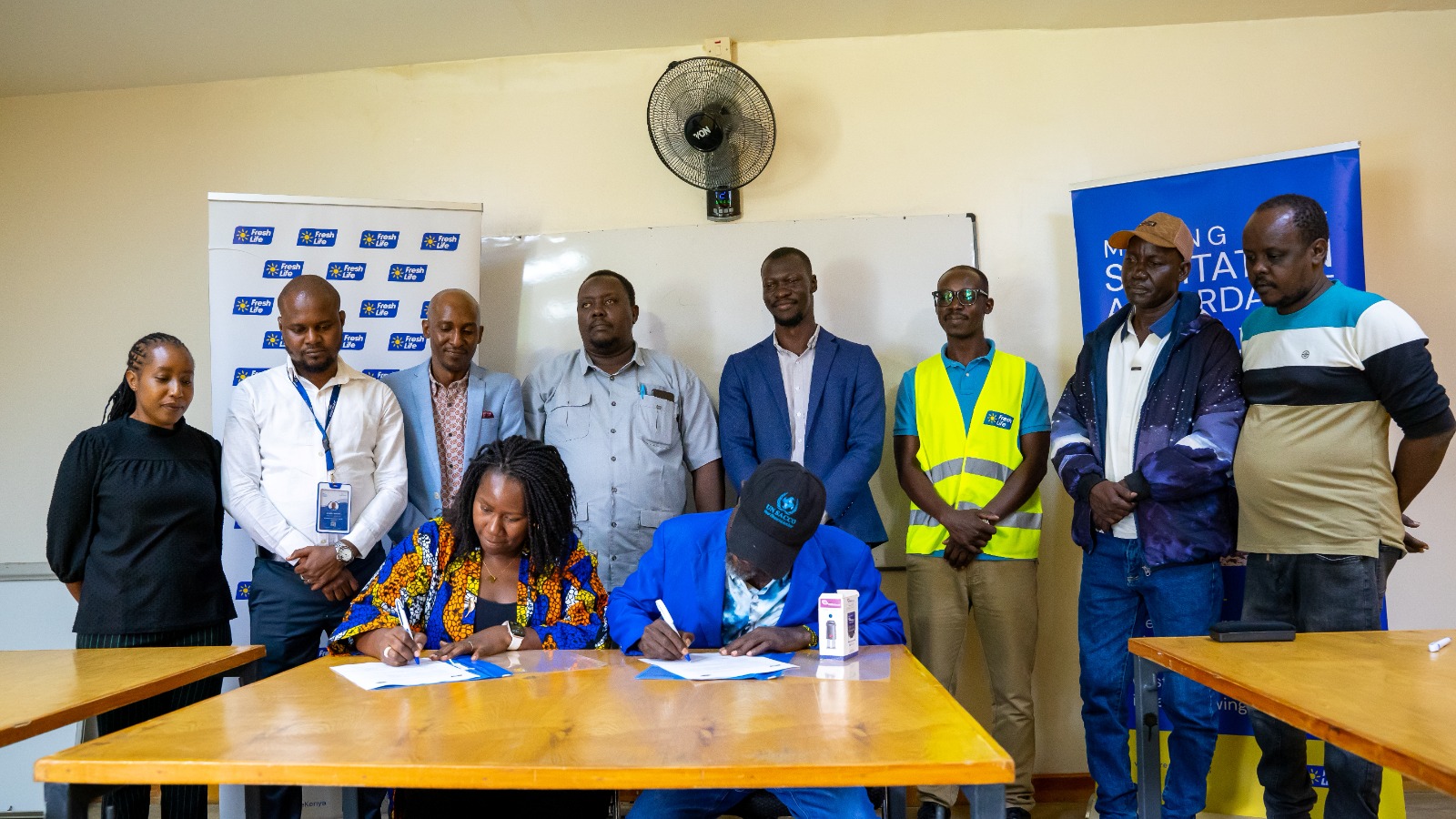
Nairobi, April 15, 2026— Fresh Life Sanitation Services Ltd and Atoo Kakuma Usafi Company Ltd have signed a long-term distributorship agreement aimed at scaling up access to sustainable and climate-resilient sanitation solutions across Turkana County.
The partnership will see Atoo Kakuma formally take on the role of a non-exclusive distributor of Fresh Life’s Urine Diversion Dry Toilets (UDDTs), targeting underserved areas including Kakuma Refugee Camp, Kalobeyei Integrated Settlement and surrounding host communities. The water-efficient sanitation technology is designed to suit arid and semi-arid regions where conventional sewer systems are limited or absent.
The agreement, facilitated by Swisscontact under its Climate Proofing WASH Services (CP WASH) Project, and implemented in collaboration with Plan International Kenya, WaterMission and APAD, marks a shift toward private-sector-led sanitation service delivery in fragile settings. Stakeholders say the model is structured to operate sustainably beyond donor-funded cycles.
The initiative aligns with Kenya’s Shirika Plan, which promotes refugee inclusion, self-reliance and market-driven service delivery.
Speaking during the signing, Swisscontact Team Lead Jimmy Delyon said the partnership demonstrates the viability of market-based sanitation solutions in complex environments.

“What began as an ambition to introduce a private-sector-led sanitation model in Kakuma has evolved into proof that sustainable, market-driven solutions can work in refugee-hosting contexts,” he said. “This model addresses public health, dignity and economic inclusion at scale.”
Bridging a Critical Sanitation Gap
Turkana West Sub-County has long struggled with limited sanitation infrastructure, with reports indicating that until recently, a single public toilet served thousands of residents raising risks of open defecation, disease outbreaks and loss of dignity.
The Fresh Life–Atoo collaboration seeks to address this gap by expanding pay-per-use UDDTs in high-density and public areas, while strengthening Atoo Kakuma as a local sanitation enterprise capable of managing and sustaining services.
Atoo Kakuma CEO Moses Eyaran described the agreement as a turning point for the organisation.
“This partnership marks a defining milestone in our journey from a community-based youth initiative to a professionally run sanitation enterprise,” he said. “With the support we’ve received, we’ve built capacity in logistics, waste collection and sanitation centre management, positioning us to expand services sustainably.”
Jobs, Enterprise and Circular Economy Growth
Since the rollout of the CP WASH initiative less than a year ago, 57 UDDTs have been installed across Kakuma, creating new economic opportunities for local residents.
Currently, 37 entrepreneurs are engaged in installation, servicing and waste management, while 45 young people are involved in briquette production and marketing. Additionally, over 200 women earn income by supplying Prosopis (Mathenge) biomass used in fuel briquette production.
Waste collected from the sanitation units is transported by the Kalobeyei Water and Sanitation Company (KALWASCO) to Sanivation Ltd, where it is treated and converted into eco-friendly fuel briquettes dupporting a growing circular economy that delivers both environmental and economic benefits.
Scaling a Sustainable Model
Fresh Life Head of Strategy Angela Nzioki noted that the partnership offers a practical solution for areas lacking sewer infrastructure.
“As we expand, we recognise that many regions in Kenya do not have sewer systems. This model allows us to replicate sustainable sanitation solutions while supporting strong local enterprises like Atoo Kakuma,” she said.
Blueprint for National Expansion
Stakeholders say the agreement provides a replicable model for scaling sanitation solutions in other arid and refugee-hosting regions across Kenya.
By embedding sanitation services within a commercially viable ecosystem, the partnership demonstrates how humanitarian WASH interventions can transition into sustainable, private-sector-led systems supporting national goals on climate resilience, inclusion and economic self-reliance.