
Opposition Leaders Warn Against Safaricom Stake Sale, Infrastructure Fund Bill
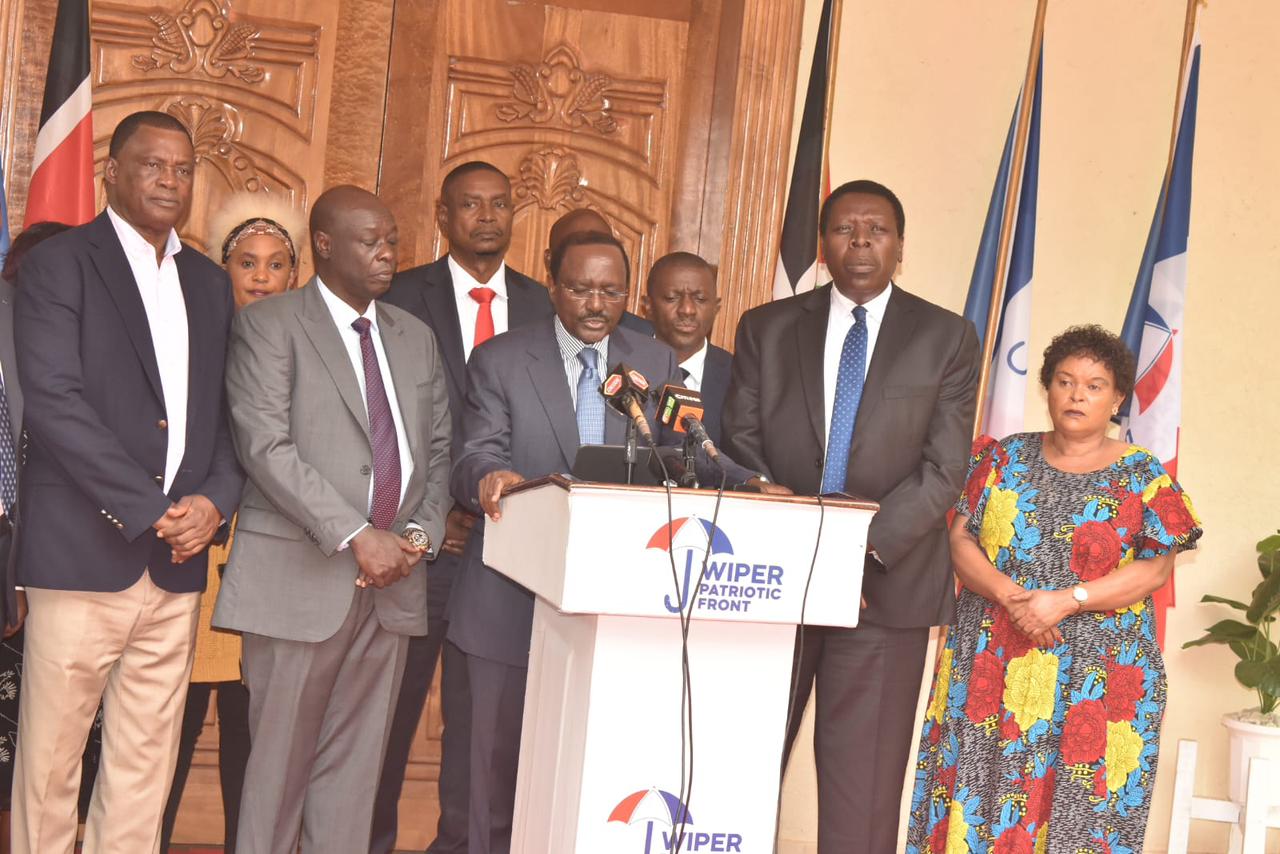
Kalonzo Musyoka speaking during a press briefing at the SKM Command Center on March 5, 2026.
Opposition leaders led by Kalonzo Musyoka on Thursday strongly criticized the proposed National Infrastructure Fund Bill 2026 and the government’s plan to partially sell its stake in Safaricom, warning that the two proposals could weaken constitutional safeguards governing public finance and place strategic national assets at risk.
Speaking during a press briefing at the SKM Command Center, Musyoka delivered a joint statement on behalf of the United Opposition. Among the leaders present were Rigathi Gachagua and Eugene Wamalwa, who joined him in expressing concern about the government’s approach to financing infrastructure and managing state assets.
Musyoka said the proposed infrastructure fund could create a financing structure that operates outside the Consolidated Fund, potentially limiting parliamentary oversight and weakening accountability in the use of public resources. According to the opposition, Kenya already has sufficient institutions and financial mechanisms to support infrastructure development, and the creation of a new fund could introduce additional governance risks.
“Kenya’s infrastructure deficit is not caused by a shortage of institutions,” Musyoka said. “It is the result of poor execution, procurement corruption and lack of fiscal transparency. Introducing a new fund into already broken systems will only add another layer of dysfunction with even less oversight.”
He warned that the structure proposed in the bill could undermine constitutional safeguards designed to ensure that public finances are managed transparently and under the scrutiny of Parliament. Musyoka emphasized that any new financing mechanism should strengthen, rather than weaken, accountability frameworks already provided under the Constitution.
The opposition also raised strong objections to the government’s plan to reduce its shareholding in Safaricom, describing the telecommunications giant as a strategic national asset that plays a critical role in Kenya’s digital and financial ecosystem.
“Safaricom is not simply a telecommunications company,” Musyoka said. “It functions as a national infrastructure utility and forms the backbone of Kenya’s digital payment architecture. Divesting it, even partially, in order to address short-term fiscal pressures is the economic equivalent of a family selling its most productive farm to cover ordinary household expenses.”
According to the opposition leaders, selling part of the government’s stake in Safaricom to raise funds could weaken long-term public value in one of Kenya’s most profitable and influential companies. They argued that decisions involving such strategic assets should be guided by long-term national interests rather than short-term fiscal challenges.
The leaders also pointed to the recent initial public offering of the Kenya Pipeline Company as an example of how government asset transactions can generate public concern when transparency and public participation are perceived to be inadequate. They said the IPO raised questions about issues such as pricing, the level of investor participation and the selection of transaction advisers.
According to the opposition, these concerns highlight the need for stronger transparency measures before the government proceeds with any additional asset sales or major financial restructuring initiatives.
Musyoka said the opposition coalition would push for Parliament to reject both the National Infrastructure Fund Bill 2026 and the proposal to sell part of the government’s stake in Safaricom. He added that opposition leaders are also prepared to pursue legal avenues should the government move forward without adequately addressing the issues they have raised.
“Kenya is not suffering from a shortage of institutions or financial instruments,” Musyoka said. “What the country is experiencing is a governance crisis and a failure to manage public resources transparently and responsibly.”
The opposition leaders also urged Members of Parliament to exercise their constitutional oversight role and ensure that any decisions affecting public finances and national assets undergo proper scrutiny. They called for meaningful public participation and open debate before policies that could significantly affect the country’s economic future are adopted.
They said safeguarding transparency, accountability and constitutional order should remain central in decisions involving Kenya’s infrastructure financing and management of key national assets.