

Kenya Urged to Strengthen Cybersecurity Collaboration as AI Fuels Sophisticated Digital Threats
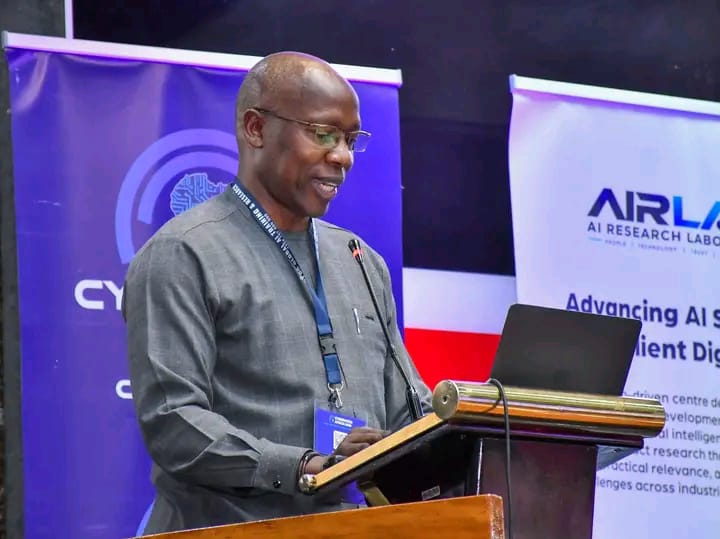
National Cybersecurity Agency Chairman Dr Martin Koyabe addresses delegates during the closing ceremony of Cyberweek Africa 2026 in Nairobi.
Kenya has been urged to strengthen collaboration between government agencies, regulators and the private sector to counter increasingly sophisticated cyber threats driven by artificial intelligence, with experts warning that the country’s expanding digital economy must be matched with stronger security systems.
The call was made during the closing ceremony of Cyberweek Africa 2026 in Nairobi, where policymakers, cybersecurity professionals, technology companies and international partners emphasised the need for coordinated responses to emerging digital threats.
Speaking at the event, Principal Administrative Secretary for Internal Security Jacob Narengo, who represented the Principal Secretary for Internal Security and National Administration, warned that artificial intelligence was becoming a powerful tool for both cyber defenders and criminals.
He described AI as a force multiplier that could strengthen cybersecurity systems while simultaneously enabling attackers to develop more convincing scams, manipulate digital identities and target unsuspecting users.
“AI is a force multiplier—both shield and spear. Threat intelligence is how defenders stay ahead, knowing about the attack before it strikes, so AI can help defenders detect threats in seconds or it can help attackers fake voices, craft convincing scams and target mobile money users,” Narengo said.
He cautioned that countries that failed to invest in cybersecurity preparedness risked exposing their digital infrastructure and citizens to increasingly complex attacks.
“Given preparation, AI multiplies resiliency; but given neglect, it multiplies exposure. For Africa, expanding our digital ecosystem without hardening its defences means building our future on sand,” he added.
Narengo called for the implementation of existing national policy frameworks while accelerating the development of regulations addressing emerging technologies.
He cited the National Cybersecurity Strategy and the National AI Strategy as important frameworks for guiding the country’s digital security agenda.
He also highlighted policies under development, including the Digital Policy, Cybersecurity Policy, Data Governance Policy and AI and Emerging Technologies Policy, saying they would provide a foundation for strengthening the country’s digital resilience.
The four-day conference, held under the theme “Cyber Threat Intelligence in the Age of AI”, brought together more than 1,200 delegates from over 20 countries to discuss strategies for securing digital infrastructure and building trust in an increasingly interconnected world.
The annual event was led by the Ministry of Information, Communications and the Digital Economy in collaboration with the Kenya School of Government, Ministry of Interior and National Administration, National Cybersecurity Agency, University of Nairobi and CyberPro Global.
One of the central issues emerging from the discussions was the importance of information sharing among institutions, with stakeholders arguing that effective cybersecurity requires coordinated action rather than isolated interventions.
Chairman of the National Cybersecurity Agency, Dr Martin Koyabe, emphasised the need to establish trust among stakeholders to facilitate the timely exchange of information on emerging threats.
Koyabe said effective collaboration between government agencies, industry players and regulators was essential in building a resilient cybersecurity ecosystem.
He also clarified that digital sovereignty should not be interpreted as isolation from international partnerships and technological cooperation.
“Digital sovereignty does not mean digital isolation,” he emphasised, calling for stronger collaboration between regulators and industry players, including sector-specific regulators in industries such as finance.
His remarks highlighted the importance of balancing national control over digital infrastructure and information systems with cooperation across borders and sectors.
The conference was among the first major cybersecurity gatherings held in Kenya following the establishment of the National Cybersecurity Agency, with Koyabe’s participation throughout the event demonstrating the agency’s focus on stakeholder engagement and partnerships.
The discussions also highlighted the role of technology companies in developing secure digital products while equipping users with the knowledge needed to identify and respond to cyber threats.
Huawei Kenya’s Country Cybersecurity and Privacy Officer, Kaine Zhang, spoke during the conference as one of its major sponsors, stressing the importance of combining secure technology solutions with capacity building.
Zhang highlighted the need to strengthen the ability of individuals and institutions to protect themselves against cyber threats, noting that cybersecurity cannot depend on technology alone.
He said Huawei remained committed to supporting secure digital infrastructure while investing in skills development and awareness programmes to improve cybersecurity preparedness.
As part of the company’s contribution, 21 government ICT officers received certificates during the closing ceremony after completing a network security training programme supported by Huawei.
The training was aimed at strengthening the technical capacity of government personnel responsible for managing and securing public digital systems.
Huawei Sub-Saharan Africa Regional Cybersecurity Expert Lu Hao also addressed the conference, presenting on the development of a next-generation autonomous intelligent security operations system.
Hao underscored the importance of integrating security solutions with other systems to achieve comprehensive visibility across digital networks.
He explained that interconnected security systems enable organisations to identify vulnerabilities, detect suspicious activities and respond rapidly to cyber incidents.
His presentation highlighted the growing importance of automated security operations as organisations contend with increasingly sophisticated attacks and expanding digital environments.
The conference also placed emphasis on developing local cybersecurity expertise, particularly among young people, as part of efforts to build a sustainable workforce capable of responding to future digital security challenges.
Ahead of the main conference, cybersecurity awareness sessions were conducted in 21 universities and technical institutions across the country, reaching young people with information on online safety, cyber threats and career opportunities in the sector.
The event further featured a youth cybersecurity hackathon supported by Expertise France and the European Union, providing a platform for young innovators to develop solutions addressing emerging cybersecurity challenges.
During the opening ceremony, Principal Secretary for Broadcasting and Telecommunications Stephen Isaboke, Dr Koyabe and Kenya School of Government Director General Professor Nura Mohamed joined European Union Ambassador Andreas Peschke and other diplomats in officially opening the conference.
The EU Ambassador congratulated 19 newly certified Kenyan SIM3 cyber auditors, while Tahar Benattia of Expertise France presented awards to the hackathon winners.
The certification of the auditors was a significant milestone in strengthening the country’s capacity to assess and improve cybersecurity incident management systems.
As the conference concluded, participating organisations committed to several actions aimed at enhancing information sharing, strengthening institutional cooperation and improving preparedness against emerging cyber threats.
The closing remarks reinforced the need for Kenya and other African countries to treat cybersecurity as a shared responsibility as artificial intelligence continues to reshape the digital landscape.
With cyber threats increasingly cutting across national borders, financial systems, government institutions and individual users, stakeholders said sustained collaboration, effective policies and investment in technical skills would be essential in protecting Africa’s digital future.