

Kenya and World Bank Launch KES 10 Billion Electrification Project for Underserved Counties
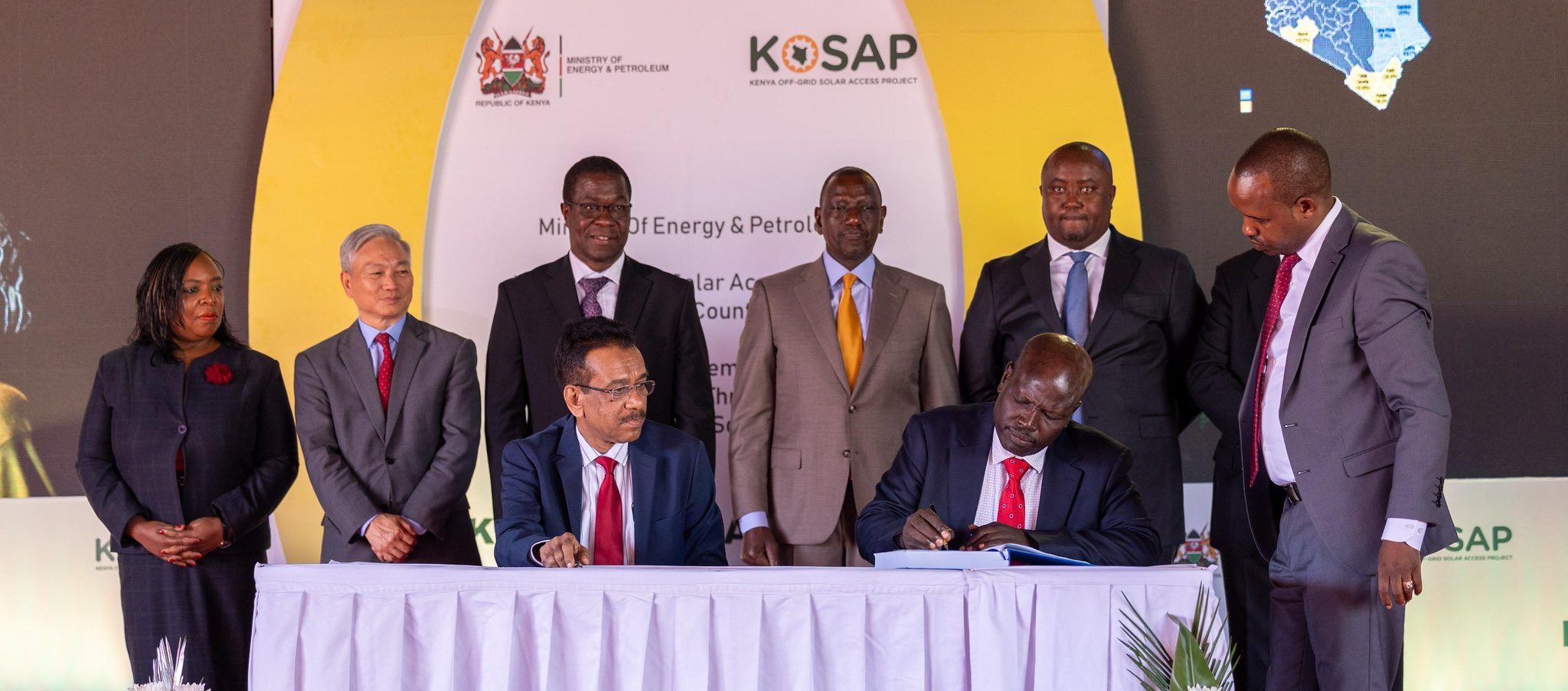
His Excellency President William Ruto has presided over the signing of contracts worth KES 10 billion for the implementation of solar electrification projects across 14 counties to enhance electricity access in remote and rural parts of Northern Kenya, powering the growth of enterprises and expansion of economic opportunities in the underserved regions.
The initiative, financed by the World Bank under the Kenya Off-Grid Solar Access Project for Underserved Counties (KOSAP), will see the installation of 113 mini-grids and standalone solar systems in 343 public facilities.
The contracts, signed between private contractors, Kenya Power and the Rural Electrification and Renewable Energy Corporation (REREC), mark a crucial step in addressing energy disparities in counties with limited or no access to the national grid.
The project aligns with the government’s broader agenda of achieving universal electricity access and supporting socio-economic development.
The USD 150 million World Bank-funded KOSAP initiative is a collaborative effort between the Government of Kenya, the Ministry of Energy and Petroleum, Kenya Power, and REREC, project targeting 14 counties including Turkana, Marsabit, Samburu, Isiolo, Mandera, Wajir, Garissa, Tana River, Lamu, Kilifi, Kwale, Narok, West Pokot, and Taita Taveta.
Speaking during the signing ceremony at Stima Club, Nairobi, President Ruto emphasized the government’s unwavering commitment to universal electricity access in line with Kenya’s Vision 2030 and the Kenya National Electrification Strategy.
“These contracts demonstrate our commitment to leaving no Kenyan behind in our efforts to attain universal access to electricity. By harnessing solar energy, we are providing a sustainable and cost-effective solution that will power underserved communities, stimulate economic growth, and improve livelihoods,” he stated.
The project’s implementation will focus on several critical areas including mini-grid Development , The construction of 113 solar-powered mini-grids across 12 counties to provide electricity to remote communities.
Stand-alone Solar Systems where Installation of solar systems in 343 public facilities, including schools, health centers, and administrative offices in 13 counties.
Solar Home Systems. The sale and distribution of 178,598 stand-alone solar home systems to households, benefiting approximately 900,000 people.
Clean Cooking Solutions.Distribution of clean cooking stoves, with over 12,486 verified sales, aimed at improving indoor air quality and reducing dependence on traditional fuels.
Solar Water Pumps . Installation of solar-powered water pumps for community boreholes to ensure access to clean water.
President Ruto commended the World Bank for its continued support in expanding electricity access, highlighting its contribution to increasing the country’s electrification rate from 29 percent in 2013 to 75 percent currently.
He reiterated that projects such as KOSAP play a pivotal role in achieving the nation’s long-term development goals.
With the rollout of these solar electrification projects, Kenya is set to make significant strides in sustainable energy access, fostering economic growth, and improving the quality of life for millions of residents in remote areas.

Kenya Embarks on Major Electrification Drive to Achieve Universal Access by 2030
Making his remarks, Cabinet Secretary for Energy and Petroleum, Opiyo Wandayi, has reaffirmed the government’s commitment to expanding electricity access across the country, aligning with Kenya’s Vision 2030 and Africa’s Mission 300 initiative.
“Today, we are embarking on a transformative journey to light up vast areas of our country that would ordinarily struggle to access electricity. Our goal remains universal electricity access by 2030, a commitment that aligns seamlessly with Africa’s Mission 300, spearheaded by the World Bank and other global partners,” said CS Wandayi.
The electrification initiative is expected to bridge the energy gap in underserved regions, boosting economic growth, education, and overall quality of life. The move also underscores Kenya’s dedication to sustainable development and regional energy integration efforts.
This ambitious project marks a significant step in ensuring equitable access to electricity, supporting both urban and rural communities in the country’s journey toward economic transformation.