
Editors push for deeper scrutiny of Kenya’s borrowing and public finances
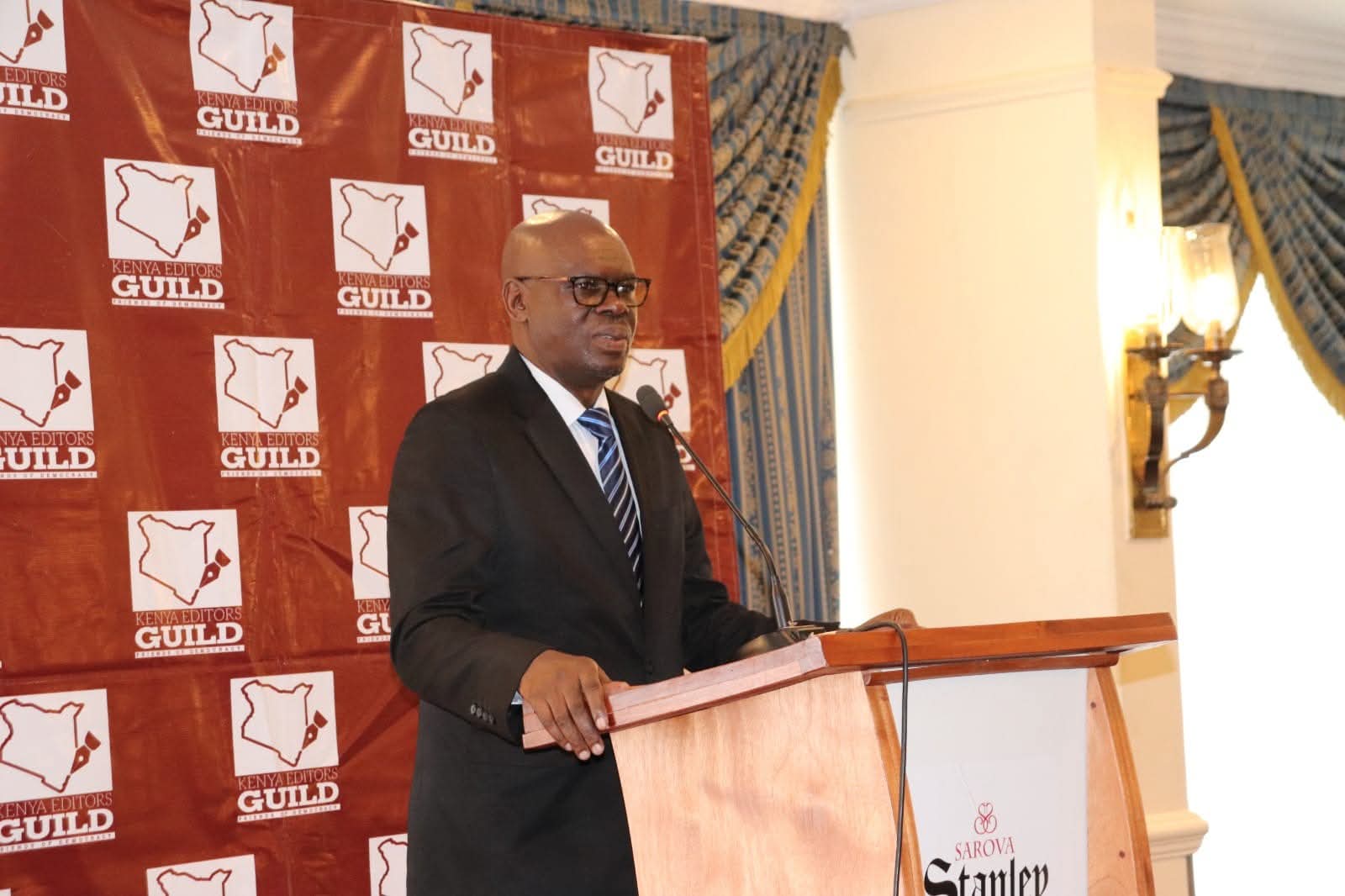
KEG Vice President Francis Openda during peer-to-peer engagement on public finance accountability, urging journalists to deepen scrutiny of Kenya’s borrowing and public finances.
The Kenya Editors Guild (KEG), in partnership with the International Republican Institute (IRI), has held its second peer-to-peer engagement on the media’s role in advancing public finance accountability, with editors and journalists examining Kenya’s growing debt burden, government borrowing, access to public information and the impact of fiscal decisions on ordinary citizens.
The engagement, held in Nairobi on Thursday 24 September, brought together media practitioners and public finance stakeholders for discussions on how newsrooms can strengthen scrutiny of government revenue, expenditure, borrowing and debt management.
KEG Vice President Francis Openda delivered the opening remarks, setting the stage for discussions on the responsibility of the media to interrogate public finance decisions and make complex financial information understandable to the public.
Openda stressed the importance of journalists asking difficult questions and using their position to ensure public institutions are held accountable for decisions involving public resources.
“We have a responsibility to ask the difficult questions and hold institutions to account.”
Alexander Riithi, Head of Programmes at The Institute for Social Accountability (TISA), took participants through Kenya’s debt situation, government borrowing, budget deficits, access to debt information and the role journalists can play in following public money.
Riithi used Kenya’s population to illustrate the individual burden of public debt, noting that with a population of about 57 million people, the country’s debt translates into a significant obligation for every Kenyan.
He said the challenge is compounded by the limited availability of detailed and accessible information on government borrowing.
“The main challenge that we have with our debt situation is the fact that the debt information and types is hidden in plain sight.”
Riithi challenged journalists to go beyond reporting the amount of money borrowed and investigate where the money goes, who receives it and whether projects financed through borrowing deliver value to citizens.
He said TISA had encountered cases involving debt contracted for projects that had not taken off, raising questions about the value and accountability of borrowing decisions.
According to Riithi, journalists should also investigate the identities of those who ultimately benefit from public borrowing and examine the relationship between debt, government spending and fiscal policy.
Riithi also raised concerns over the relationship between debt repayment and the resources available for development and essential services.
Kenya’s public debt stood at about Sh13 trillion by June 2026, with domestic debt accounting for roughly Sh7.3 trillion and external debt about Sh5.7 trillion. The debt stock was equivalent to about 68.5 per cent of GDP.
The figures provide context to the concerns raised at Thursday’s engagement about the increasing share of government resources committed to debt obligations.
Riithi argued that the media should examine what happens when government revenue is increasingly committed to debt servicing instead of services and investment.
“Debt repayment is growing faster while investment in education, healthcare, social protection, water, and sanitation is being squeezed.”
He urged journalists to examine the connection between borrowing and service delivery, rather than treating debt as a technical subject that belongs exclusively to economists and financial experts.
A major issue raised during Riithi’s presentation was access to information on government borrowing.
Riithi referred to a High Court ruling requiring the National Treasury to provide debt contracts, saying the information had not been provided within the stipulated period.
“The High Court ruled in our favour and gave the National Treasury 45 days to provide us with the debt contracts. However, this did not happen.”
He also focused on the importance of journalists understanding the budget-making process and examining borrowing from the point of formulation through implementation.
Riithi pointed to the current Sh4.82 trillion 2026/27 budget and the financing gap that requires borrowing. The fiscal framework provides for expenditure of about Sh4.82 trillion against revenues of roughly Sh3.63 trillion, leaving a deficit of more than Sh1.1 trillion.
For journalists, the discussion underscored the importance of examining how such deficits are financed and what the financing choices mean for the economy and citizens.
The event moved into a group engagement where journalists and editors discussed the practical challenges they face when covering public finance, including access to government documents, technical financial language, tracking borrowed funds and following the money from the point of borrowing to expenditure.
Among the questions highlighted were who authorises government borrowing, who lends the money to Kenya, what the interest rates and repayment terms are, what projects or programmes are being financed, who the ultimate beneficiaries are, whether borrowed funds are being used for their stated purposes and what happens when projects fail to take off.
Participants also examined how much money is being spent on debt repayment, the implications for education, healthcare, water, social protection and employment, and what contingent liabilities could eventually become obligations for taxpayers.
The journalists further discussed the challenge of translating complex public finance information into stories that ordinary Kenyans can understand.
The issue of access to information was also central to the group discussions, with participants stressing the need for newsrooms to use existing legal mechanisms to obtain information necessary for public-interest reporting.
The discussions emphasised that journalists need to know not only how much Kenya borrows, but also from whom it borrows, at what cost, under what terms, for what purpose and how the money is ultimately spent.
The group engagement also emphasised the importance of using Kenya’s constitutional right to access information when reporting on public finance.
The discussions also stressed that obtaining a document should not be the end of a journalist’s investigation.
Journalists were encouraged to verify figures, compare government records with independent sources, examine contracts and trace expenditure to establish whether public resources are delivering the intended outcomes.
The engagement comes amid continued concern over the complexity of Kenya’s public finance system and the difficulty many citizens face in understanding government borrowing and expenditure.
The discussions therefore placed the media at the centre of efforts to improve public understanding of borrowing, taxation, budgeting and government expenditure.
The overall message from the engagement was that journalists covering public finances should not simply reproduce figures contained in government statements.
Instead, newsrooms were encouraged to ask what the numbers mean, who makes the decisions, who benefits, who carries the cost and whether public institutions can account for the resources entrusted to them.
The engagement is part of the broader KEG-IRI effort to strengthen media capacity to scrutinise complex public financing and make public finance accountability a sustained newsroom priority.