
CEMASTEA Sparks Interest in STEM Among Kajiado Students with Practical Learning
Over 1,500 students from five Junior Secondary Schools in Kajiado County have gained valuable skills in Science, Technology, Engineering, and Mathematics (STEM) through a mentorship and outreach programme led by the Centre for Mathematics, Science, and Technology Education in Africa (CEMASTEA).
The five-day programme, launched at Enkasiti Junior Secondary School in Isinya Sub-county, aims to equip students with practical skills essential for excelling in STEM subjects. Other schools that benefited from the initiative include Kajiado Township, Ilbissil Boarding, Naromoru, and Arap Moi Comprehensive Primary Schools.
The outreach covered key STEM subjects, including Mathematics, Integrated Sciences (Biology, Physics, and Chemistry), and Pre-Technical Studies. Since its inception three years ago, the programme has reached ten counties, including Nairobi, Nakuru, Machakos, and Kisumu, among others.Practical Learning ApproachCEMASTEA’s STEM Outreach and Mentorship Programme Coordinator, Beatrice Macharia, emphasized the importance of strengthening STEM education in Kenya, as 60% of students under the Competency-Based Curriculum (CBC) are expected to specialize in STEM at the senior school level.
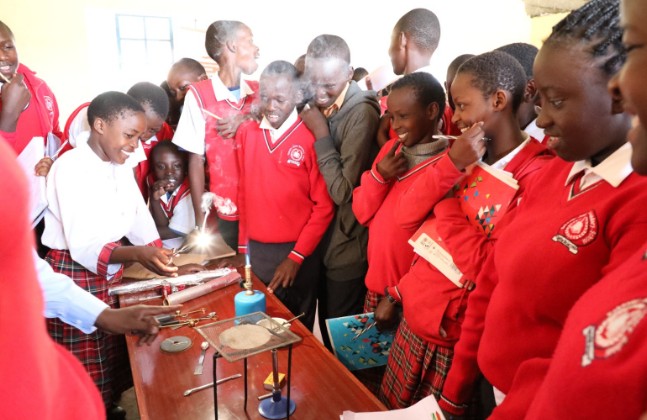
Speaking at Kajiado Township Junior Secondary School, Macharia highlighted the programme’s hands-on approach, which engages students in experiments and interactive activities. This approach not only enhances understanding but also allows teachers to identify students’ interests and guide them in selecting STEM pathways.
“We focus on practical rather than theoretical learning to improve comprehension. Teachers can mentor students by observing their abilities and interests and guiding them accordingly,” she said.
Equipped with computers, laboratory apparatus, and other innovative materials, CEMASTEA trainers conducted practical demonstrations, making complex STEM concepts more relatable and engaging. Macharia encouraged teachers to use locally available materials to create learning resources in schools with limited equipment.
“In cases where resources are scarce, teachers can improvise using everyday materials to make lessons more interactive. Practical learning helps students understand STEM better and relate concepts to real-life applications,” she noted.
Breaking Barriers in STEM
Macharia further emphasized that integrating practical learning helps dispel the notion that STEM subjects are difficult or gender-exclusive, encouraging both boys and girls to pursue STEM careers.
Kajiado County Director of Education, Dr. Martin Cheruiyot, praised the programme for its role in improving STEM education and teacher training under the CBC framework. He noted that practical learning fosters curiosity, critical thinking, and problem-solving skills among students.
“Incorporating experiments and visual aids enhances memory retention and deepens students’ understanding of scientific concepts. This exposure also prepares them for real-world applications of STEM,” he said.
Dr. Cheruiyot also reported significant progress in the county’s transition to Junior Secondary School, with over 500 classrooms already constructed to support learners.
Students Express Interest in STEM Careers
Students who participated in the programme expressed gratitude for the hands-on experience, which allowed them to interact with scientific equipment they had only read about in textbooks.
Nancy Wangare, a Grade 9 student at Kajiado Township Comprehensive School, was excited to use a microscope for the first time, enhancing her understanding of biology.
“We’ve finally seen and used lab equipment we previously only studied in books. Observing onion cells under a microscope was an eye-opening experience,” she said.
Enock Mutei, from the same school, said the programme strengthened his interest in ICT.
“I want to pursue the STEM pathway in senior school. We learned about the software and hardware components of a computer and even got to dismantle and assemble the parts, which was both fun and educational,” Mutei remarked.
Abigael Pius, a student at Ilbissil Boarding Comprehensive Primary School, shared her dream of becoming a pilot and encouraged girls to embrace STEM.
“Many girls shy away from sciences, thinking they are too difficult. But this programme has shown us that STEM is fun and achievable for everyone,” she said.
Teachers Welcome the Interactive Learning Approach
Kendi Michubi, a Mathematics and Pre-Technical Studies teacher, commended the initiative for bridging the gap between theory and practice.“Through hands-on activities, students develop a deeper interest in STEM subjects because they can see and interact with what they learn. The outreach programme has also helped teachers learn how to use locally available materials to create practical teaching aids,” she said.
As Kenya continues to strengthen STEM education under the CBC, programmes like CEMASTEA’s outreach play a crucial role in shaping the next generation of scientists, engineers, and innovators.