
President Ruto Hosts 9,000 Muslim Leaders, Says Every Kenyan Deserves Equal Dignity and Opportunity
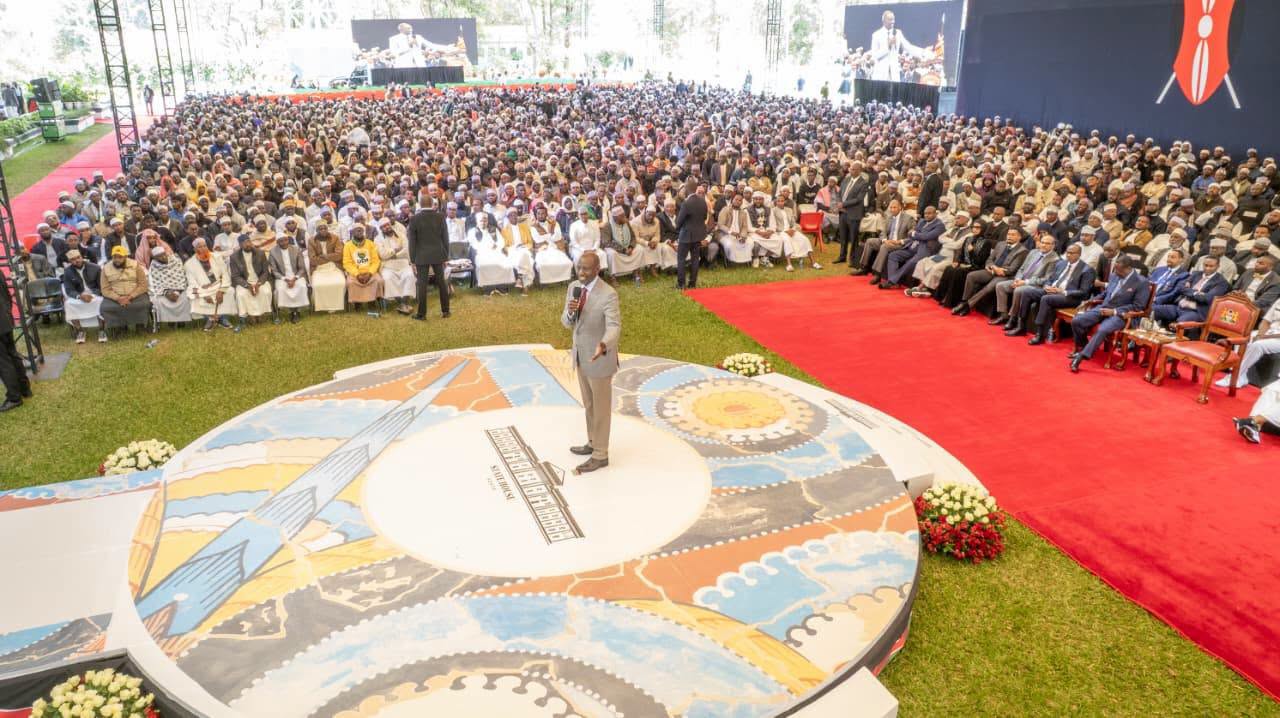
President William Ruto has said his administration is committed to building a government that reflects the face of Kenya and ensures no community is left behind in national development.
Speaking when he hosted more than 9,000 Muslim religious leaders from across the country at State House, Nairobi, President Ruto said inclusivity is not just a constitutional requirement but a moral duty.
“It is our duty and responsibility to ensure that the Government of Kenya reflects the face and diversity of our nation and leaves no one behind. No one is Kenyan by accident,” President Ruto told the gathering.
The President said Kenya remains one indivisible nation bound by one Constitution, and that every citizen, regardless of faith, ethnicity or place of birth, is entitled to equal dignity, equal rights and equal opportunity.
“We are one people, united by one Constitution, and every Kenyan is entitled to equal dignity, equal rights and equal opportunity,” he said.
President Ruto said his government has moved beyond rhetoric to implement concrete measures that demonstrate its commitment to inclusivity.
He singled out the abolition of discriminatory vetting in the issuance of national identity cards, a practice that had for years subjected Kenyans from Northern Kenya and other border counties to a degrading and lengthy vetting process before they could obtain IDs. The President said ending the practice has restored dignity and a sense of belonging to thousands of Kenyans.
The Head of State also cited the establishment of a Consulate-General in Jeddah, Saudi Arabia, to better serve Kenyans travelling to Makkah and Madinah for religious pilgrimages, as well as the operationalization of passport centres in Mombasa and Garissa to decentralize immigration services and reduce the burden on Nairobi.
On religious and educational reforms, the President noted that the government has commenced the process of establishing the Waqf Commission to ensure proper protection, regulation and management of Muslim charitable endowments, and has initiated the formal recognition of Madrasas and Duksis within the country’s education system.
“That commitment is reflected in action. We have ended discriminatory vetting in the issuance of national identity cards, established a Consulate-General in Jeddah to serve Kenyans travelling to Makkah and Madinah, operationalised passport centres in Mombasa and Garissa, commenced the establishment of the Waqf Commission to strengthen the protection and management of Muslim charitable endowments, and initiated the formal recognition of Madrasas and Duksis within our education system,” he said.
President Ruto added that his administration is deliberately correcting historical injustices through equitable sharing of national resources and development projects.
He pointed out that historically underserved regions, including Northern Kenya and the Coastal region, are now receiving unprecedented investment in roads, energy, water and economic empowerment programmes as part of the government’s agenda to ensure no region is left behind.
The President further revealed that the government has begun charting Kenya’s development journey beyond Vision 2030 through an inclusive, people-centred national conversation that will culminate in a National Development Charter, aimed at placing Kenya firmly on the path to becoming a first-world economy.
The meeting at State House brought together Imams, scholars and Muslim leaders from all 47 counties for prayers and dialogue on national unity and development.