
Government spokes person Charles Owino warns misinformation could become 2027 election ‘time bomb
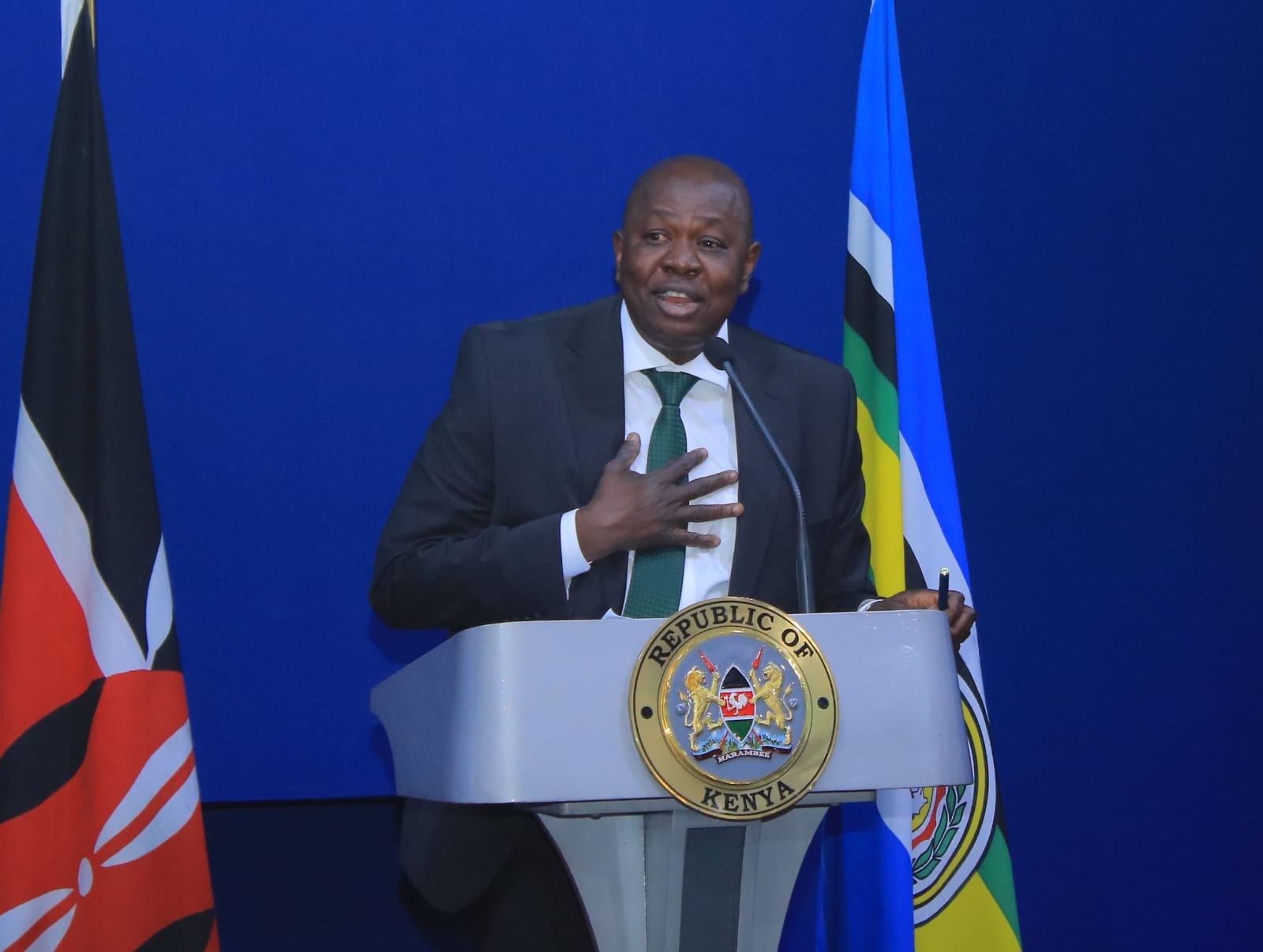
Government spokes person Charles Owino speaking during a press briefing in Nairobi. Photo/ Courtesy
Kenya risks entering the 2027 General Election with voters making critical political decisions on the strength of misinformation and disinformation, Government Spokesperson Charles Owino has warned.
Owino said the rapid growth of social media and increased access to smartphones, including in rural areas, had created an environment where false information could reach millions of Kenyans within minutes, making misinformation a threat to democracy, peace and national security.
Speaking during a press briefing in Nairobi on Wednesday, Owino described the situation as a “time bomb”, urging the government, media and the public to work together to ensure political and public discourse is anchored in facts.
“As a country, we are sitting on a time bomb following the rise of misinformation, disinformation and basically making decisions based on false information,” he said.
His warning comes as political activity begins intensifying ahead of the 2027 elections, with social media expected to play an increasingly central role in shaping public opinion, political campaigns and voter mobilisation.
Owino said the danger was not simply that Kenyans could encounter false information, but that they could make decisions based on it without questioning its source or accuracy.
“The greatest threat to our democracy, peace and security shall originate from people making decisions based on false information, misinformation, disinformation and fake news,” he said.
He challenged the media to take a more aggressive role in interrogating political claims, insisting that journalists should subject both government and opposition leaders to the same standard of scrutiny.
Owino said the fourth estate should not merely reproduce statements made by politicians, but should demand evidence and use facts and data to establish whether claims are accurate.
“Because this is a democracy, we must have government at every time. We must have opposition at every time. But you must ask us hard questions. We must corroborate all our sentiments with facts and with data,” he said.
His remarks come against the backdrop of several politically charged claims that have circulated rapidly on social media in recent months.
One example he cited was the controversy surrounding the Ol Kalou parliamentary by-election, where former Deputy President Rigathi Gachagua alleged that 68 women had been raped by police officers during unrest surrounding the July poll.
The allegation was not independently verified. The National Police Service subsequently said no rape incidents had been reported before, during or after the election, while the government called on anyone with information or evidence to report to the relevant authorities for investigation.
For Owino, the episode illustrated the need for journalists and citizens to distinguish between an allegation and an established fact, particularly when dealing with claims capable of provoking public anger or undermining confidence in institutions.
He said the responsibility extended beyond political actors to ordinary citizens, who must resist the temptation to share information simply because it supports their political position.
The Government Spokesperson also warned against what he described as the misuse of constitutional freedoms, noting that the 2010 Constitution guarantees freedom of expression but also provides limits to the exercise of rights.
“Rights have limits as provided for in the Constitution. So the right to speak, the right of speech might have limits,” he said.
Owino further raised concerns over the growing use of abusive language in political discourse, arguing that Kenyans should be able to disagree with political leaders without undermining institutions of state.
He particularly criticised attacks directed at President William Ruto, saying the presidency should be treated as a symbol of national unity even when citizens disagree with the person occupying the office.
“The presidency is a symbol of national unity. You may have a difference with individuals, but the presidency is a symbol of national unity,” he said.
The remarks add another dimension to the emerging political contest ahead of 2027, where disagreements over the Ruto administration’s record are increasingly being played out alongside calls from sections of the opposition for the President to leave office after one term.
Owino challenged uopposition leaders to go beyond telling Kenyans that “Ruto must go” and explain what they would do differently if given the opportunity to govern.
“The President must go. We know the President must go whether one term or two terms, he must go, because that is what our Constitution has provided. But what are you laying for these young people who are coming up? What are you going to do better?” he asked.
He similarly challenged Kenyans to interrogate claims that the government had achieved nothing by comparing its record against commitments contained in the President’s 2022 campaign manifesto.
Owino pointed to agriculture, affordable housing, healthcare, MSMEs and the digital economy as areas where the administration should be assessed using measurable outcomes rather than political rhetoric.
He cited the reduction of fertiliser prices, increased coffee prices and the digitisation of agricultural services as examples of government interventions that he said should be evaluated through facts and data.
The argument comes as Owino settles into the Government Spokesperson’s office at a particularly politically sensitive period. He took over the role from Isaac Mwaura earlier this month, with the transition coming as the country moves towards the 2027 General Election.
But beyond defending the administration, Owino’s message placed a broader responsibility on all actors in Kenya’s political ecosystem.
He said young Kenyans, particularly Generation Z, were increasingly engaged in political affairs and deserved accurate information as they decide the direction they want the country to take.
“They want to listen to us. They want to push our country to a certain level. But it must be factual. We cannot afford to spread rumours and say things that don’t add up,” he said.
With the election approaching, the contest may therefore be fought not only through rallies, manifestos and traditional media, but also through the information that reaches voters on their phones.
For Owino, how Kenyans verify that information before believing, sharing or acting on it could ultimately determine whether social media strengthens democratic participation—or becomes the “time bomb” he warned against.