
Ronaldo’s World Cup Journey Ends After Spain Defeat
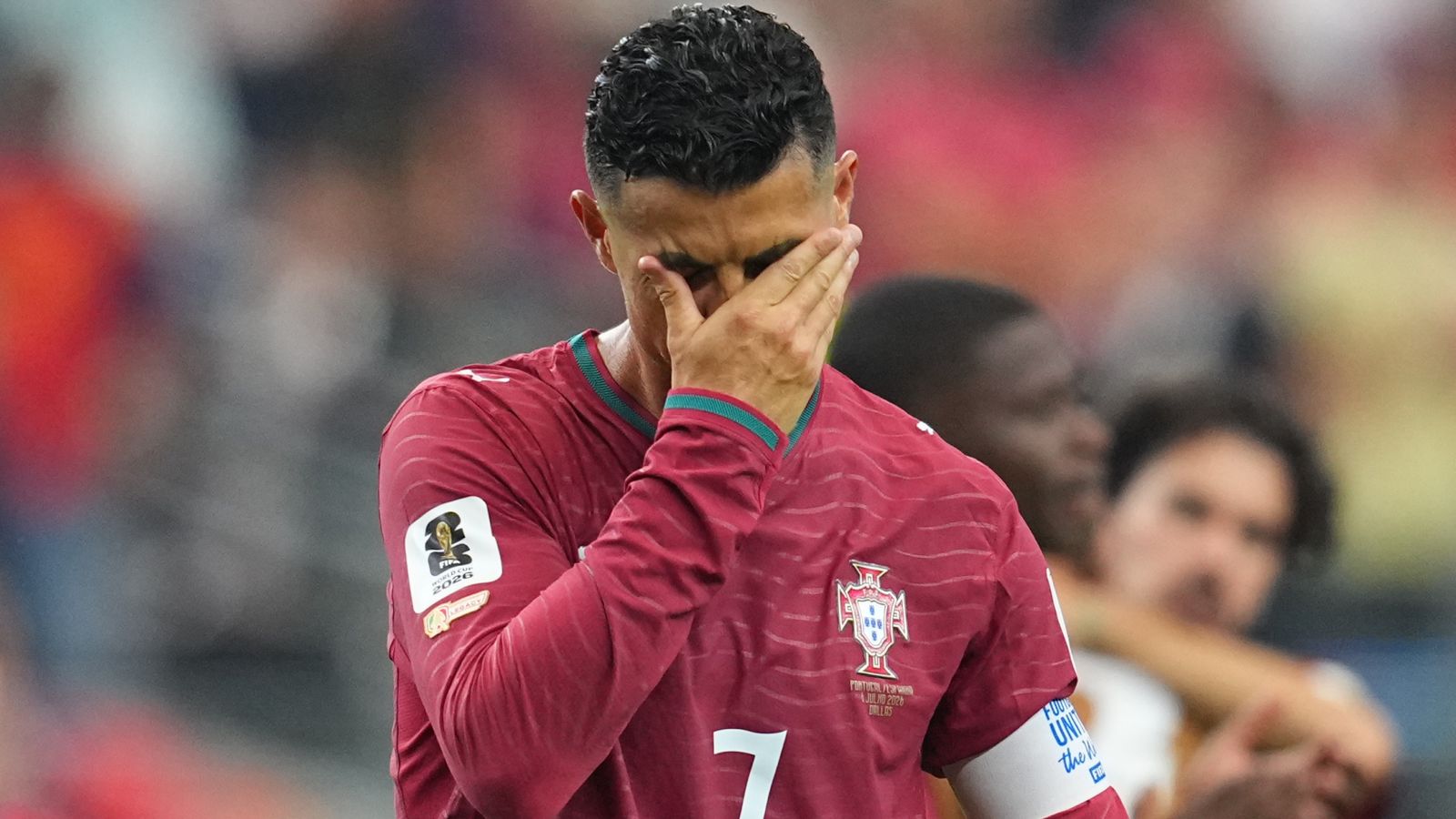
Cristiano Ronaldo walked off a FIFA World Cup stage for what is expected to be the final time on Monday, ending an international tournament career that spanned more than two decades after Portugal suffered a heartbreaking 1-0 defeat to Spain in the Round of 16.
The 41-year-old Portugal captain was overcome with emotion after Mikel Merino scored a stoppage-time winner to send Spain into the quarterfinals and eliminate one of football’s greatest players from the sport’s biggest competition.
As the final whistle sounded, Ronaldo struggled to contain his emotions, marking what many see as the symbolic end of an era for Portuguese football.
Although Ronaldo has not officially announced his retirement from international football, this tournament had already been billed as his sixth and final World Cup, extending a record unmatched by any other men’s player.
An Unmatched World Cup Legacy
Few players have shaped international football as profoundly as Ronaldo.
The five-time Ballon d’Or winner leaves the World Cup with 11 goals, becoming the only men’s player to score in six different World Cup tournaments, a milestone that reflects both extraordinary longevity and consistency.
Across a career that has taken him from Sporting Lisbon to Manchester United, Real Madrid, Juventus and Al Nassr, Ronaldo has collected virtually every major club honor, including five UEFA Champions League titles and multiple domestic league championships.
For Portugal, he remains the country’s all-time leading scorer and most-capped player, while also captaining the team to its first major international trophies at UEFA Euro 2016 and the 2019 UEFA Nations League.
Yet the FIFA World Cup remained the one title that eluded him.
Portugal’s best finish during Ronaldo’s career came in 2006, when the team reached the semifinals before losing to France.
Spain Exposed Portugal’s Limitations
Portugal entered the knockout stage boasting one of the tournament’s deepest squads.
Manager Roberto Martinez had midfield creativity through Bruno Fernandes, João Neves and Vitinha, while Bernardo Silva, Rafael Leão, Pedro Neto and João Cancelo provided attacking quality.
Defensively, Rúben Dias and Nuno Mendes offered stability against elite opposition.
However, against Spain, Portugal struggled to convert possession into meaningful chances.
The European champions controlled much of the contest before Merino struck in stoppage time to end Portuguese hopes.
While Ronaldo remained the focal point of Portugal’s attack, he found few opportunities against Spain’s disciplined defense.
Statistics from the tournament reflected his changing role.
Despite registering 17 shots across five matches, Ronaldo created only one chance for a teammate throughout the competition. He also failed to complete a single dribble during the tournament, illustrating how his game has evolved from the explosive winger who once terrorized defenders.
His standout performance came during Portugal’s 5-0 victory over Uzbekistan in the group stage, where he scored twice. However, he was unable to reproduce that form against stronger opposition in the knockout rounds.
A Changing of the Guard
Portugal’s elimination is expected to accelerate the team’s transition toward a younger generation.
Players such as Gonçalo Ramos, João Neves, Vitinha and Nuno Mendes are widely viewed as the core of Portugal’s future as the national team begins planning for UEFA Euro 2028 and the next World Cup cycle.
Ramos, who has emerged as one of Europe’s most promising strikers, is among those tipped to inherit the No. 9 role that Ronaldo made famous for Portugal.
Football analysts say Portugal possesses enough young talent to remain among Europe’s strongest national teams, even as it prepares for life after its greatest-ever player.
A Career Beyond Comparison
While the latest World Cup ends in disappointment, it is unlikely to diminish Ronaldo’s standing in football history.
He leaves the international stage as one of the most decorated players the game has produced, with records for international goals, appearances and World Cup longevity that may stand for years.
The absence of a World Cup winner’s medal will inevitably remain part of discussions surrounding his career, particularly alongside comparisons with Lionel Messi, who lifted the trophy with Argentina.
Still, few careers have matched Ronaldo’s influence on modern football.
His relentless pursuit of excellence, unmatched goal-scoring record and commitment to Portugal transformed the national team into a consistent contender on the world stage.
Whether Ronaldo formally announces his retirement from international football or chooses to continue for a limited period, Monday’s defeat to Spain felt like more than the end of a tournament.
It marked the closing chapter of one of the most remarkable World Cup careers the sport has ever witnessed.