

From Abroad to the Village: How Remittances Are Transforming Lives in Rural Kenya
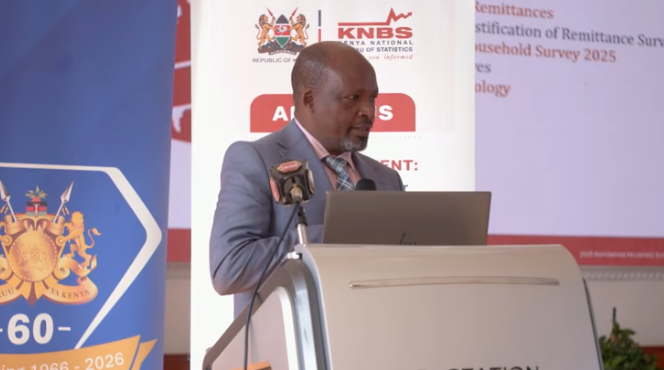
Professor Benjamin Muchiri, Kenya National Bureau of Statistics Director of microeconomic Statistics speaking during the launch of the 2025 Remittances Household Survey on June 16, 2026 in Nairobi
Money sent home by Kenyans living abroad is increasingly becoming a vital source of support for families, helping pay for education, healthcare, food and investments while contributing significantly to the country’s economy.
This emerged during the launch of the 2025 Remittances Household Survey, which brought together stakeholders from The Central Bank of Kenya, Kenya Bureau of Statistics and FSD Kenya highlighted the growing role of diaspora remittances in improving household welfare and supporting economic resilience across the country.
The survey, conducted by the Kenya National Bureau of Statistics (KNBS) provides fresh insights into how remittances are received, utilized and the challenges faced by both senders and recipients.
According to KNBS Director of Macroeconomic Statistics Prof. Benjamin Muchiri, the findings will play a crucial role in guiding government policies aimed at maximizing the impact of remittances on national development.
“The main benefit from the survey is to provide information that can help the government and other stakeholders come up with policies that guide issues of remittances,” he said.
The survey found that remittances are filling critical gaps in household welfare, with many recipients using the funds to pay school fees, access healthcare services and invest in income-generating activities.
“We’ve also found that remittances fill a big gap because some of the respondents actually say that they use remittances for investment, things like school, health and many other important aspects of human welfare,” Prof. Muchiri noted.
The findings come at a time when diaspora remittances have become one of Kenya’s leading sources of foreign exchange, underscoring the importance of millions of Kenyans living and working abroad. Beyond supporting individual households, remittances are increasingly viewed as a potential driver of entrepreneurship and rural economic transformation.
However, stakeholders at the launch noted that a significant portion of remittances continues to be spent on immediate household consumption, particularly food purchases. This has sparked discussions on how more of these funds can be channelled into productive investments such as agriculture.
Prof. Muchiri observed that while many households use remittances to meet basic needs, there is growing interest in exploring ways of investing the funds in sustainable agricultural production to strengthen food security and generate long-term income.
Another key concern highlighted by the survey is the cost of sending money home. According to Prof. Muchiri, many of the charges associated with remittances originate in the countries where the money is sent from, reducing the amount ultimately received by families in Kenya.
“There is a need for the government to have bilateral engagements with source countries so that the cost of remittances can come down,” he said.
Reducing transfer costs, experts argue, could encourage more diaspora Kenyans to send money home while increasing the value of funds received by households.
The survey also revealed disparities between men and women in both the sending and receiving of remittances, highlighting areas that may require targeted policy interventions in future.
As Kenya seeks to leverage remittances for rural resilience, entrepreneurship and employment, policymakers hope the findings will provide a roadmap for transforming diaspora contributions from a household safety net into a catalyst for sustainable development.
For many families across rural Kenya, the impact is already evident. Every remittance received represents school fees paid, a hospital bill settled, a farm improved or a small business sustained. Behind the billions of shillings flowing into the country each year are stories of families whose lives continue to be shaped by the support of loved ones living thousands of kilometres away.