

Ride-Hailing Services Ranked Safest Mode of Transport by Kenyans,New Safety Index

From Left to Right, Stephanie Kanyiri, Associate Consultant (Ipsos), Sandra Buyole, Regional PR Manager, Africa, (Bolt), Arthur Gacharia, Senior Operations Manager, (Bolt), Marion Wambua, Senior PR Manager (Bolt) and Soyinka Witness, Strategy Director Sub-Saharan Africa, (Ipsos) during the Safety Index Report press briefing held at Sarova Panafric Hotel in Nairobi
Nairobi, Kenya, November 10, 2025 — A new Safety Index by Ipsos, commissioned by leading ride-hailing company Bolt, has revealed that 94% of Kenyan users now view ride-hailing services as safer than traditional public transport modes such as matatus and regular taxis.
The report highlights a growing public trust in technology-enabled transport solutions, with ride-hailing emerging as the preferred choice for safety, reliability, and convenience.
The study surveyed 250 active ride-hailing users across Nairobi, Mombasa, Kisumu, and Nakuru, revealing that the shift toward app-based transport is largely driven by advanced safety features and real-time digital monitoring. Many passengers said they feel more in control of their journeys, thanks to innovations such as GPS tracking, verified drivers, and in-app emergency response options.
The report also highlights significant demographic trends: women make up 70% of Kenya’s ride-hailing users, with most between 18 and 34 years old. For this group, convenience (70%) and safety (57%) are the primary reasons for choosing ride-hailing platforms.The services are associated with comfort, reliability, and peace of mind attributes that have cemented their position as a modern and trusted mode of transport
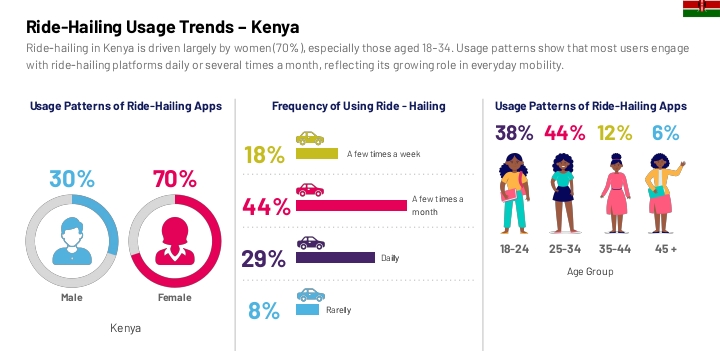
Ride-hailing is also influencing responsible mobility. About 79% of respondents believe such services have reduced drunk driving by providing safe alternatives, particularly during late-night travel. Additionally, 64% of users have booked rides for family or friends to ensure their safety demonstrating the growing social role of these services in promoting responsible travel habits.
“Safety has always been at the heart of our mission,” said Dimmy Kanyankole, Senior General Manager at Bolt. “We invest heavily in systems that prevent incidents through technology, data, and accountability. Features like real-time tracking and verified driver profiles ensure riders feel safe and in control.”

According to Soyinka Witness, Strategy Director at Ipsos Sub-Saharan Africa, the findings represent “a major behavioral shift in urban mobility,” with ride-hailing now seen as “not just a convenient option but a safer and more responsible one especially among young women and professionals.”
Nearly 97% of riders said in-app safety tools significantly enhance their confidence, with driver verification (79%) and the SOS button (78%) ranking as the most valued. Moreover, 94% reported feeling safer using ride-hailing apps at night, attributing this to real-time location sharing and flexible drop-off options.
As Kenya accelerates its digital transformation in transport, the study underscores the growing role of ride-hailing platforms in driving safer, smarter, and more responsible urban mobility.