
Government Steps Up Mt. Elgon Restoration Drive, Targets 125,000 Seedlings for Bungoma Farmers
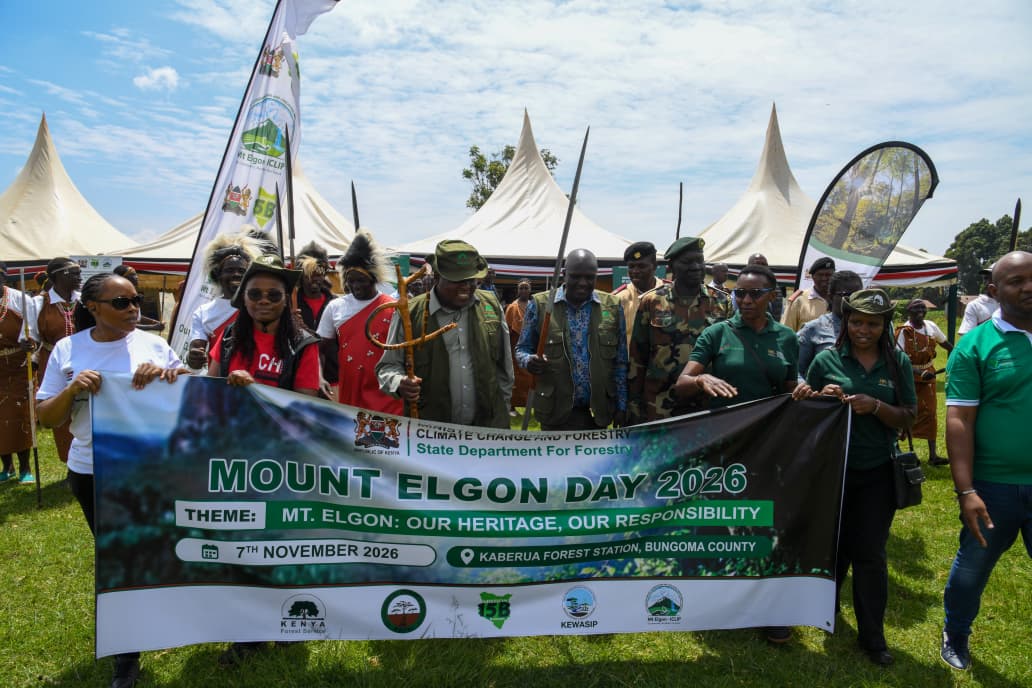
Participants, led by Secretary for Administration in the State Department for Forestry, Patrick Meso (centre), display the Mt. Elgon Day 2026 banner during the commemoration at Kaberua Forest Station in Bungoma County on November 7, 2026.
The government has reaffirmed its commitment to restoring the Mt. Elgon ecosystem, strengthening community livelihoods and promoting sustainable forest management as Kenya marked the second Mt. Elgon Day on November 7, 2026.
During the commemoration held at Kaberua Forest Station in Bungoma County, the government outlined a series of conservation and livelihood interventions aimed at protecting the mountain’s biodiversity, restoring degraded landscapes and improving the economic wellbeing of communities living around the forest.
The Cabinet Secretary for Environment, Climate Change and Forestry, in a speech read on her behalf by Secretary for Administration in the State Department for Forestry, Patrick Meso, said Mt. Elgon remained one of the country’s most important ecological assets and a critical source of water for millions of people.
Speaking under the theme “Mt. Elgon: Our Heritage, Our Responsibility,” the Cabinet Secretary said the mountain’s conservation required collective responsibility from government agencies, local communities and other stakeholders.
“Mt. Elgon is one of Kenya’s five water towers. Its rivers, among them the Nzoia, Malakisi, Kuywa and Suam, drain its extensive watersheds, providing water to millions for domestic use, irrigation and hydropower,” she said.
She noted that the mountain was also home to unique biodiversity, including elephants known for mining salt deep inside caves, the Elgon teak and the Elgon Francolin.
The Cabinet Secretary further highlighted Mt. Elgon’s cultural and historical significance, noting that archaeological discoveries in its caves had revealed evidence of human habitation dating back more than 3,000 years.
She recognised the Ogiek community of Chepkitale and residents of Bungoma and Trans Nzoia counties for preserving indigenous knowledge and traditional practices that promote coexistence with the mountain’s ecosystem.
Mt. Elgon was designated a UNESCO Biosphere Reserve in 2003 and later became a Transboundary Biosphere Reserve shared between Kenya and Uganda in 2023.
The Cabinet Secretary said the mountain’s environmental importance extended beyond its immediate surroundings, explaining that its rivers supported communities and ecosystems across several counties before flowing into Lake Victoria.
“What happens on these slopes decides whether farmers downstream face silt, floods and polluted water, or enjoy clean rivers, healthy wetlands and fish in the lake,” she said.
The commemoration also provided an opportunity to assess progress made since the inaugural Mt. Elgon Day, which established the Mt. Elgon Integrated Conservation and Livelihood Improvement Programme (Mt. Elgon ICLIP) as a coordinating platform for conservation and community development.
The programme is anchored on four pillars: Mazingira Dhabiti, which focuses on environmental resilience through community-led restoration, nurseries and agroforestry; Ustawi kwa Wote, which promotes climate-smart agriculture, beekeeping and green enterprises; Masomo na Maarifa, which emphasises environmental education and knowledge; and Utamaduni Kiasili, which seeks to protect indigenous knowledge and cultural heritage.
The Cabinet Secretary said President William Ruto officially launched the programme’s 10-year strategy during the National Mazingira Day celebrations at Endebess in Trans Nzoia County last month.
She explained that the programme was supported by the FAO-GEF-7 Integrated Landscape Management Project under the Food Systems, Land Use and Restoration programme.
The project targets integrated landscape management plans covering 178,880 hectares, improved farming and land management practices across 50,000 hectares, and restoration of 10,000 hectares of degraded forests and farmland.
It also seeks to benefit 60,000 people directly, with women accounting for half of the beneficiaries, while supporting 40 enterprises led by women, young people and local communities to develop nature-based businesses.
On progress, the Cabinet Secretary revealed that the government had completed household baseline surveys, vulnerability profiles and capacity assessments in the two counties.
She added that environmental teams had mapped 15 degraded sites in Cheptais, Kaberua, Saboti, Sosio and Kaboywo, with Banantega in Cheptais identified as requiring urgent intervention.
The government has also mapped tree nurseries in Kaberua, Saboti, Sosio, Kaboywo and Kongit, which collectively hold more than one million seedlings.
Additionally, a new nursery established through a partnership between the Kenya Forest Service (KFS) and British American Tobacco (BAT) at Kamuneru is targeting a production capacity of 600,000 seedlings.
On the national tree-growing agenda, the Cabinet Secretary said the government was implementing the 15 Billion Tree Growing Initiative, which targets the restoration of 10.6 million hectares of degraded landscapes and achieving at least 30 per cent national tree cover by 2032.
Bungoma County has planted 20,624,618 trees since 2022, but still faces a significant gap in meeting its allocated target.
According to the speech, the county is expected to grow 193,763,802 trees over the next 10 years, leaving a deficit of 173,139,184 trees to be planted within the remaining six years.
The Cabinet Secretary challenged residents, institutions and other stakeholders to intensify tree-growing activities to help close the gap.
“This ambitious target is achievable if we come together and devote ourselves to massive tree growing here in Bungoma County,” she said.
She also disclosed that the Ministry had received a request to implement the Tree Establishment Livelihood Improvement Scheme in Mt. Elgon Forest.
The government is considering the request and will develop technical guidelines before undertaking further public participation, reaffirming its commitment to sustainable restoration of the forest.
On immediate interventions, the Ministry announced plans to distribute more than 75,000 avocado seedlings and 50,000 cocoa seedlings to farmers in Bungoma County once adequate soil moisture has accumulated.
The Cabinet Secretary explained that mass tree planting would begin when the rains were firmly established, noting that the ceremonial planting conducted during the commemoration was only an initial symbolic activity.
“The rains have not yet built enough moisture for mass planting, so today we plant ceremonially, led by the Ministry. The real work of planting will follow when the rains are firmly established, and I ask every school, CFA and farmer to be ready,” she said.
She emphasised that conservation efforts must go hand in hand with economic empowerment, particularly for communities whose livelihoods depend on the surrounding landscape.
The Cabinet Secretary urged Community Forest Associations to expand tree nurseries, protect natural regeneration and report illegal logging and forest fires.
She further encouraged women and young people to take advantage of opportunities created through the programme, particularly in agroforestry, value addition and nature-based enterprises.
Addressing county governments, she called on Bungoma and Trans Nzoia leadership to incorporate Mt. Elgon restoration priorities into their County Integrated Development Plans and budgets to ensure continuity beyond individual projects and administrations.
She also appealed to development partners and the private sector to increase investments in tree nurseries, agricultural value chains and community-based enterprises.
The FAO-GEF project is expected to run until mid-2027, while the broader Mt. Elgon Integrated Conservation and Livelihood Improvement Programme has a longer-term outlook extending to 2036.
The Cabinet Secretary said protecting Mt. Elgon required collaboration beyond the two counties, given that its water systems support communities across Nandi, Kakamega, Vihiga, Busia, Siaya and Kisumu before reaching Lake Victoria.
She urged stakeholders to preserve the mountain’s natural resources and indigenous heritage for future generations.
“The mountain gave us its water, its soils and its stories long before any of us was born. What we owe in return is simple: to leave it greener than we found it,” she said.
She concluded by calling on Kenyans to embrace collective responsibility in restoring the ecosystem, saying the success of conservation efforts would depend on the willingness of communities, government institutions and development partners to work together.
“Let us restore Mt. Elgon. Let us restore it together, for the farmer, for the Ogiek elder, for the child in the classroom, and for the generations who will drink from its rivers, from the slopes of Mt. Elgon to the shores of Lake Victoria,” she said.
The second Mt. Elgon Day commemoration reinforced the government’s position that protecting the mountain is not only an environmental obligation but also an investment in water security, food production, biodiversity conservation and sustainable livelihoods.