
Rachel Wandeto’s Death Sparks Debate Over “Selective Outrage” on Violence Against Women.
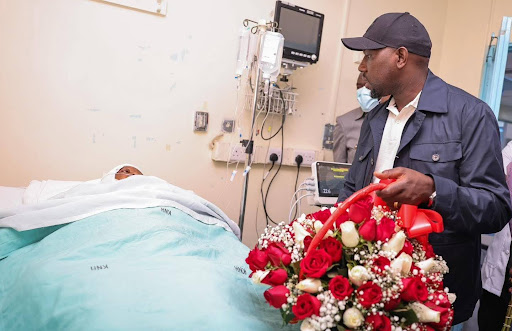
Kipchumba Murkomen, Cabinet Secretary, while visiting Rachel Wandetto at KNH following the violent attack against her.
The tragic death of Rachel Wandeto following a reported petrol attack in Kasarani, Nairobi, has ignited a heated national conversation online, with many Kenyans questioning what they describe as “selective outrage” in responses to violence against women.
Across social media platforms, users have been debating why some cases of violence attract widespread public campaigns and solidarity while others appear to receive muted reactions.
Many commentators argued that violence against women should never depend on political beliefs, ideological alignment, tribe, or social standing.
“If this was political intolerance, then silence is not neutrality, it is complicity,” reads a post by a user on x(formerly Twitter). The user goes further to ask where are the voices that are usually loud when women are attacked, including activists, civil society groups and human rights defenders.
Another user on the platform noted that the case of Rachel Wandeto is a reminder that violence and intolerance endangers every member of the society.
The online debate extended into concerns over growing political intolerance, with some users questioning whether support for particular political positions was increasingly being used to justify hostility, harassment, or violence.
A common theme emerging from the discussions is that justice cannot be selective and that all forms of violence should be condemned equally and without hesitation.
In a statement, the Kenya Women Parliamentary Association (KEWOPA) joined the family, friends, and the nation in mourning Wandeto’s death, describing the incident as “tragic and deeply painful.”
KEWOPA condemned the attack, stating that it constituted a grave violation of the rights and freedoms guaranteed under the Constitution of Kenya, including the right to life, equality, human dignity, and security of the person.
The association further urged leaders and citizens alike to reject narratives that normalise or justify violence against fellow Kenyans.
“We further urge all actors in public life to exercise restraint and responsibility, and to reject any narratives that normalise or justify violence against citizens,” the statement said.
KEWOPA also expressed concern over what it termed an emerging pattern of targeted violence and growing intolerance in public life, warning that such incidents threaten democratic participation and weaken public trust in state protection mechanisms.
As investigations continue, many Kenyans online say the conversation surrounding Wandeto’s death has evolved beyond a single incident into a broader national reflection on consistency, empathy, and the collective responsibility to condemn violence in all its forms.