
Absa, GIZ Launch Kenya’s Largest Circular Economy Programme to Create 6,000 Jobs
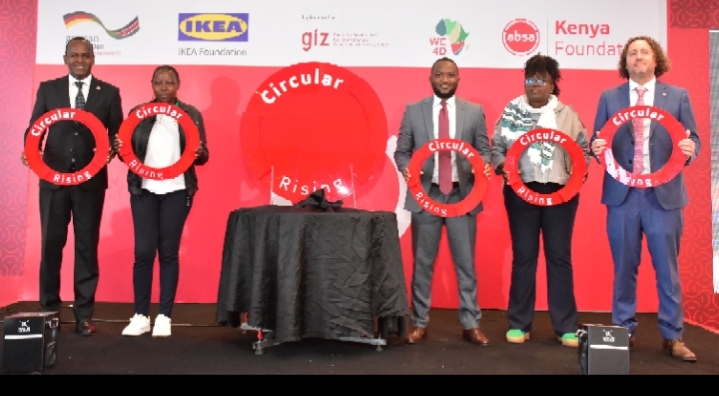
From left: Abdi Mohamed, Pauline Wangui, Charles Wokabi, Nyandia Kamawe and Thomas Jaeschke during the launch of the CirculaRising Programme in Nairobi on April 30, 2026.
A new programme targeting job creation, waste reduction, and support for small businesses has been launched in Nairobi, with partners projecting over 6,000 new and improved jobs by 2028.
The CirculaRising Programme, a joint initiative by Absa Bank Kenya PLC through the Absa Kenya Foundation and Deutsche Gesellschaft für Internationale Zusammenarbeit (GIZ) GmbH, aims to empower more than 2,000 micro, small and medium enterprises (MSMEs), particularly those led by women and youth.
The programme, described as Kenya’s first and largest circular economy initiative of its kind, will also focus on recycling over 6,000 tonnes of waste and indirectly improving livelihoods for more than 30,000 people.
Speaking during the launch, Abdi Mohamed said the initiative is designed to address growing concerns around sustainability and economic inequality.
“For decades, economic growth has followed a linear model of take, make, use and dispose. While it has driven progress, it has also created waste and strained natural resources. The future belongs to economies that create value differently, where waste becomes a resource and sustainability drives enterprise,” he said.
The CirculaRising Programme is co-funded by the German government and the IKEA Foundation, and will be implemented in phases targeting businesses at different levels of growth.
Under the first phase, the CirculaRising Academy will support over 2,000 microenterprises through training, coaching, access to markets, and financing opportunities. The Academy is fully funded by Absa Kenya Foundation and will run for 27 months.
The second phase, the CirculaRising Accelerator, will focus on 150 small enterprises across regions including Nairobi, Central, Western, Nyanza, and the Coast. This component will provide capacity building, market linkages, and financial access.
In the third phase, the Scale-Up programme will target between 25 and 30 medium and large enterprises that generate significant waste volumes and seek to expand into export markets. These businesses will receive specialised support to integrate circular practices and meet global sustainability standards.
According to Thomas Jaeschke, the initiative combines environmental sustainability with economic empowerment.
“With CirculaRising, we are strengthening women’s participation in green value chains while supporting businesses to adopt circular models. This will lead to increased employment, better incomes, and improved waste management practices,” he said.
Government officials welcomed the programme, noting its alignment with national development priorities.
Remarks from Susan Mang’eni, delivered on her behalf, highlighted the central role of MSMEs in Kenya’s economy.
“MSMEs are the backbone of our economy. Initiatives like CirculaRising are critical in unlocking their potential by improving access to finance and enabling them to transition into sustainable and competitive enterprises,” she said.
She added that the government remains committed to creating an enabling environment through supportive policies and partnerships that promote inclusive growth and job creation.
Also present at the event was Dr. Selly Kimosop, representing the State Department for Environment and Climate Change. She underscored the importance of circular economy practices in addressing environmental challenges.
“The transition to a circular economy offers significant opportunities for Kenya, especially for MSMEs. Programmes like CirculaRising will help reduce waste and support climate action at scale,” she said.
The African Guarantee Fund (AGF), a key partner in the initiative, emphasised the need to address financing gaps affecting women-led enterprises.
Patrick Lumumba noted that despite women owning a significant share of MSMEs in Kenya, access to finance remains limited.
“Women-led businesses contribute greatly to the economy but continue to face barriers in accessing financial services. Through this partnership, we aim to bridge that gap and strengthen their role in driving inclusive growth,” he said.
The programme will leverage existing initiatives such as the Affirmative Finance Action for Women in Africa (AFAWA) to expand financing opportunities and support women entrepreneurs in green sectors.
By 2028, CirculaRising aims to mobilise over €2 million in financing while delivering measurable environmental impact through waste reduction, reuse, repair, and recycling.
The initiative aligns with the core pillars of Absa Kenya Foundation, which include entrepreneurship, education and skills development, natural resource management, and health and humanitarian support.
Partners say the programme reflects a growing shift toward sustainable business practices in Kenya, where economic growth is increasingly being linked to environmental conservation and social inclusion.
The launch event brought together key stakeholders from the public and private sectors, development organisations, and entrepreneurs, signalling strong support for the transition to a circular economy in the country.
As Kenya continues to face challenges related to waste management, unemployment, and climate change, initiatives like CirculaRising are expected to play a critical role in shaping a more sustainable and inclusive economic future.