
ISK Raises Concern Over Exclusion of Land Experts in NLC Appointments
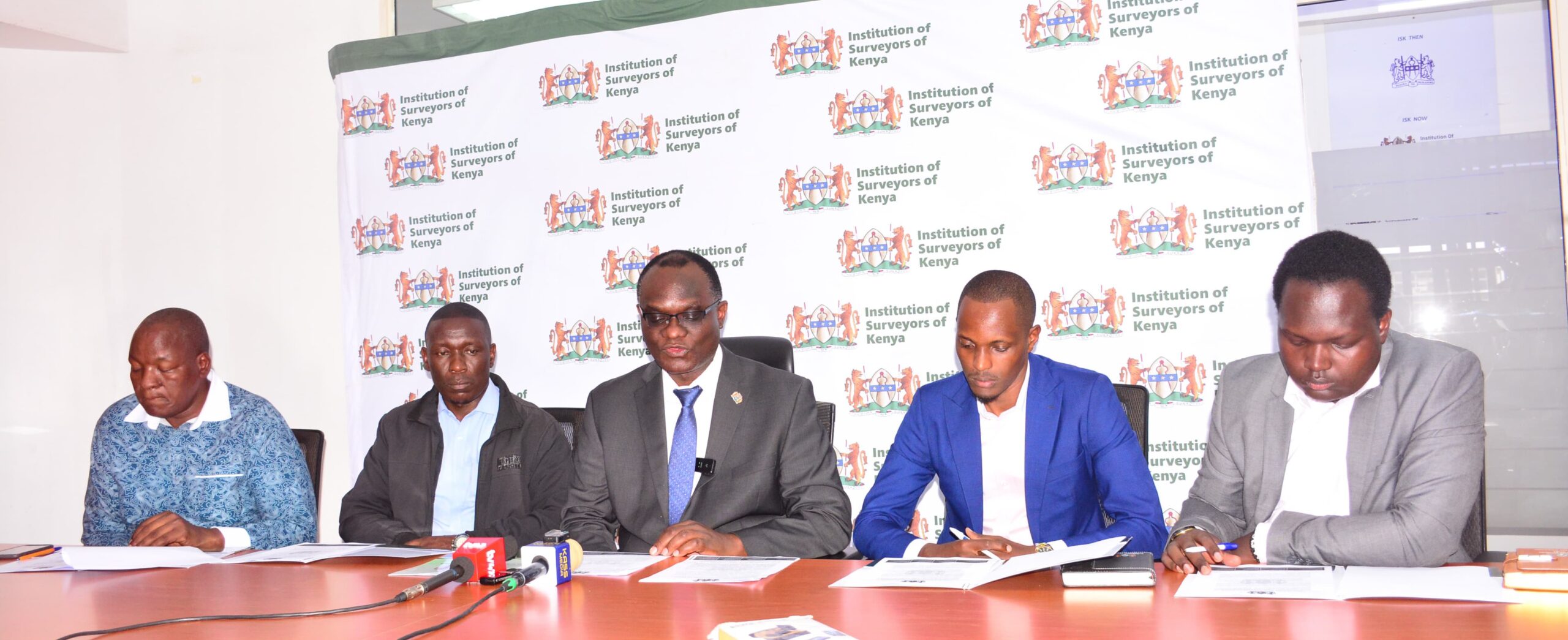
ISK President Eric Nyadimo ( centre), ISK CEO Peter Biwot ( left), Secretary Estate Agency Chapter, Moses Wanjohi (2nd right) together with Council Members speaking during a press briefing held at ISK office on Wednesday at Nairobi.
The Institution of Surveyors of Kenya (ISK) has raised concerns over what it terms as the exclusion of key land professionals in the recent nominations to the National Land Commission (NLC).
Speaking during a press briefing, ISK President Eric Nyadimo expressed disappointment with the Executive’s communication under Presidential Action No. 5 of 2026, dated February 17, which announced the nomination of a chairperson and six commissioners to the land body.
Nyadimo noted that ISK was among institutions that strongly advocated for the inclusion of land and environmental governance provisions in the Constitution, arguing that the NLC was created to professionalize land administration, address historical injustices, and enhance accountability in land management.
He said the establishment of the commission followed years of reform efforts informed by past inquiries into land law systems, illegal and irregular allocation of public land, and post-2007 reconciliation processes, all of which underscored the need for technical expertise in land governance.

While acknowledging the constitutional mandate guiding the appointments, ISK questioned the apparent omission of professionals in fields such as land surveying, land law, spatial planning, and land economics disciplines explicitly recognized in the National Land Commission Act as critical qualifications for commissioners.
According to the institute, the law requires appointees to possess relevant academic credentials and substantial experience at least 15 years for the chairperson and 10 years for members in matters related to land management and administration.
ISK argued that the commission’s core functions including managing public land, advising on land registration, investigating historical injustices, overseeing land-use planning, and developing land information systems are highly technical and demand specialized professional knowledge.
“The commission’s work is not theoretical; it requires expertise in surveying, valuation, physical planning, environmental management, and land administration,” Nyadimo said, warning that the absence of such competencies could weaken the institution’s effectiveness.
The institute further cautioned that excluding land professionals could undermine technical capacity, disrupt multidisciplinary balance within the commission, and affect the execution of statutory functions such as reviewing public land grants and advising national and county governments.
Describing land governance as one of the most sensitive areas of public administration, ISK emphasized that decisions made by the NLC have far-reaching implications for property rights, infrastructure development, historical justice, and public trust.
The body maintained that professionalism was the central rationale behind establishing the commission and compared the need for technical representation to other constitutional commissions that rely on domain-specific expertise.
ISK reaffirmed its commitment to upholding professional standards, supporting transparent and merit-based public appointments, and collaborating with government agencies to strengthen land governance.
The institution has now urged the President to reconsider the appointments to ensure the commission reflects the multidisciplinary expertise envisioned in law, stressing that effective land management must be guided by legality, technical competence, and the public interest.