Uraia Trust Calls for Issue-Based Politics Ahead of 2027 General Elections
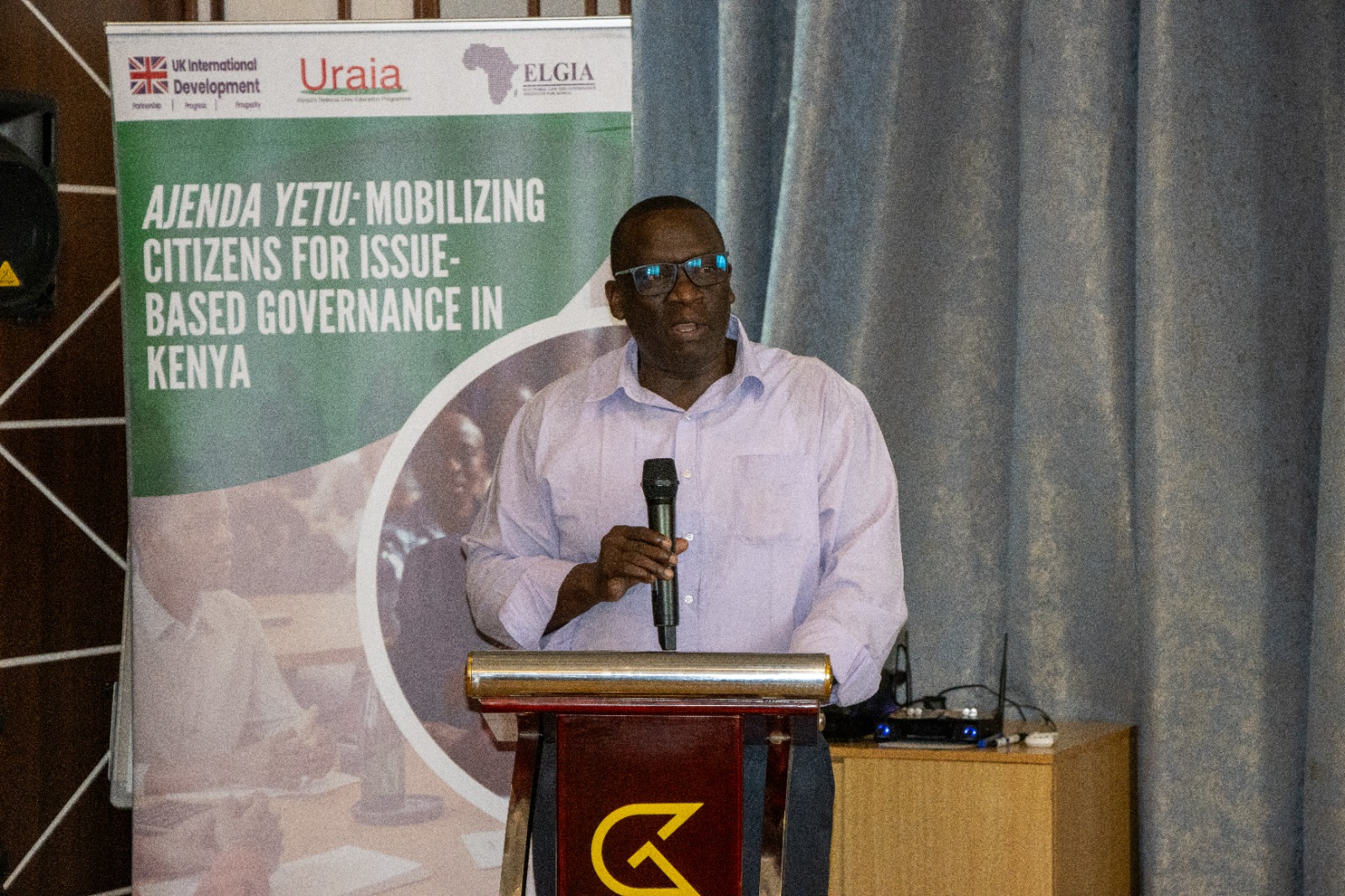
Uraia Trust Executive Director Oliver Waindi speaks during the launch of The People’s Agenda in Nairobi on Friday, challenging political leaders to shift from divisive politics to addressing the real needs of Kenyans ahead of the 2027 General Election.
Uraia Trust and its partners have urged Kenyans to prioritise issue-based politics, accountability and citizen participation ahead of the August 2027 General Election, warning against ethnic mobilisation, political distractions and personality-driven campaigns that overshadow the needs of ordinary citizens.
The call was made on Friday during the launch of The People’s Agenda: A Synthesis of Citizen Priorities in Elections and Responsive Governance in Kenya, a report consolidating citizen priorities from 10 counties to guide political leaders and strengthen responsive governance.
Speaking during the launch, Uraia Trust Executive Director Oliver Waindi said the initiative was aimed at putting citizens’ needs at the centre of the country’s political discourse, amid growing political exchanges that risk diverting attention from the issues affecting millions of Kenyans.
“Today, we are launching what we call Agenda Yetu. This is a project that we want to bring to the fore, the agenda of the wananchi to be superior to any other agenda in the country,” Waindi said.
He expressed concern that the prevailing political environment was characterised by competing narratives and exchanges between political factions, leaving little room for discussions on the priorities of ordinary citizens.
“Currently, we are experiencing a great deal of confusion, concoction of ideas and a lot of salvos being thrown from both sides of the political divide. And in that confusion, therefore, the real agenda of the 55 million Kenyans then disappears,” he said.
Waindi said the report was informed by engagements with citizens over the past 12 to 13 months, providing a clearer picture of the issues communities want addressed by their leaders.
He maintained that the concerns raised through the consultations should take precedence over political rhetoric, noting that citizens’ aspirations and needs were more important than the divisions dominating the political landscape.
“Their desire, their agenda, their needs, their aspirations are much superior according to the Constitution than the noise that we are getting around. And we don’t want that to get lost in the midst of the current discussion and the discourse that’s going on in the country,” Waindi said.
The report brings together citizen manifestos from Nairobi, Murang’a, Tharaka-Nithi, Mombasa, Baringo, Kisumu, Nakuru, Kisii, Isiolo and Siaya, alongside women’s and youth manifestos developed by other stakeholders.
According to Waindi, citizens are primarily concerned about practical issues affecting their livelihoods, including employment, access to water, food security, healthcare, education and opportunities to participate in decision-making.
“As we’ve seen from the data, their needs are not what we are hearing in the media from the political divide. They want jobs, they want water, they want food, they want opportunities, they want to feel part and parcel of the decision-making in this country. They want to get a good health system, they want to get a good basic, mid and high level education in this country,” he said.
He criticised what he termed political balkanisation and personality-driven politics, saying the focus should instead be on leaders capable of addressing the country’s development challenges and offering tangible solutions.
Waindi said the 2027 election presented an opportunity for Kenyans to demand accountability and evaluate candidates based on their ability to respond to citizens’ needs rather than political affiliations.
“The real numbers are the people who are willing to actually dig deeper into the needs of these people and to offer solutions to them as well,” he said, urging politicians to move away from political contests centred on numbers, alliances and personalities.
He further called on political leaders to ensure their campaigns address the needs of young people, women and the wider population, warning that the country risked missing an opportunity to strengthen democracy if public concerns continued to be sidelined.
“We want any time the politicians come to the fore, they are able to articulate the needs of these young people, the needs of the women, the needs of the entire population of this country so that next year’s election can be an election that is going to be consequential in terms of helping people have a better understanding of the reality of the constitutional aspirations,” Waindi said.
The report identifies public debt, corruption and youth unemployment as leading national concerns, alongside electoral integrity, accountable political parties, fair revenue sharing, secure land tenure, functional social health insurance and equitable bursary allocation.
It cites Kenya’s public debt at KSh13.47 trillion as of August 2026, equivalent to 72.3 per cent of Gross Domestic Product (GDP), raising concerns over public spending priorities and the need for stronger oversight of government borrowing.
Waindi said the report was motivated by a disconnect between citizens and their leaders, arguing that those in positions of authority often prioritise issues that do not reflect the concerns of the public.
“What pushed us to really go deep into getting this agenda up and to make it public is because we feel there is a big disconnect between the citizens and those in leadership. What they consider to be important is not, as you’ve seen from the research that we just had, what the citizens consider to be important,” he said.
He cited proposed expenditure priorities as an example of the disconnect, questioning the allocation of resources against the funding required for essential public oversight and services.
“We are now seeing, for example, the proposal of the State House needing an extra 23 billion shillings for repairs, while on the other hand, we have got IPOA just needing 170 million shillings to have proper oversight of the police force,” Waindi said.
He also pointed to gaps in education financing and healthcare support, arguing that leaders should pay greater attention to institutions and programmes that directly affect the welfare of citizens.
County priorities highlighted in the report include healthcare, water, education, jobs and public participation, with residents raising specific concerns ranging from irrigation and land ownership to housing, sanitation, environmental protection and insecurity.
In Nairobi, residents prioritised informal settlements, drainage, public safety and gang prevention, while Mombasa residents raised sanitation, housing and Blue Economy concerns. In Kisumu, attention focused on pending bills, own-source revenue and stalled projects, while Murang’a residents highlighted agricultural livelihoods, river pollution and high water tariffs.
The report also highlights challenges facing women and young people, including unemployment, drug abuse, exclusion from procurement opportunities, sexual and gender-based violence, sexual extortion and barriers to political nominations.
It estimates that 20.2 per cent of young Kenyans are not in employment, education or training, with young women disproportionately affected at 26.1 per cent compared to 14.3 per cent among young men.
Waindi further raised concerns over insecurity and political violence, accusing political actors of contributing to insecurity through their association with violent groups.
“We want them to address the insecurity that is really rampant around, which we think they’ve really caused in terms of arming goons everywhere and working with them everywhere to terrorise people,” he said.
He warned against a situation where citizens feel excluded from their own country, insisting that the Constitution places sovereignty in the hands of the people.
“We don’t want a situation where our citizens feel almost like second-rate citizens in their own country. We want them to be in the fore. After all, Article 1 of our Constitution talks exactly about that,” he said.
The report further raises concerns over inadequate funding for civic and voter education, noting that the Independent Electoral and Boundaries Commission (IEBC) requested KSh6.5 billion for voter education ahead of the 2027 elections but was allocated KSh1.9 billion.
It warns that inadequate funding could undermine voter registration, increase rejected ballots, fuel misinformation and heighten electoral tensions.
Uraia Trust and its partners are urging the National Treasury and Parliament to protect voter education funding, electoral agencies to enforce campaign regulations, county governments to strengthen civic education, and political parties to develop measurable commitments based on citizens’ priorities.
Waindi said placing citizens at the centre of political decision-making would help bridge the gap between leadership and the electorate, reduce tensions and promote a more accountable political environment.
“We want their needs to be the needs of the country, not the needs of the politicians and what they think we need. Let them listen to the agenda of the people from the ground. That is when there will be less friction, there will be less tension in the country,” he said.
He maintained that the upcoming election should provide an opportunity for Kenyans to demand leadership that reflects their aspirations and delivers on constitutional promises.