
Kenya Moves to Establish Regional Biopharmaceutical Hub as APIFA Biopharma Park Feasibility Study Begins
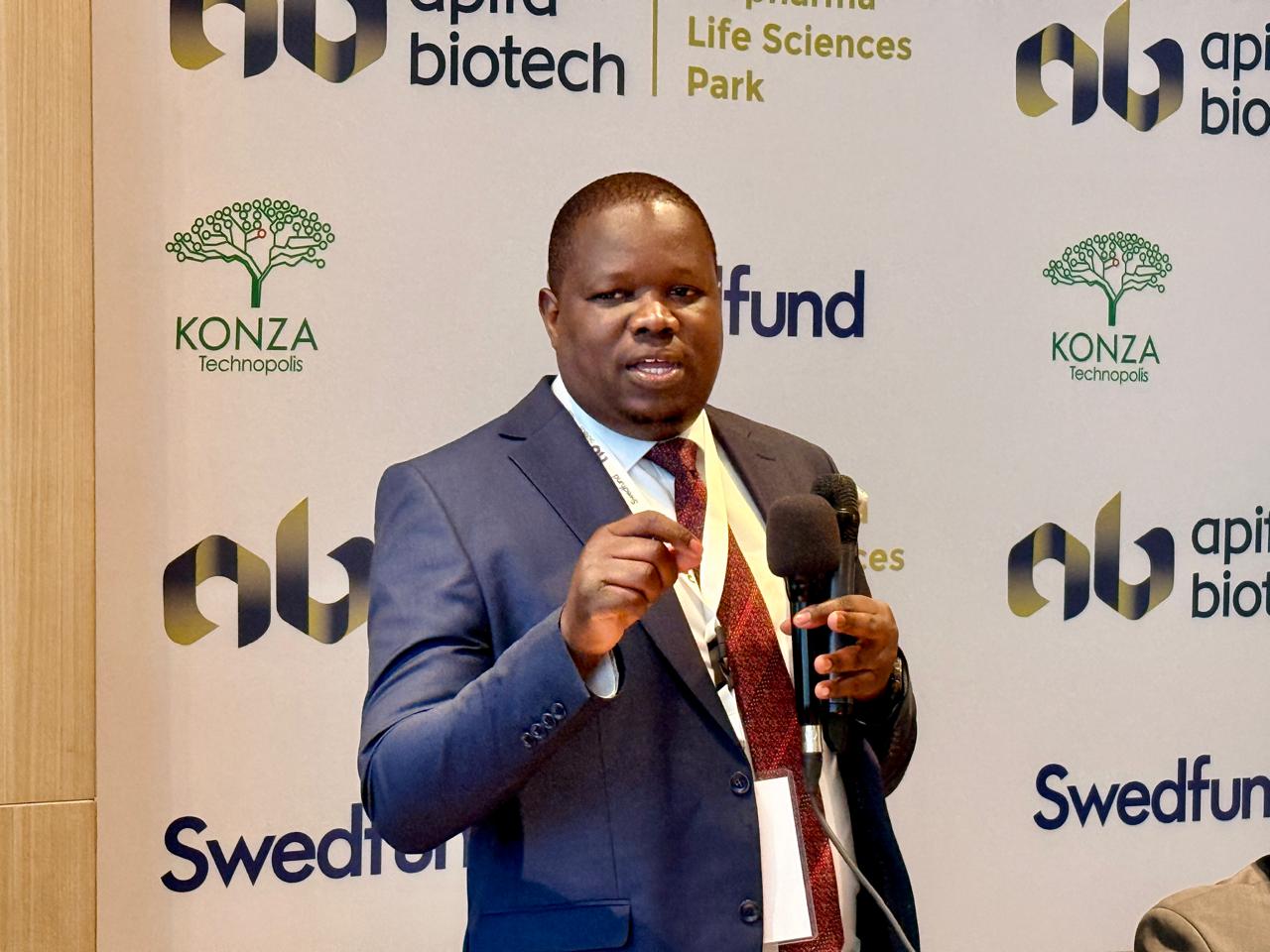
John Paul Okwiri, CEO of the Technopolis Development Authority, speaks during the APIFA Biopharma Park feasibility study agreement signing at JW Marriott, Nairobi.
Kenya has taken a significant step towards positioning itself as a regional centre for advanced pharmaceutical and biopharmaceutical manufacturing following the launch of a feasibility study for the proposed APIFA Biopharma Park at Konza Technopolis.
The project, being developed through a public-private partnership (PPP), seeks to establish a world-class life sciences park that will provide shared infrastructure for pharmaceutical manufacturers, biotechnology companies, researchers and investors seeking to expand advanced medicine production in Kenya and across Africa.
The milestone was marked by the signing of a grant agreement through which SWED Fund will finance the feasibility study, alongside the signing of a contract to facilitate its commencement.
The initiative is expected to assess the project’s commercial viability, financial sustainability, investment potential and development structure before the park moves into implementation.
Speaking during the event, Chief Executive Officer of the Technopolis Development Authority John Paul Okwiri, described the development as an important milestone in Kenya’s ambition to strengthen its pharmaceutical manufacturing capabilities and attract investment into the life sciences sector.
Okwiri noted that the authority had been working with the National Treasury on the initiative for the past three years, making the commencement of the feasibility study a significant achievement.
He said the proposed facility would become the first life sciences park in the region, providing an opportunity to attract investors interested in advanced pharmaceutical manufacturing.
“We’ve been working with the National Treasury at Konza Technopolis for the last three years, and to get to this point where we are commissioning the feasibility study, and to get us to the confirmation stage that there is viability in this project, it is truly a momentous occasion,” Okwiri said.
He added that the project would accommodate investors interested in moving beyond conventional pharmaceutical manufacturing into advanced medicines, including biologics and biosimilars.
According to Okwiri, the next priority following the feasibility study would be attracting investors to accelerate the establishment of the park.
He expressed optimism that the project would progress to implementation within the shortest time possible, noting that stakeholders were looking forward to receiving a comprehensive feasibility report.
Chief Executive Officer of the Kenya BioVax Institute, Dr. Wesley Rono, said the proposed development would introduce a new model of pharmaceutical manufacturing in Kenya by bringing together manufacturers and other industry players within a specialised industrial park.
Rono observed that pharmaceutical manufacturing facilities in the country had traditionally been spread across Nairobi, unlike leading global destinations where specialised pharmaceutical parks provide shared infrastructure.
He said the proposed model would help reduce investment risks by providing an enabling environment for companies seeking to establish pharmaceutical and biotechnology manufacturing facilities.
“When you bring these shared facilities within this park, you are kind of de-risking the environment,” he said.
He noted that some investors continued to view Africa as a risky investment destination, adding that the availability of shared infrastructure would help build confidence and attract more capital into the sector.
Rono further observed that Kenya had a significant opportunity to develop advanced technologies in pharmaceutical and biologics manufacturing, areas where the country still relies heavily on imported products.
He said the project would strengthen local manufacturing capacity while positioning Kenya as a competitive destination for pharmaceutical investments.
Rono also noted that specialised life sciences clusters would create synergies among companies while providing an environment where research, innovation and manufacturing could develop together.
He cited countries such as India, which have successfully established pharmaceutical parks, as examples of how concentrated investments could strengthen the industry.
“Where you can locate these investments, there is always the innovation that comes along and opportunities for the local population, our young graduates, to get world-class opportunities in terms of training and skills,” he said.
He expressed optimism that the initiative would create opportunities for Kenyan scientists and graduates while supporting the country’s ambitions in pharmaceutical manufacturing.
On its part, Jones Lang LaSalle (JLL), through its Healthcare and Life Sciences team for the Middle East and Africa, will lead the feasibility assessment in collaboration with IQVIA, a global pharmaceutical and life sciences research and consulting firm.
Sandeep, who leads JLL Healthcare and Life Sciences for the Middle East and Africa, said the team would undertake comprehensive assessments to establish the project’s viability and guide its development.
He said the study would examine market demand and supply, regional and global benchmarks, financial viability and recommendations for developing the proposed life sciences park.
“We are going to work a lot on looking at the entire market demand and supply assessment, regional benchmarking, global benchmarking, and also bringing in some of the global experts on this project,” Sandeep said.
He added that the team would also develop recommendations on the park’s financial structure and the appropriate public-private partnership framework.
As part of the process, the consultants will engage prospective investors and strategic partners through a market-sounding exercise to establish their interest and appetite for investing in the project.
Sandeep expressed confidence in Kenya’s potential to host the development, citing its skilled workforce, English-speaking population, existing manufacturing capabilities and relatively stable economic environment.
He also pointed to the country’s openness to foreign investment and the participation of development finance institutions as factors that could strengthen the project’s prospects.
For APIFA Biotech, the initiative represents a broader commitment to expanding local pharmaceutical production and improving access to affordable medicines across the continent.
An APIFA Biotech representative said the organisation’s focus extended beyond establishing individual pharmaceutical companies to creating an enabling environment where local manufacturers and foreign investors could operate successfully.
“Our drive has been expansion of local production on the continent, starting from home in Kenya, for purposes of making sure that we increase access to medicines and not just medicines, affordable medicines,” the representative said.
He explained that the proposed park would support the country’s economic development objectives by encouraging manufacturing, attracting foreign direct investment and creating employment opportunities.
The initiative would also provide young Kenyan scientists with opportunities to undertake product development, research, development and innovation.
The representative said Kenya should look beyond conventional pharmaceutical manufacturing models and explore opportunities to develop intellectual property that could generate revenue through royalties.
“We don’t necessarily need to build big pharmaceutical companies, but we can actually innovate and generate IP that we can get royalties for and then use that to develop our country,” he said.
He described the signing of the agreements as the beginning of a journey towards developing bankable and investable proposals that would attract the resources required to establish the park.
The feasibility study is expected to lay the groundwork for the next phase of the project, with stakeholders expressing optimism that its findings will help mobilise investors and accelerate implementation.
Once operational, the proposed APIFA Biopharma Park is expected to strengthen Kenya’s pharmaceutical manufacturing ecosystem, reduce dependence on imported medicines, support scientific innovation and position the country as a competitive destination for life sciences investment in Africa.