

ACA Intensifies Crackdown on Counterfeit Alcohol, Tobacco, Farm Inputs
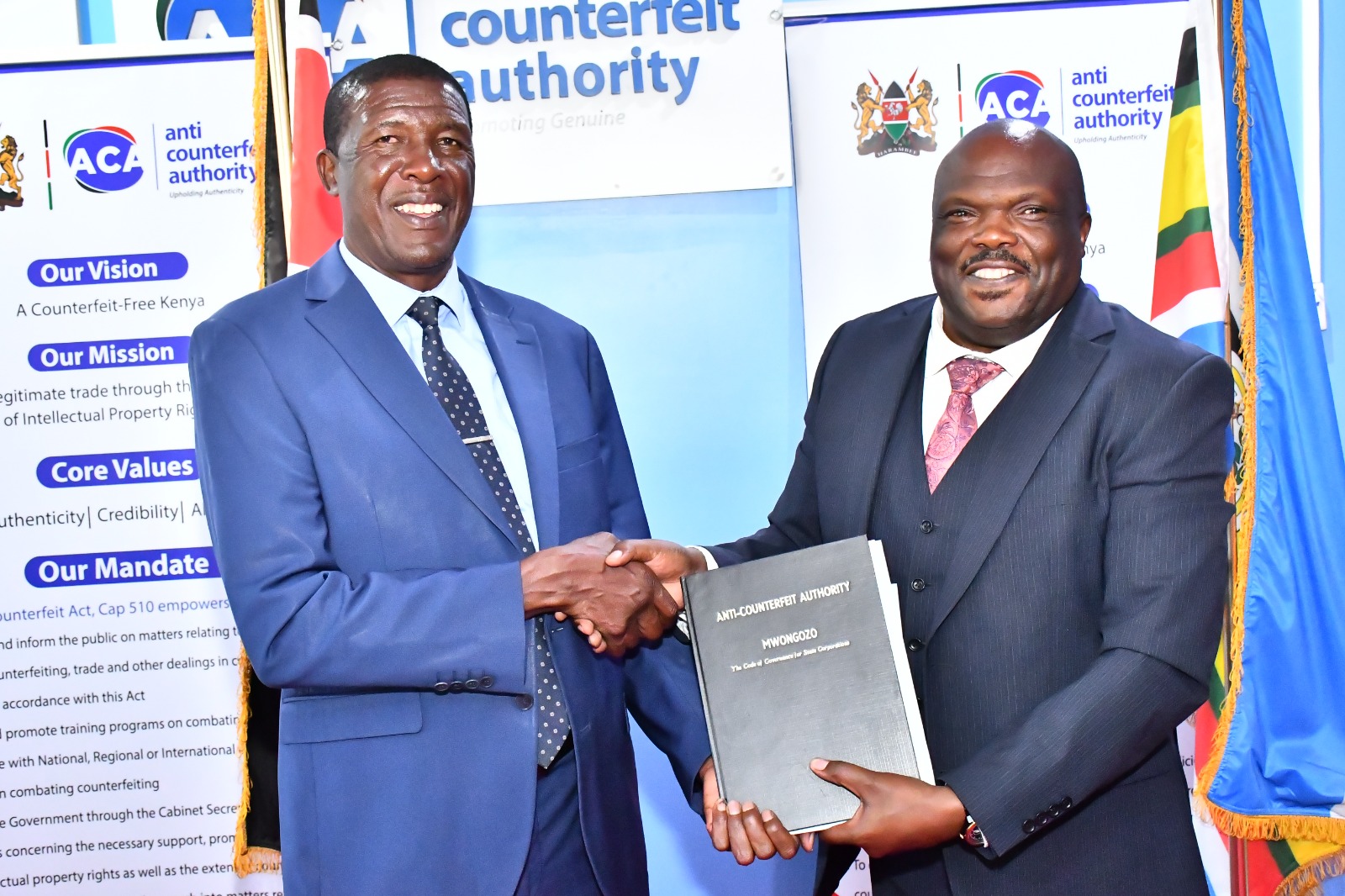
Anti-Counterfeit Authority Board Chairperson Nelson Ributhi Gaichuhie and Executive Director Robi M. King’a during a previous event.
The Anti-Counterfeit Authority (ACA) has intensified countrywide enforcement against counterfeit and illicit products, targeting alcohol, tobacco, agricultural inputs and school learning materials amid rising demand during the festive and planting seasons.
Speaking during a press briefing on Thursday in Nairobi, ACA Board Chairperson Nelson Ributhi Gaichuhie said the authority was stepping up operations following a series of seizures targeting counterfeit and illicit goods across the country.
“Counterfeit and illicit trade imposes a cost on our country that cannot be measured in money alone. It is borne by the farmer whose harvest fails because of counterfeit inputs, by the consumer exposed to dangerous alcohol, by the student relying on substandard learning materials and by families whose health is put at risk,” Gaichuhie said.
Between August 20 and September 3, a multi-agency Rapid Results Initiative in high-risk areas of Nairobi resulted in 36 arrests and apprehensions, the seizure of more than 5,555 suspected counterfeit bottles and approximately 39,580 litres of illicit brew.
Dagoretti North accounted for approximately 27,330 litres of illicit alcohol, while more than 5,000 bottles were seized in Kayole and 868 assorted alcoholic beverages recovered in Eastleigh.
On September 15, ACA officers working with police seized 8,459 suspected counterfeit alcoholic products valued at approximately Sh2.1 million in Makindu. Further seizures in Nairobi, Nyeri and Eldoret brought the value of goods recovered in September to approximately Sh3.74 million.
The authority is also targeting counterfeit tobacco and related products, including cigarettes bearing imitations of registered brands and forged excise stamps, as well as counterfeit nicotine products, electronic cigarettes, vapes, refill liquids, rolling papers and filters.
In agriculture, officers last Friday seized illegally repackaged fertiliser in Matungu, Kakamega County, together with two loaded lorries and industrial packaging equipment.
Preliminary investigations indicated that the fertiliser had been diverted from the Government subsidy programme and repackaged in counterfeit branded bags for sale at commercial prices.
With national examinations underway, the authority is also targeting pirated textbooks and revision materials, as well as counterfeit calculators and mathematical sets. Inspections will be stepped up at bookshops, stationery wholesalers and suppliers serving schools.
Gaichuhie said the crackdown would continue as demand for alcohol, tobacco, foodstuffs and personal care products increases during the festive season, while the planting season is expected to increase demand for agricultural inputs.
“Counterfeiters should not expect a holiday from enforcement,” he said.
ACA Executive Director Robi M. King’a said the authority was also strengthening measures to prevent counterfeit products from entering the country, noting that about 70 per cent of counterfeit products entering Kenya are imported.
King’a said ACA was using a digital recordation system to allow brand owners and importers to interact with the authority and enable inspectors to verify products before they enter the Kenyan market.
He also disclosed that the authority was working with the Office of the Attorney General to review the Anti-Counterfeit Act, arguing that existing penalties were not sufficiently punitive to deter the trade.
“We say, currently, they are not as punitive as they should. What we are doing currently, we are working with the other ministry, the Office of Attorney General, reviewing the anti-counterfeit act,” King’a said.
Under the current provisions cited by the authority, a first conviction can attract a fine equivalent to three times the cost of the counterfeit product, while a repeat offence can attract five times its value.
King’a said ACA was also engaging the East African Community on harmonising anti-counterfeit laws across member states to make it harder for traders to evade enforcement by moving across borders.
He said counterfeit goods were increasingly affecting a wide range of sectors, including agricultural inputs, electronics, food and alcoholic beverages, cosmetics, footwear, clothing and educational materials.
ACA urged members of the public to buy products from licensed and reputable outlets, check seals, labels and packaging, and verify excise stamps and standardisation marks through official channels. Farmers were also advised to obtain subsidised fertiliser only through authorised channels.