
Africa Must Equip Youth With Future Skills to Unlock Jobs, PS Mwadime Says
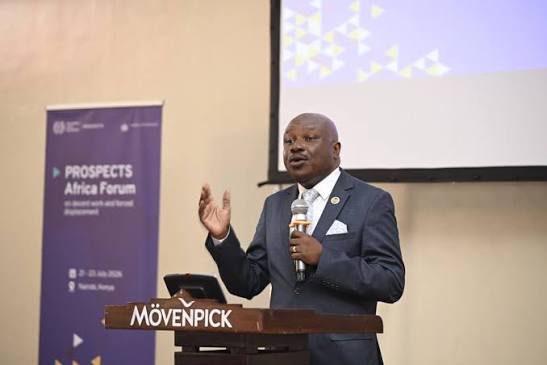
Labour and Skills Development Principal Secretary Shadrack Mwadime addresses delegates during the opening of the PROSPECTS Africa Forum on Decent Work and Forced Displacement, organised by the International Labour Organization (ILO) under the PROSPECTS Partnership, at the Mövenpick Hotel in Nairobi on July 21, 2026.
Labour and Skills Development Principal Secretary Shadrack Mwadime has challenged African governments to urgently reform education and skills development systems to prepare young people for the changing world of work, saying the continent’s youthful population presents its greatest opportunity for economic transformation.
Speaking during the opening of the three-day PROSPECTS Africa Forum on Decent Work and Forced Displacement in Nairobi on Monday, organised by the International Labour Organization (ILO) under the PROSPECTS Partnership, Labour and Skills Development Mwadime said Africa’s demographic advantage can only be fully realised if governments invest in market-driven skills development, recognise skills acquired through informal learning and create an enabling environment for entrepreneurship and job creation.
“The future is in Africa. We have the youngest population in the world and by 2050 the continent will have the largest population globally. But to realise this potential, we must equip our young people with the right skills for the jobs of today and tomorrow,” said Mwadime.
The conference brought together government officials, employers’ organisations, development partners and labour experts to discuss strategies for expanding decent work opportunities for refugees, host communities and young people while addressing emerging labour market challenges.
The Principal Secretary said political instability across parts of Africa continues to displace millions of people but noted that refugees also possess valuable skills that can contribute to the economies of host countries if properly integrated. Drawing from Kenya’s experience, he recalled how refugee professionals, including teachers and doctors, helped strengthen the country’s education and health sectors, demonstrating the economic value of skilled migration.
Mwadime said one of Africa’s biggest challenges is the mismatch between education and labour market demands, with many graduates leaving institutions without the skills employers require.
He called for closer collaboration between governments, training institutions and employers to align curricula with changing labour market needs, particularly in artificial intelligence, the green economy and other emerging sectors.
“It is immoral for us to train young people for many years only to tell them they are not employable. We must work with employers to understand the skills they need and ensure our education and training systems respond to those demands,” he said.
The PS also highlighted the government’s progress in implementing Recognition of Prior Learning (RPL), a programme that certifies skills acquired through work experience rather than formal education.
He revealed that the Ministry has assessed about 20,000 skilled workers over the past six months and expects to issue approximately 5,000 certificates in the coming weeks, enabling more Kenyans to secure better employment opportunities locally and abroad.
According to Mwadime, recognising practical skills will not only improve public confidence in artisans and technicians but also support the government’s labour mobility programme by allowing certified workers to access international employment opportunities and return home with new knowledge and experience.
The Principal Secretary further urged African governments to prioritise small and medium-sized enterprises (SMEs), describing them as the foundation of sustainable economic growth and job creation.
He said Africa’s rapidly growing population will provide one of the world’s largest consumer markets in the coming decades, making it essential to build the capacity of local entrepreneurs instead of relying on foreign companies to drive economic expansion.
Citing Germany as an example, Mwadime said consistent government support for family-owned businesses and SMEs had helped build one of Europe’s strongest economies, adding that Africa could achieve similar success by empowering its own enterprises. He also acknowledged support from the Netherlands Embassy in strengthening businesses run by refugees and host communities.
He called on delegates to incorporate skills development, recognition of prior learning and support for SMEs into the conference’s action plan, saying the three priorities will be critical in creating decent jobs and unlocking Africa’s full economic potential.