



Grief and Outrage as Family Discovers Body of Form Three Student Killed During Nanyuki Protests
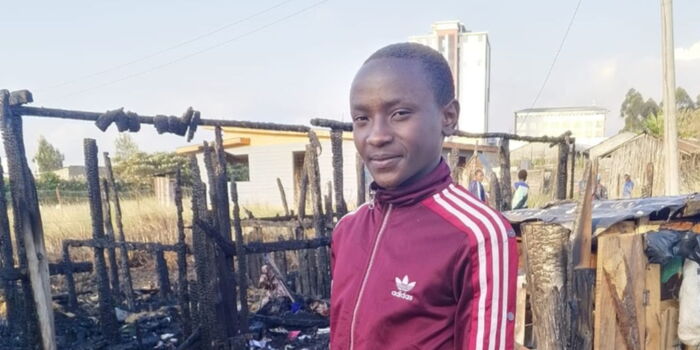
A cloud of sorrow has engulfed a family in Nanyuki after a 16-year-old secondary school student who disappeared during violent anti-Ebola facility protests was found dead at a local mortuary, days after he was allegedly shot by police during chaotic clashes in the town.
The heartbreaking discovery has intensified calls for accountability and justice as residents continue to grapple with the fallout from the controversial demonstrations that have rocked Nanyuki for more than a week.
Sylvester Muigai Ndung’u, a Form Three student at Thingithu Secondary School, was reported missing on Monday after violent confrontations erupted between police officers and protesters opposing the planned construction of a U.S.-backed Ebola quarantine facility at the Laikipia Airbase.
For two agonising days, his family desperately searched hospitals and other facilities hoping to find him alive. Their hopes, however, were shattered when they located his body at the Nanyuki Referral Hospital Mortuary.
His mother, Lucy Kagure, recounted the painful moment she learned of her son’s fate.
“I went to the general hospital ward, and I was told he is not there. I was told to check the mortuary,” she said, struggling to contain her emotions.
The tragic death has left a family devastated and a community demanding answers over the circumstances under which the teenager lost his life.
According to relatives, Muigai had recently been sent home from school to collect a fee balance of Ksh5,700. On the day of the protests, concerns had already been raised about the security situation in Nanyuki Town as demonstrations against the proposed Ebola quarantine centre intensified.
Family members revealed that his mother had advised him to avoid the streets because of the unrest. A relative later told NTV that Muigai had also been discouraged from going to school because the demonstrations had blocked the route commonly used by students.
Despite the warnings, the teenager later joined crowds that had gathered in town at around 5:30 p.m. as tensions between protesters and police escalated.
Witnesses say the demonstrations quickly descended into chaos, with running battles erupting as security officers attempted to disperse the crowds.
Amid the confusion and confrontation, Muigai was allegedly shot in the head. He died instantly at the scene.
The teenager’s death has sparked outrage among residents and human rights advocates who are now demanding a thorough investigation into the use of force during the protests.
“I am seeking justice. They killed my boy. I am a single mother of four,” Kagure lamented.
Muigai was the firstborn in a family of four children and was widely described by relatives as a promising young student with a bright future ahead of him.
His death adds to the growing toll linked to the Nanyuki protests, which have become increasingly violent as opposition to the planned Ebola quarantine facility continues to mount.
At least three people have reportedly been killed since demonstrations began, while several others have sustained injuries during confrontations with security officers.
The protests were triggered by public opposition to a proposal backed by the United States to establish a 50-bed Ebola quarantine facility at the Laikipia Airbase. Residents have raised concerns about potential health risks, transparency surrounding the project and what they describe as inadequate public participation before the plan was announced.
Community leaders and residents have repeatedly called for greater consultation, arguing that the project has generated widespread fear and uncertainty among locals.
As investigations into Muigai’s death gather momentum, his grieving family is now preparing to lay him to rest while seeking answers over the loss of a young life cut tragically short.
The incident has renewed scrutiny on police conduct during public demonstrations and intensified calls for authorities to ensure accountability as tensions continue to simmer in Nanyuki.
5 thoughts on “Grief and Outrage as Family Discovers Body of Form Three Student Killed During Nanyuki Protests”