
Echo Network Africa Foundation Boosts CBC Learning with Mobile Science Lab Donation to Kibera School
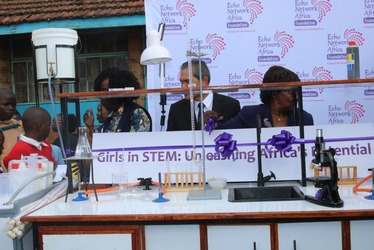
Learners at Kibera Primary and Junior School are set to benefit from enhanced science learning following the donation of a mobile science laboratory by the Echo Africa Network Foundation(ENAF) in partnership with the High Commission of Malaysia in Kenya.
The facility is expected to strengthen the implementation of Kenya’s Competency-Based Education (CBE) curriculum by providing learners with access to practical science lessons and hands-on experiments, a key component of the country’s education reforms.
Speaking during the handover ceremony, the High Commissioner of Malaysia to Kenya, Ruzaimi Mohamad, said the laboratory would help bridge a critical gap in science education by enabling students to apply classroom concepts through practical learning.
“We are donating a mobile science lab for this school for the use of students who before could not have proper science lessons because they did not have a science laboratory. We hope this donation will help them better understand science, which is very important for their future success,” he said.
The donation comes at a time when schools across the country continue to face challenges in implementing the Competency-Based Education curriculum, particularly due to inadequate infrastructure and limited access to learning resources.
Unlike the former 8-4-4 system, CBE places greater emphasis on the development of competencies, values and practical skills through learner-centred approaches. Students are encouraged to engage in experiments, projects and problem-solving activities that promote critical thinking, creativity and innovation.
Education stakeholders have repeatedly identified inadequate laboratory facilities as one of the major obstacles to the successful implementation of science-based learning under the curriculum, especially in schools serving low-income communities.
An ENAF representative called for greater collaboration among government, development partners and the private sector to ensure schools are adequately equipped to deliver quality education.
“The schools in this country are going through a very difficult time. The challenges of inequality in terms of equipment and infrastructure are many. There is a need for all of us to come together and support schools,” she said.
She noted that while the curriculum reforms are intended to equip learners with practical skills for the future, many schools still lack the facilities necessary to support effective learning.
Beyond the laboratory, the foundation also distributed sanitary towel packages containing pads, soap, undergarments and other personal care items to support adolescent girls and help reduce school absenteeism linked to period poverty.
“It came to us as a shock that there is something called sex for pads. Girls are giving themselves to older men so that they can get sanitary towels. We want to ensure they stay in school and that this practice stops,” she said.
The foundation said it has already reached 17 schools across the country with similar menstrual health interventions and plans to expand the programme to more institutions.
Kibera Primary and Junior School Headteacher Samuel Onyango welcomed the support, describing it as a timely intervention that will benefit hundreds of learners.
“We have a population of about 1,800 learners. There is a struggle to get sanitary pads for these children. Sometimes we receive supplies from the ministry, but they are never enough. When we get support from partners, we are very grateful,” he said.
Onyango noted that while the government has made significant efforts to support the Competency-Based Education system, schools continue to face staffing challenges, particularly at the junior school level.
“The major challenge has been the lack of enough staff to handle junior school learners. At times teachers from primary have had to overlap into junior school because of staff shortages,” he said.
Participants at the event also observed a moment of silence in honour of learners who have lost their lives in recent school fire tragedies, with speakers calling for improved safety standards and stronger child protection measures in learning institutions.
As Kenya continues to advance Competency-Based Education, stakeholders say investments in laboratories, learning infrastructure and student welfare programmes will be critical in ensuring that all learners, regardless of their background, can fully benefit from the practical and skills-based approach envisioned under the curriculum.