


Africa turns to character education for ethical leadership
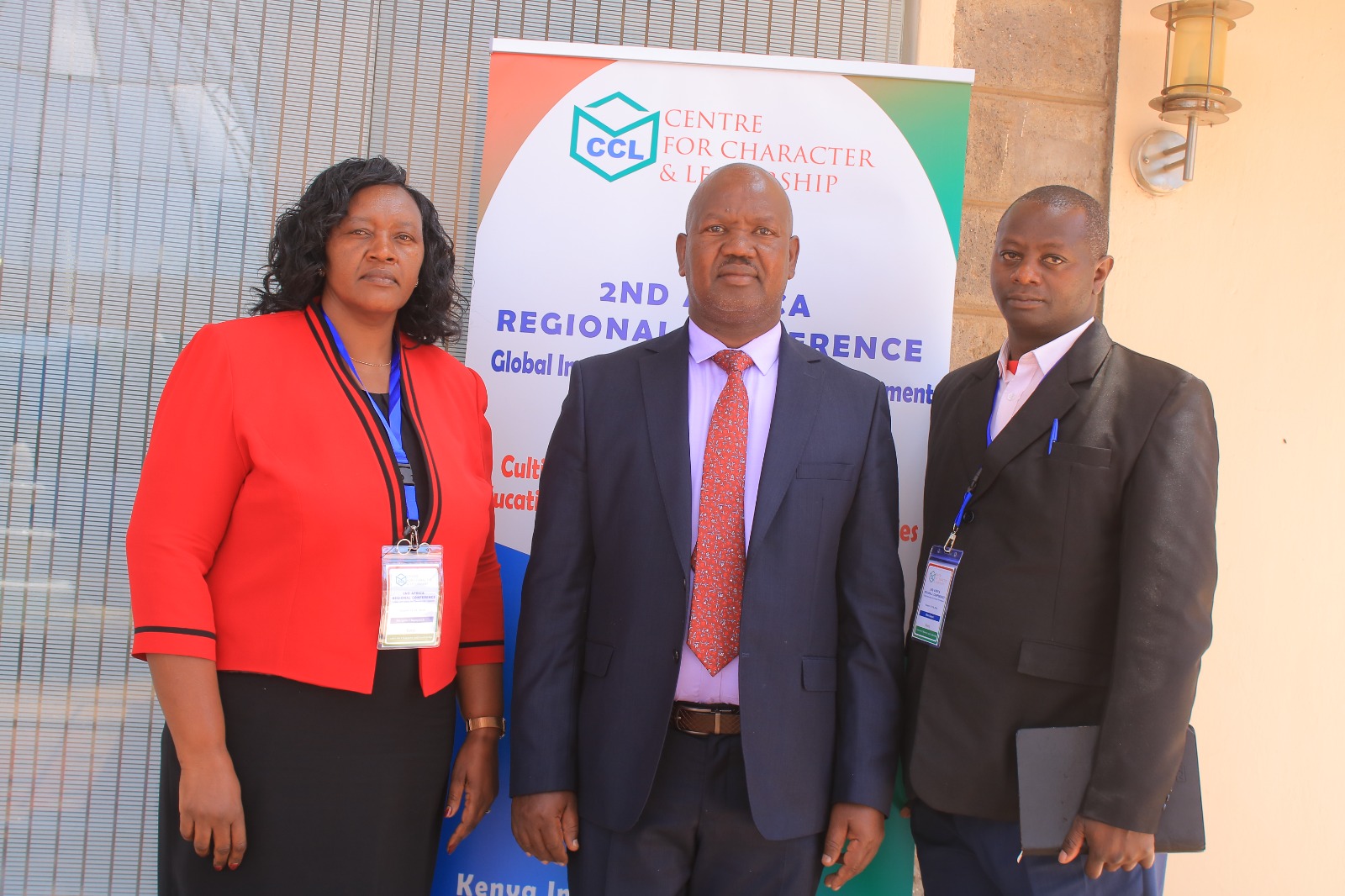
Director in charge of Environment and Service Programmes at the Centre for Character and Leadership, Margaret Chepngetich (left), TSC Nairobi Regional Director Samuel Marigat (centre) and Centre for Character and Leadership Director Peter Kengori (right) during the 2nd Africa Regional Conference at the Kenya Institute of Curriculum Development on August 27, 2026. Photo/ Clara Sande
African education leaders are calling for character development to be embedded across education systems, warning that academic qualifications and professional skills alone cannot guarantee ethical leadership, responsible citizenship and resilient societies.
Principal Secretary for Higher Education Dr Beatrice Miganda Inyangala officiated the opening ceremony of the 2nd Africa Regional Conference at the Kenya Institute of Curriculum Development, where she said institutions of higher learning must deliberately create environments that nurture good character.
She said universities and colleges have a critical role in shaping the values of young people as they prepare to enter professional and public life, adding that institutional culture can significantly influence the character of those who study and work there.
“Creating an institution culture that promotes good character development is to provide the best possible conditions in which individuals can flourish,” Inyangala said.
She said the ultimate goal should be to produce graduates who are both competent and morally grounded.
“The higher education institutions should therefore aim at producing competent and moral graduates, ethical leaders, and citizens of good character,” she said.
Teachers Service Commission Nairobi Regional Director Samuel Marigat said the responsibility extends to teacher training because educators eventually become role models for millions of learners.
He said universities must ensure teachers graduate with the values they are expected to pass on to children, arguing that intelligence and professional qualifications mean little when they are not accompanied by good character.
“Character is everything. You may have the intelligence, you may have the money, you may have all that it takes, but if you don’t have character, you will not go far in life,” Marigat said.
He said the education system should nurture patriotic and critical-thinking citizens capable of making a positive difference in society.
The concern over character is also prompting calls to examine the environments in which young people are being educated.
Peter Kingori, Director of the Centre for Character and Leadership, said discussions about character often focus on students and individual leaders while overlooking the institutions that shape them.
“We normally speak about the character of our students, our leaders, our role models and our heroes. But we are challenging researchers to discuss the character of our community, the character of our education institutions, our colleges and our universities,” Kingori said.
He said stronger character could help societies confront violence and intolerance, including political violence.
“If we nurture values and raise individuals of good character, I think the issue of gunism in our country can come to an end,” he said.
The emphasis is increasingly shifting from discussion to practical interventions.
Margaret Chepngetich, a Director in charge of Environment and Service Programmes at the Centre for Character and Leadership, said the organisation has linked environmental conservation to character development, with more than 2.5 million trees planted under programmes that attach specific virtues to environmental activities.
She said the organisation mentors school leaders, teachers and learners while also running online training for principals and head teachers.
The programme has also expanded its work with teachers through the Teacher Service Commission, while efforts are now extending into universities to ensure character formation continues beyond basic education.
“We are here to have the continuity of character formation,” Chepngetich said, citing concerns over moral degradation and gaps in parental engagement.
She said schools participating in the programme across 16 counties had recorded improvements in discipline, academic performance and responsible citizenship since the initiative began in 2016.
Evidence from outside Kenya is also strengthening the case for character-based education.
In Nigeria, University of Jos lecturer Utek Ishaku and his research team developed a programme using indigenous approaches such as storytelling, songs, games and crafts to nurture perseverance, hope and joy among children.
The programme was informed by concerns over economic hardship, insecurity and declining character, with about 90 per cent of school administrators involved in a baseline assessment saying character was declining.
Ishaku said character education should help children withstand difficult circumstances rather than simply shield them from adversity.
“We may not be able to change the country or the situation of the world in terms of economic hardship and insecurity, but we can help children build the skills and the ability to face the situation with hope and joy,” he said.
Teachers involved in the programme reported improved classroom cooperation, participation and interest in learning, alongside improvements in reading, spelling, writing and homework completion.
The value of character development is also being demonstrated beyond education.
In Rwanda, Angele Bienvenue Ishimwe, Director of Primary Care Research at TIP Global Health, said healthcare workers need virtues such as empathy, compassion, forgiveness, hope and resilience alongside their clinical knowledge.
“The clinical knowledge they get to provide care is not enough. They need an additional set of skills,” Ishimwe said.
A nine-month resilience programme involving mentorship, weekly messages and mindfulness activities recorded an 11 per cent improvement in the adoption of resilient behaviours, while the quality of care at one participating health centre improved by seven per cent.
The results have led to collaboration with Rwanda’s Ministry of Health to develop a training curriculum covering virtues, mental health and self-care for healthcare workers.
The experiences point to a broader argument that character is not a quality that should be taught once and assumed to remain intact.
Inyangala said character development requires continuous effort involving institutions, educators, families, employers and communities.
She urged education leaders to recognise that those teaching values must also embody them.
“As an adult, the single most powerful tool you have to impact a student’s character is your own character,” she said.
The message emerging from the character education movement is therefore extending beyond producing academically successful graduates to producing people who can use their knowledge responsibly, withstand adversity and contribute to the common good.

I have been searching for a solid welcome bonus platform for a while now and finally found something that actually delivers. The registration process was smooth and the bonuses are exactly as advertised. Every time I log in I feel welcomed and ready to play my favorite slots without any hassle. Check out this spot if you want a fair gaming experience with great rewards. casinobonodebienvenida
I have been searching for a solid welcome bonus platform for a while now and finally found something that actually delivers. The registration process was smooth and the bonuses are exactly as advertised. Every time I log in I feel welcomed and ready to play my favorite slots without any hassle. Check out this spot if you want a fair gaming experience with great rewards. casinobonodebienvenida