
Global Rights Advocates Warn of Growing Anti-Gender Backlash as Calls for Abortion Bias Intensify
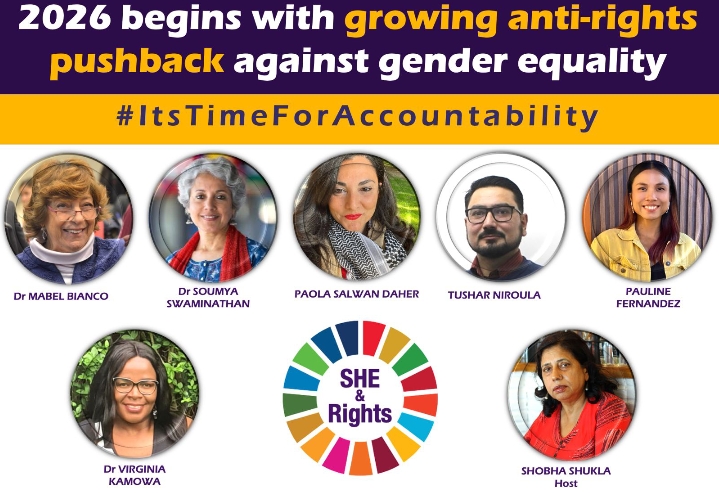
At a high-level SHE & Rights session jointly hosted by the Global Center for Health Diplomacy and Inclusion (CeHDI) alongside partners at the Women Deliver Conference 2026, global women’s rights advocates sounded the alarm over a rising international pushback against gender equality and sexual and reproductive health and rights (SRHR).
The session brought together key organizations including the International Planned Parenthood Federation (IPPF), Asian-Pacific Resource and Research Centre for Women (ARROW), Women’s Global Network for Reproductive Rights (WGNRR), Asia Pacific Media Alliance for Health, Gender and Development Justice (APCAT Media) and CNS, providing a platform for frontline advocates to demand renewed accountability from governments and global institutions.
Speaking at the forum, Pauline Fernandez, Coordinator of the Philippine Safe Abortion Advocacy Network (PINSAN), said 2026 has begun with an alarming escalation of anti-rights movements that threaten decades of progress on gender equality. She noted that PINSAN recently took its advocacy to the global stage with the launch of the Decriminalize Abortion Now Network at the World Economic Forum in Davos, marking a milestone for Philippine reproductive rights advocacy.
Fernandez traced the roots of PINSAN to 2015, when legal, medical and community-based advocates came together following the passage of the Philippines’ landmark Responsible Parenthood and Reproductive Health (RPRH) Act. While the law was celebrated as a major victory for the women’s movement, she said it left abortion rights unresolved, forcing advocates to continue pushing for reform in a highly restrictive legal environment.
“Abortion remains criminalized under the revised penal code, with no explicit legal exceptions,” Fernandez said, noting that despite this, an estimated one million Filipino women undergo abortions annually, often in unsafe conditions. She added that fear of arrest and stigma prevents many women from seeking post-abortion care, turning hospitals into spaces of fear rather than healing and shielding the state from accountability for what she described as a public health crisis.
Fernandez warned that opposition to abortion rights in the Philippines is not only religious but also deeply political, using culture and faith to entrench control over women’s bodies. She cited legislative pushback, online disinformation campaigns and resistance within health systems as evidence of a coordinated effort to undermine reproductive justice.
She emphasized that PINSAN’s central demand is the decriminalization of abortion, which would remove punitive provisions from criminal law and ensure that no one is jailed for seeking or providing abortion care. “Health care should never be a crime,” she said, adding that the formal national launch of the decriminalization campaign last year has strengthened solidarity among advocates and allies.
The global dimension of the crisis was highlighted by Tushar Niroula, gender justice advocate and former Executive Director of Marie Stopes International Nepal, who warned that the withdrawal of major donors particularly the United States from international organizations has far-reaching consequences for gender equality and health systems worldwide as well as weakens everything.

Niroula noted that reduced funding for agencies such as UN Women, UNFPA and WHO weakens support for women’s leadership, gender-based violence prevention, and access to sexual and reproductive health services, including safe abortion care. He said funding gaps also allow conservative actors to influence global agendas, leading to stalled or reversed gains in bodily autonomy, LGBTQI rights and adolescent health.
Focusing on South and Southeast Asia, Niroula said many countries rely heavily on multilateral support for gender and health programming, and funding withdrawals risk scaling back regional initiatives and increasing dependence on politically conditional bilateral aid.
In Nepal, he warned, reduced international support could slow progress on maternal health, reproductive services and gender equality, disproportionately affecting marginalized women, including Indigenous, Dalit, migrant and women with disabilities.
Both speakers concluded that the global rollback on gender rights demands stronger national commitments, resilient multilateral systems and renewed collective action. As Fernandez stressed, “The fight for abortion rights is the fight for dignity, autonomy and justice—and it cannot be postponed.”
Youth Inclusion Seen as Key Antidote to Anti-Rights Pushback, Kenyan Activists Say
Kenyan women’s and human rights advocates have called for meaningful youth participation and grassroots inclusion as a powerful response to the growing anti-rights pushback threatening gender equality, sexual and reproductive health, and civic space.
Speaking during a rights and accountability forum, Yvonne Ogolla, Executive Director of Dreams Redefined Community-Based Organization in Kisumu, said that the exclusion of young women and youth from decision-making spaces continues to weaken efforts to advance gender equality and fuels resistance to human rights gains.

Ogolla emphasized that meaningful youth participation is not symbolic representation but a shift of power that strengthens legitimacy, accountability and resilience in movements for equality.
“When young people are not included in the room, that becomes the strongest pushback against gender equality. But when we promote meaningful youth participation, it becomes the strongest antidote to anti-rights forces because it builds accountability from the ground up,” she said.
She noted that issues such as access to sexual and reproductive health and rights (SRHR), climate resilience, and women’s and youth participation in political processes face increased resistance when young people’s voices are ignored or not acted upon. According to Ogolla, involving young people directly in decision-making would strengthen advocacy around abortion, contraception and broader reproductive health services, as they would be able to articulate their needs and solutions themselves rather than being spoken for.
Ogolla also highlighted the impact of USAID funding cuts, saying access to reproductive health services in Kenya has declined, with shortages of contraception, condoms, and safe abortion and post-abortion care services particularly affecting young women and marginalized communities.
“Even when services were available, choices were limited. Now, the situation has worsened. That’s why creating youth-led spaces is urgent, especially on issues that directly affect young people’s bodies and futures,” she added.
Echoing the call for inclusion, Latoya Johnstone, Founder and Executive Director of Tranzuri Organization, a community-based group working in Homa Bay and Western Kenya, raised concerns about the continued marginalization of transgender, intersex and gender non-conforming people, particularly in rural areas.
Johnstone said that while national, regional and international platforms often dominate human rights discussions, rural-based organizations working with minorities are frequently excluded from these spaces and lack access to resources such as internet connectivity, digital tools and policy platforms.
“We are still struggling with legal gender recognition in Kenya. Data about our communities is collected but not used to protect us. Instead, it becomes a tool for exclusion,” she said.
She called for stronger partnerships between national and international rights organizations and grassroots groups to ensure program exchanges, civic education, movement building, and participation in global processes such as the Universal Periodic Review (UPR) include rural and marginalized communities.
Johnstone warned that global funding cuts and shrinking civic space, worsened by political shifts in donor countries, have disproportionately affected rural gender-diverse communities, leaving them invisible in policy debates and underfunded in advocacy efforts.
“If we are serious about pushing back against anti-rights movements, then we must move together. Inclusion must mean going to the ground, seeing the work, and building power with communities so that no one is left behind,” she said.
They both stressed that the fight for gender equality and human rights must be youth-led, inclusive and grounded in community realities, urging rights organizations to invest in grassroots partnerships and shared platforms that amplify the voices of those most affected by inequality.