Women, youth are at centre of rising digital threats as Kenya’s digital footprint expands
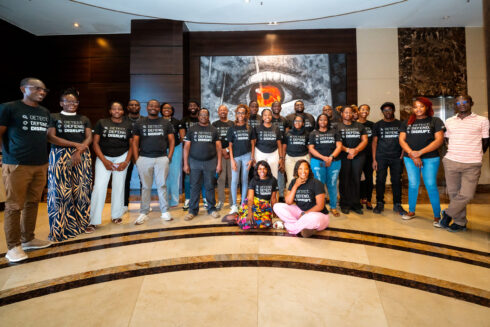
Different media and CBO’s organizations taking a group photo after a training with Trust lab at Double Tree Hilton Nairobi.
As Kenya accelerates its shift towards a digital economy, women and young people who are the most active online users are increasingly finding themselves on the frontline of sophisticated digital threats that are evolving as fast as the technology they rely on.
From cyberbullying and phishing scams to misinformation and the misuse of artificial intelligence, the risks facing digital users are growing both in scale and complexity. Data from the Communication Authority of Kenya (CA) shows that cybercriminals are no longer relying on basic attacks. Instead, they are deploying artificial intelligence, voice deepfakes and multi-vector attacks that are harder to detect and prevent.
In its latest sector report, the regulator revealed that 842 million cyber threats were detected between July and September last year, pointing to a sharp rise in malicious online activity targeting individuals, businesses and institutions.
Global technology firms are also sounding the alarm. Microsoft’s 2025 Security Review indicates that Africa led by Kenya is emerging as a proving ground for AI-driven cyberattacks, as criminals exploit rapid digital adoption, growing cloud infrastructure and gaps in digital literacy.
Kenya’s growing status as a regional hub for digital commerce, fintech and cloud services has made it an attractive target. The country’s expanding fibre networks, data centres and mobile money ecosystem have boosted economic growth, but they have also widened the attack surface for cybercriminals.
Women and youth are particularly exposed. As primary users of social media, digital finance platforms and online communication tools, they face heightened risks of online harassment, identity theft and financial fraud. Misinformation and manipulated content powered by AI are further blurring the line between truth and deception, with real-world consequences for livelihoods, mental health and public trust.
In response, non-governmental organisations and civil society groups are stepping in to bridge the digital safety gap. Several initiatives are currently training communities and national media organisations in Nairobi and Nakuru on identifying and responding to emerging digital threats.
Stakeholders say strengthening digital literacy is one of the most effective ways to build long-term resilience. By equipping media practitioners and community actors with the skills to verify information, recognise cyber risks and responsibly report on digital issues, these programmes aim to reduce harm before it spreads.
Among the organisations leading this effort is Trust-Lab, which has partnered with other agencies to roll out capacity-building programmes focused on cyber awareness, misinformation detection and ethical AI use. The goal, organisers say, is to strengthen the media ecosystem and ensure accurate, responsible reporting in an increasingly complex digital environment.
TrustLab is a collaborative, multi-partner ecosystem of Code for Africa, SiasaPlace with two core pillar solution of incubator guides participants to develop locally relevant solutions while and real time defence provides specialised support to partners.
As Kenya’s digital economy continues to grow, experts warn that cybersecurity must be treated not just as a technical issue, but as a social and economic priority. Protecting women and youth, the backbone of the country’s digital future may well determine how safely and sustainably the next phase of digital growth unfolds.